> Theirs is the responsibility, then, for deciding if they want merely to live, or intend to make just the extra effort required for fulfilling, even on this refractory planet, the essential function of the universe, which is a machine for the making of gods.
In sum, this circularity—implied by semantic closure—does not prohibit successful treatment or modelling. Instead it marks a tangled reciprocity: protein dynamism can be a product of biological organisation while that organisation is itself produced through protein dynamism.
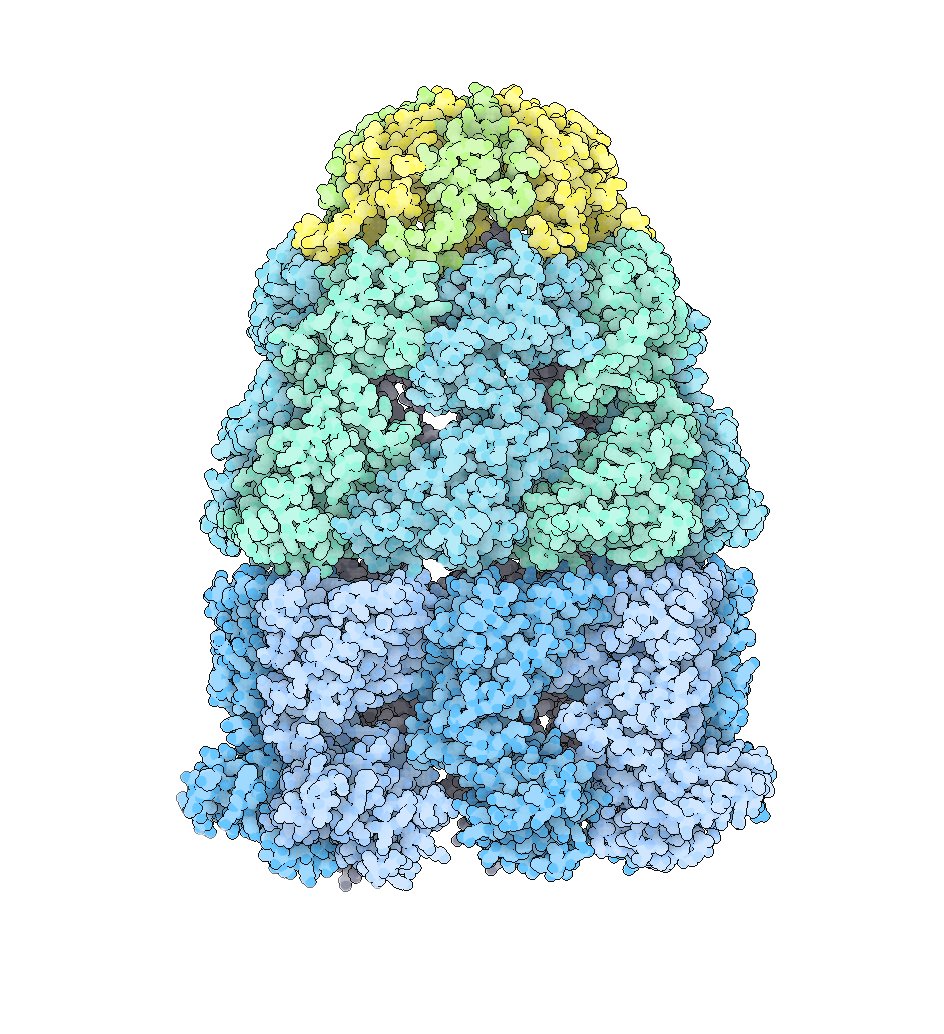
AlphaFold was a first step; new architectures are now modelling protein dynamism, with BioEmu2 recently adding interactions—but these models start with the chicken: in this they encounter the circularity implied by semantic closure. Consider the case of chaperonin.
There is also precedent for evolving chaperones on the basis of their effects on folding (albeit with GFP being unusually tractable). GroEL/S displayed a “great plasticity” that was readily shaped—although evolving specialisation impaired its role as a general chaperone.
Dretske is criminally neglected. He has what all great philosophers have, what Hegel had in spades: a preface that convinces one he has solved philosophy. The answers that follow are, of course, mistaken—but he has the right question: can information have a causal effect?
Language models will complete the system of German idealism: “This entirely real subject matter is the real prototype for Hegel’s portrait of ‘God’ or the ‘absolute spirit’.”
> The forms and laws of thinking understood in this manner (as a ‘natural-historical’ process achieved in concert by millions of individuals connected by a web of communications into one ‘head’, one ‘thinking being’ that is in constant dialogue with itself) constitute the subject matter of logic in Hegel’s sense of this word.
> The forms and laws of thinking understood in this manner (as a ‘natural-historical’ process achieved in concert by millions of individuals connected by a web of communications into one ‘head’, one ‘thinking being’ that is in constant dialogue with itself) constitute the subject matter of logic in Hegel’s sense of this word.
I believe he was the first to do this: before him the notion of a single substance constituting the whole was unthinkable. There were narratives of single origins, but nothing quite like a single substance of which all things were transformations. Robert Hahn argues that this was not thinkable prior, specifically due to the absence of anything in the world upon which such a relation could be modelled—until the geometry which Thales introduced to Greece, in which the right-angled triangle represents a fundamental figure. To think such a thought and thereby be inspired to the formulation of a new metaphysics, water is a natural candidate: an undivided wholeness in flowing movement.
There is an obligate mutualism: technology depends upon the norm which structures it as activity—without which it is meaningless, and which meaning is inevitably negotiated with the technology itself. These are two orthogonal reductions in degrees of freedom; constraints which are simultaneously generative and limiting.
@williawa@bngfromitalt1 This happened a long time ago, really—in our lucid moments we know that: there is nobody at the wheel. History is managed by an inhuman set of acephalic Hecatoncheires and will continue to be managed thus, however they may be constituted: flesh, paper, silicon, etc.