Oil on-chain is actually pretty interesting.
Retail finally getting real spot exposure without the usual futures headache is overdue.
Gonna dig into $WTIC a bit more.
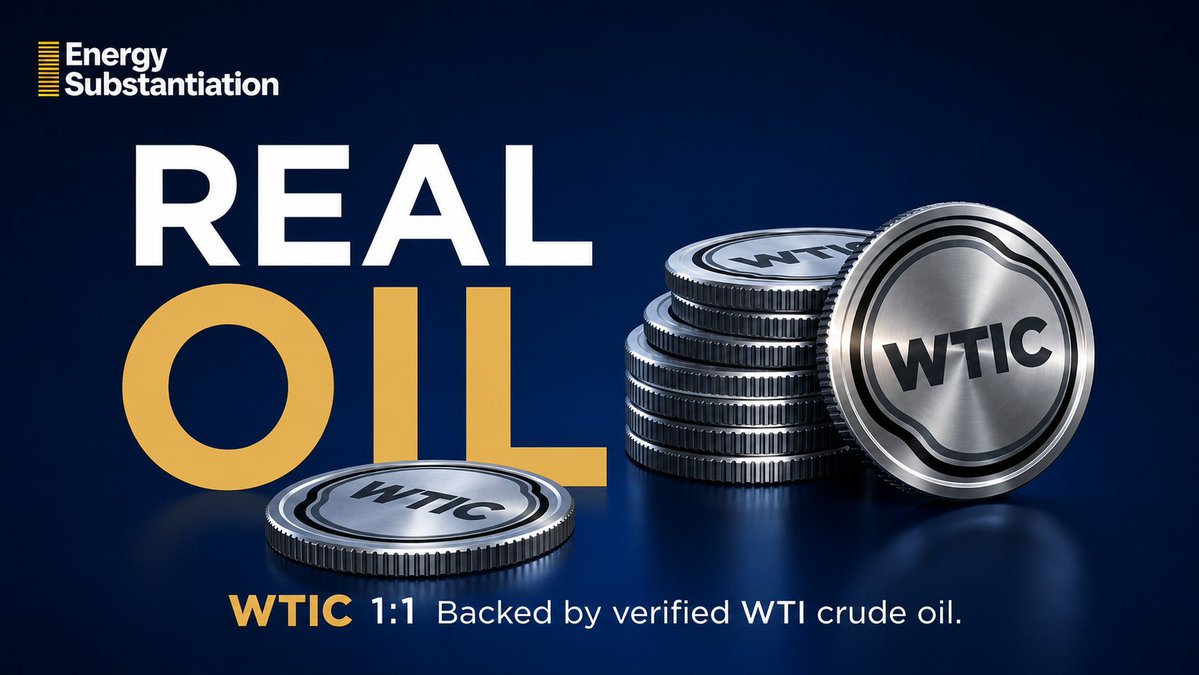
$WTIC is 1:1 backed by physical WTI crude on Ethereum, spot exposure, 24/7 trading, no futures roll or tracking error.
Energy is the next real world asset.
For decades, owning actual oil was reserved for producers, traders, and institutions.
Retail investors got:
- Futures (with rollover costs)
- Oil ETF (with contango drag)
- Or nothing at all
You could own gold. You could own dollars.
You couldn’t own a barrel of oil.
The vision is bigger than one token.
Natural gas (HHC) and Brent (BRNTc) are on the roadmap.
Energy markets are coming onchain.
$WTIC is the first barrel.
Real world energy. Digital markets.
Let’s build the rails.
This is clean as hell.
Real fees → actual buybacks → stakers. No team dump, no emissions, no black box. Fully escrowed both sides so no liquidation cascade either.
Banks have been printing money on this product for decades.
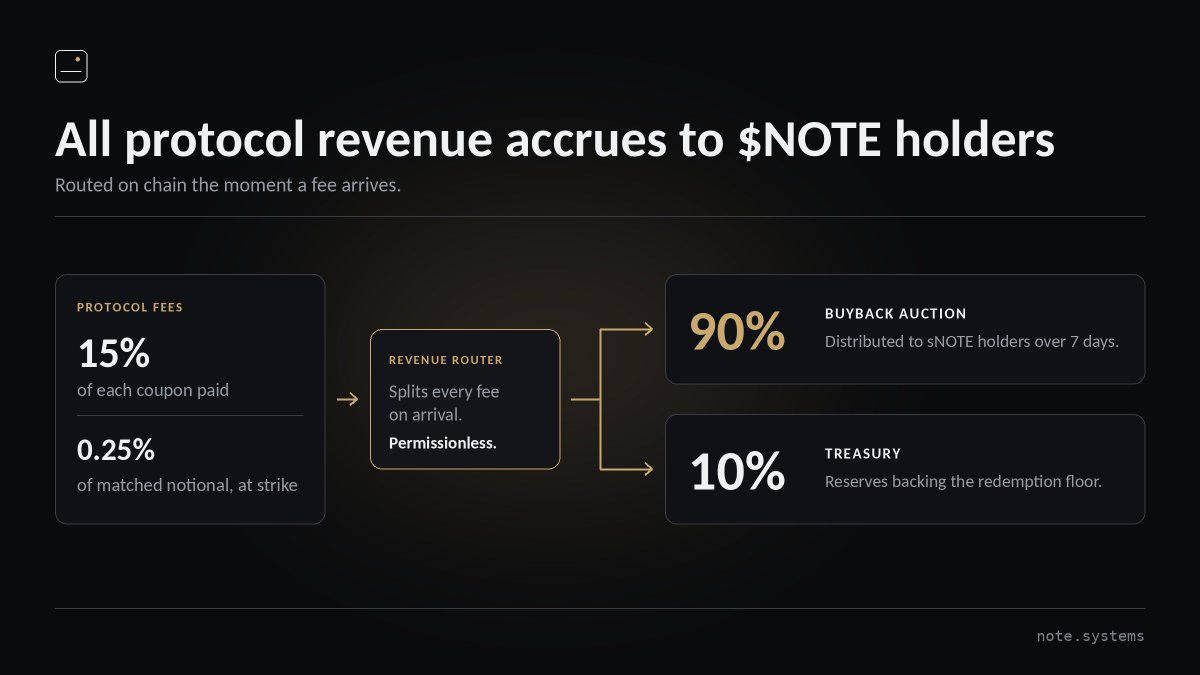
Every fee Note Systems collects goes to $NOTE holders.
Not to a team wallet.
Not to a market maker.
Not sitting in some protocol owner black box.
On chain. Automatically. The moment a fee arrives.
The split is simple:
- 90% → continuous buyback auction → streamed to sNOTE stakers over 7 days
- 10% → Treasury reserves that back the NOTE redemption floor
Usage becomes demand for the token. Reserves become a floor under it.
Where do the fees come from?
15% of each coupon paid + 0.25% of matched notional at strike
That’s roughly 3.25% a year on capital sitting in live notes.
Important : no fee is charged on a coupon that never gets paid. The protocol earns most when notes actually work.
This is not DeFi revenue in the usual sense.
NoteCore never takes principal risk.
It never funds coupons out of protocol cash.
It never liquidates anyone.
Fees are a cut of a product that was already fully escrowed before the series went live.
That product is the thing banks have sold for decades:
Autocallable barrier notes.
One side wants income.
The other already holds the stock and wants crash protection.
A bank used to sit in the middle, set the coupon, and keep the spread.
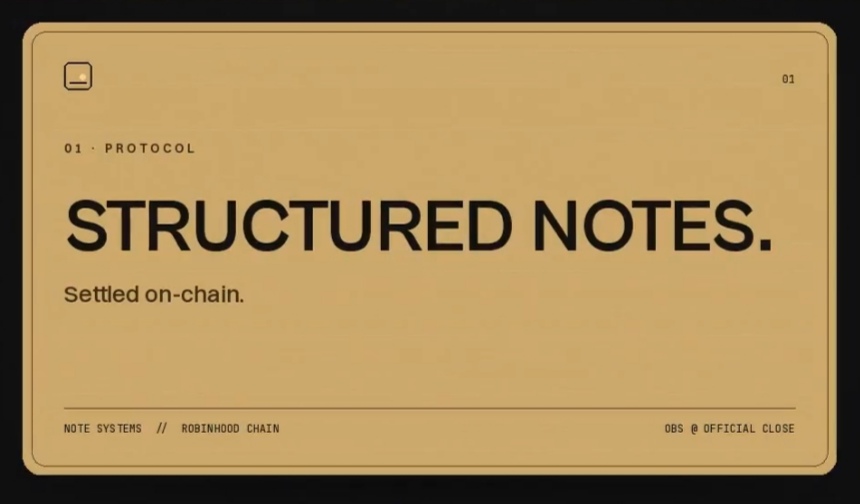
Note Systems removes the bank.
COUPON side : deposit USDG, earn a fixed coupon at every official close the barrier holds.
SHIELD side : post tokenized stock, prefund coupons, hold a put struck at S0.
Both legs are funded in full at strike.
No margin.
No liquidations.
No unsecured claim on an issuer.
Then the flywheel starts:
More notes written
→ more coupon + notional fees
→ 90% buys NOTE on a Dutch auction (no DEX, no pool to sandwich)
→ bought NOTE streams to stakers
→ 10% thickens the Treasury floor
Volume in notes becomes demand for $NOTE.
The market this is pointing at already exists.
Hundreds of billions in structured notes get issued every year, almost all of them by banks.
Tokenized stocks finally give that product a settlement layer. Note Systems is trying to turn the desk itself into a permissionless primitive.
$NOTE is not required to use the protocol.
Notes settle in USDG and Stock Tokens.
NOTE is governance, staking, and a redeemable floor against Treasury reserves.
Rewards are bought with realized fees, not printed.
That’s the whole design.
Private bank product.
Fully collateralized.
No liquidations.
Fees routed on chain to holders.
A half trillion dollar market, being rebuilt as a protocol.
That’s the bet.
Solid angle with the Bedrock 20% stake. Most RWAs just prove the assets exist and call it a day. This one actually gives someone legal teeth if the operator tries to pull something
Curious how the monthly distributions have been looking so far with the 200 machines already live
Most RWA tokens stop at “do the assets exist?”
A machine raise needs a harder question : Who can act if the operator turns?
@BedrockFndn incorporates the company the machines sit inside. The Bedrock Foundation holds 20% of that company, independent of @DualMintRWA
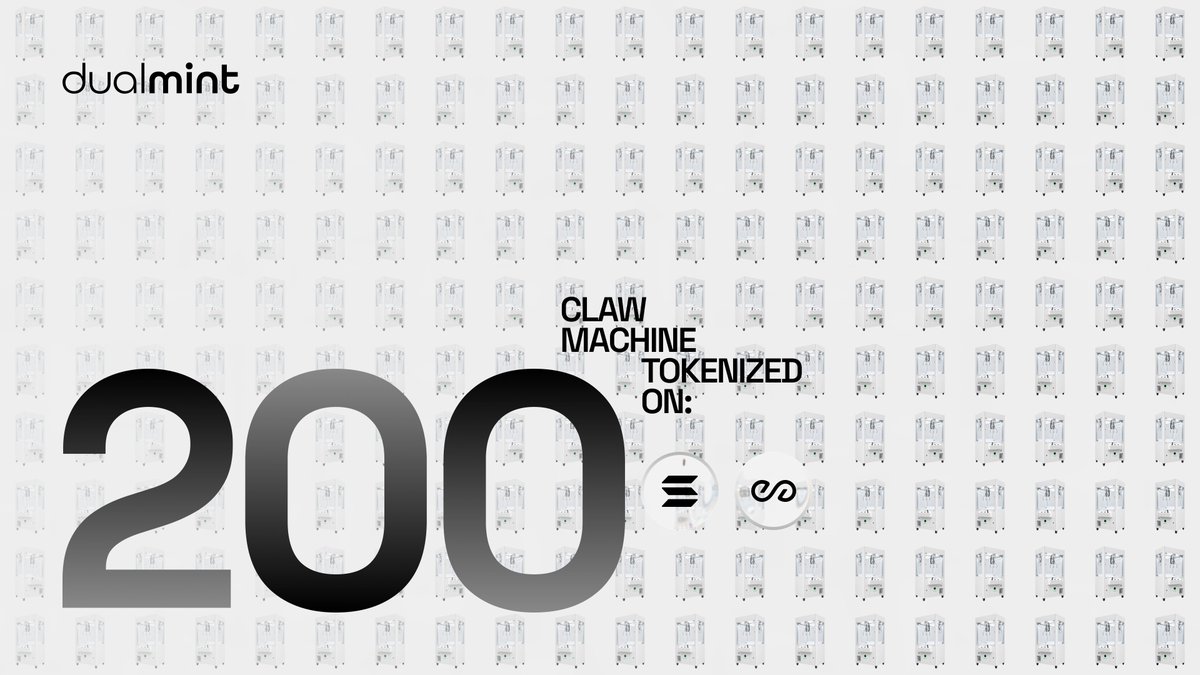
PLAY is DualMint first machine yield product on Solana, a tokenized claim on what 200 operating arcade claw machines earn.
Players put coins in. Machines record every play. That revenue becomes monthly distributions. The position amortizes as machines pay off.
Typical wrappers only prove existence. This structure adds enforcement.
The Foundation 20% stake carries legal standing on:
- Fraud
- Selling machines without consent
- Value extracted behind holders backs
Underperformance does not qualify. Token holders cannot sue or vote the shares. The Foundation can answering to holders, not DualMint. Up to $2M funds it.
The stake also welds the company to the token.
Anyone who wants the machines outright must accumulate 30% of supply, then buy the Foundation out above market.
No route to the physical assets goes around token holders.
Bedrock makes the company answerable to someone. DualMint turns that into a claim capital can actually hold.
DualMint already finances 1,250+ everyday machines (laundromats, HVAC, vending, now arcade) with zero recorded operator defaults since May 2025.
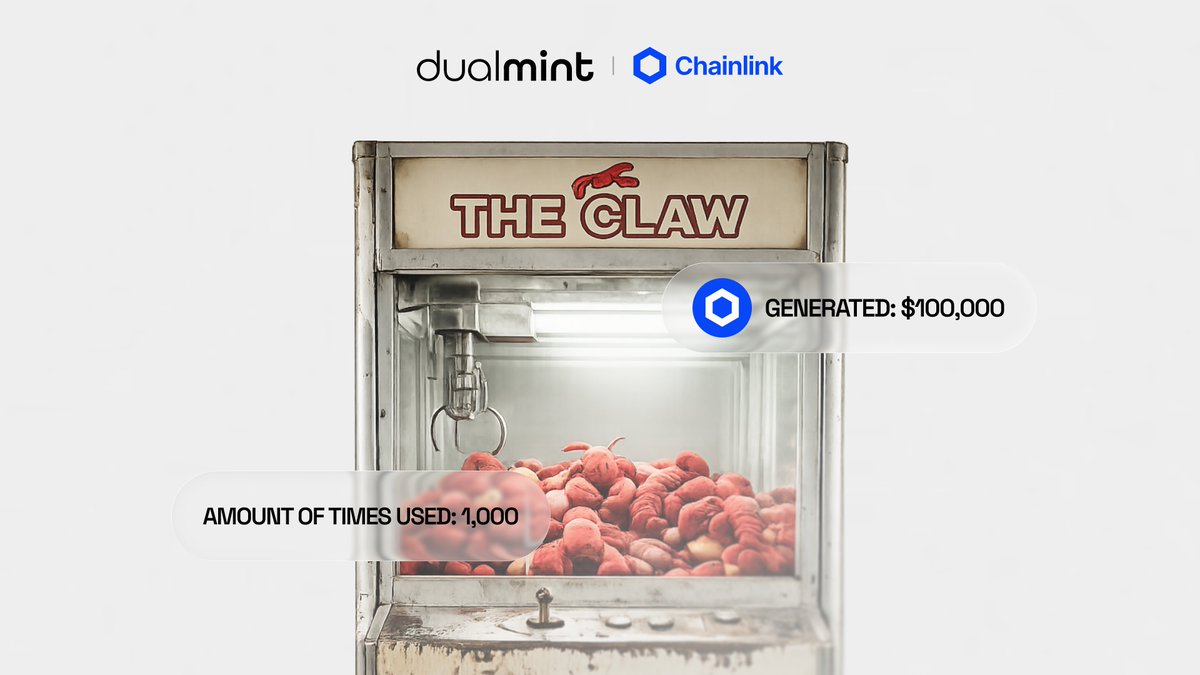
PLAY applies the same method : IoT telemetry (@peaq + @chainlink ) reconciles plays and uptime against reported revenue before any distribution moves.
The machines are already operating. Pre deposits are live.
This is what stands behind PLAY.
Steel earns it. Solana moves it.
Burning 70% of the supply at mint level with no mint authority left? That’s not just talk, that’s permanent.
Respect to the team (and Mališa) for doing the hard thing instead of just locking or promising. $STREAM looking way cleaner now. 🔥
The Streamflow Foundation burn 100% of its holdings, 70% of total supply plus a large part of founder and team allocations.
Check burn tx
https://t.co/SIC2mtbeAI
This is the biggest change to $STREAM since launch.
This was not a lock.
Not a vesting delay.
Not a promise.
Tokens were burned at the mint level on Solana. Supply dropped on chain. There is no mint authority. Nothing can be restored.
The overhang is gone.
What was removed :
- 100% of Foundation allocation (locked + unlocked)
- A significant portion of founder and future team allocations
- Founder Mališa returned 90% of his personal allocation (5% of original supply) : part burned, part returned to the team bucket
What remains of the original 1B :
- 11.47% in existing investor/contributor vesting (114.7M)
- 11.08% freely circulating (110.8M)
- 4.03% small team reserve (40.3M)
- 3.42% Active Staking Rewards (34.2M)
That's the entire new 300M cap.
Every remaining token is accounted for.
Investor vesting contracts were left untouched. Product operations are unchanged : locks, vesting, staking, airdrops, and payouts continue as before.
@streamflow_fi still powers token distribution for 40,000+ projects on Solana.
Why burn instead of hold?
A treasury that can be spent is a treasury the market has to price in.
Burning it is the only commitment that does not depend on anyone's future intentions. The transaction is public. The supply cap is now 300,000,000.
Let’s celebrate this historic move!
This is a clever angle for RWAs.
Most projects just show “reserves are there,” but verifying actual gameplay + uptime against reported revenue is way more useful.
Especially for something as simple as claw machines.
Most onchain attestation only answers one question
Is the reserve still there?
A fleet of 200 claw machines needs a harder one
Did they actually earn what the operator claims?
That’s what @chainlink CRE does for PLAY.
It reads gameplay and uptime directly from the machines, then reconciles those numbers against the revenue the operator reports.
If the two don’t match, the gap is visible onchain.
Nobody funding this raise can walk into every arcade and count the plays.
The reconciliation dashboard is how they check anyway:
→ gameplay
→ uptime
→ onchain revenue
Independent of @DualMintRWA own reporting.
PLAY is a tokenised claim on what those 200 operating claw machines earn.
- Target 12–15% annual lease rate.
- Monthly distributions.
- $230k raise.
- Machines already running.
Chainlink makes the activity verifiable by anyone.
DualMint turns that check into a claim capital can hold.
The machines report.
The oracle attests.
You decide.
this is actually clean af.
taking the structured note and splitting it into two fully escrowed legs (COUPON + SHIELD) removes the whole “you’re just an unsecured creditor of the bank” problem.
Stocks on chain is only half the story.
Tokenized AAPL, NVDA, TSLA and the rest give you the asset. They do not give you the payoff.
Every tokenized stock is a building block. Structured notes are what you build with them.
A structured note is a packaged payoff : fixed coupons if the stock holds a floor, early exit if it rallies, stock delivered at the original price only if it crashes through the barrier at maturity.
Banks have issued hundreds of billions of these every year. The investor is an unsecured creditor of the desk the whole time.
@notesystems unbundles that product.
One series. Two escrowed legs. No dealer.
COUPON (Leg 0) : deposit USDG, earn a fixed coupon at every official close the barrier holds, get cash back on autocall or maturity.
SHIELD (Leg 1) : post the stock token, prefund the coupons, hold a put struck at S0.
Three levels decide every payment.
- Coupon : paid at each scheduled close above the barrier.
- Autocall : if the stock is at or above S0 on a later observation, the note ends. Principal + coupon.
- Barrier : typically 65% of S0. Only a final close below it delivers stock instead of cash
Everything is fully collateralized before the series goes live.
The note buyer notional and the stock holder maximum coupon liability sit in escrow. There is no liquidation engine and no oracle triggered margin call. The solvency invariant is the product
When protection demand exceeds note demand, the Desk steps in
It is a capped USDG vault, the counterparty of last resort. Caps are contract parameters. Positions are public tokens. No hidden book
Protocol fees do not sit in a black box
They buy $NOTE through a continuous auction. Most of that flows to stakers. A slice capitalizes the redemption floor. The token is backed by cash flows, not promises
This only became possible once stock tokens were plain ERC-20 with official close oracles on Robinhood Chain
Spot, perps, and lending already exist there. The missing primitive was the structuring desk itself
That is what Note Systems is
Get your $NOTE
https://t.co/bmWw4onjPZ
ngl this is one of the few RWA posts that actually makes sense
real machines already running, real cash from people playing, monthly payouts… not just another “trust the APY” farm
claw machines as onchain yield is kinda genius ngl
Most onchain yield is a rate, a spread, or an emission.
$PLAY is none of those.
It is a claim on 200 arcade claw machines that are already operating. People put in coins. The machines pay a fixed monthly lease. That cash flow is what depositors receive.
Your USDC does not sit in a lending pool. It finances a fleet of physical claw machines.
Target : 12–15% a year
Term : 16 months
Payouts : monthly
Raise size : $230k
The machines are already earning. This is not a blueprint raise.
Why claw machines?
They are small, high frequency cash machines. Each play is a discrete revenue event. High traffic locations. Simple economics.
A player pays. The claw moves. The machine records it. Thousands of those events become a record capital can inspect.
How the money actually moves?
An SPV holds title to the machines.
An operator runs them on the ground.
Players generate revenue.
The operator pays the lease.
Depositors get paid monthly.
@DualMintRWA takes a processing cut from cash flow. The rest distributes. Yield comes from usage, not token incentives.
The part that makes this different from “trust me RWA”
Every play and every hour of uptime is tracked.
@peaq handles the machine side telemetry.
@chainlink reconciles gameplay and uptime against the revenue the operator reports.
If the two do not match, the gap shows up. Underwriting follows the machine because the machine can now report for itself.
The claw fleet is not @DualMintRWA first experiment. It is the first Solana native yield asset built on a model they have already run
Claw machines and CNC lathes printing real yield on Solana is actually a solid angle for RWAs.
Most of these projects feel forced but this one at least has physical machines behind it.
Curious how transparent the revenue data is though.
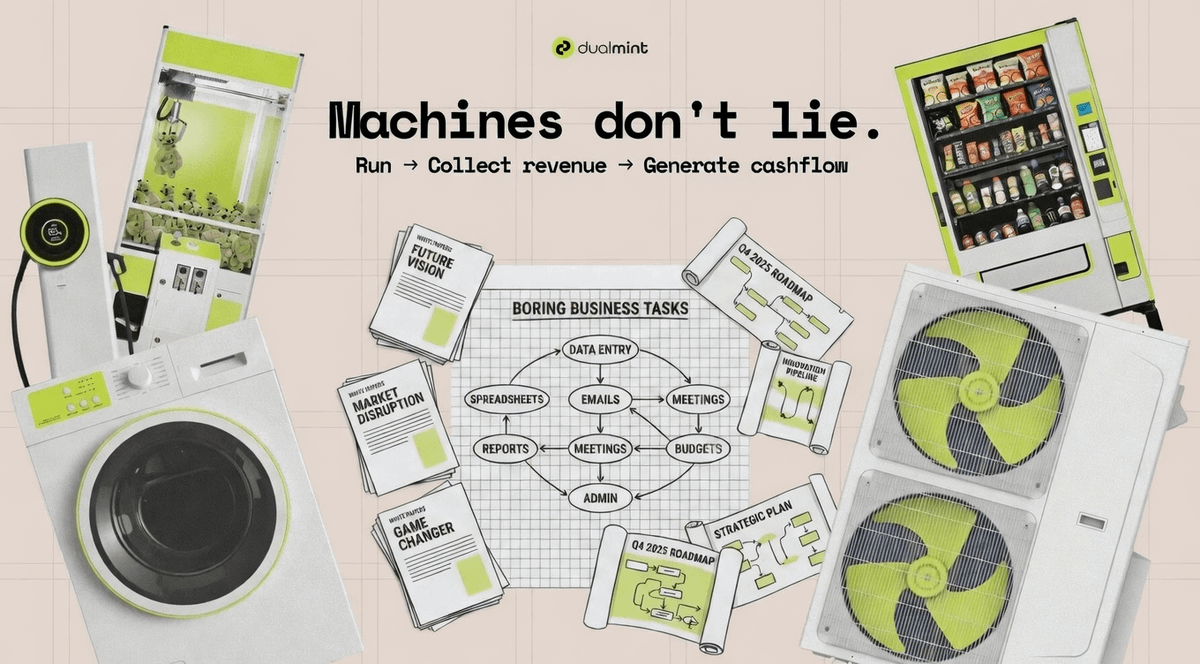
A machine doesn’t need to be digital to generate real cash flow.
It just needs to exist in the physical world, a CNC lathe, a robotic arm, a 3D printer farm, an Iot enabled conveyor belt, a solar powered generator in a remote mine and start printing revenue the moment it’s online.
But that revenue has always lived in spreadsheets, bank statements, and offline invoices.
Until now.
@DualMintRWA built Machine Finance so the machines themselves become revenue generating assets that speak Solana.
The Vision
- Any machine = a cash flow machine
- Its revenue is tokenized into PLAY (the machine token) on Solana
- The token is listed, traded, and used to pay for upgrades, maintenance, or direct payouts to the machine owner
- Everything stays onchain, instant, transparent, and accessible to anyone with a Solana wallet
Why Solana Wins
- Sub second finality
- <$0.01 fees
- Infinite scale
- Battle tested for high volume DeFi
We don’t need Ethereum gas wars or Bitcoin settlement time.
Solana makes the machine finance fly.
This isn’t just another token.
This is infrastructure for the real economy
Every machine that joins us earns PLAY holders real revenue.
Every PLAY holder is part of the physical future.
Steel earns it.
Solana moves it.
PLAY pre deposits are open
Not a render. Not a roadmap machine.
A tokenized claim on what 200 operating arcade claw machines already earn.
- $230K target
- 12–15% annual lease rate.
- Paid monthly in USDC.
This time you own the machine.
The problem is not that small machines don’t earn.
A claw in a mall pays whether crypto is up or down.
The operator with four units still can’t easily finance a fifth.
Why ?
Checking a $1,250 machine costs almost as much as checking a $50,000 one.
So capital skips the small stuff.
PLAY is built so the machine can report for itself.
How the cash actually moves:
• An SPV holds title to the fleet
• The operator runs the machines under a finance lease
• The SPV gets a fixed lease ahead of the operator share
• Recovered equipment cost can be recycled into replacements and fleet growth
Depositors are not betting on a token emission.
They sit on lease cash flow from plays already happening.
What PLAY is not :
• Not DeFi yield from emissions
• Not a treasury wrapper
• Not number go up from a narrative
Yield comes from people putting coins in machines.
Revenue can fall. Machines break. Operators fail. Liquidity after the raise is intended via Meteora, not a bank withdrawal button.
If the raise doesn’t fill, deposits are designed to come back.
A fleet that is already on the floor, already taking plays, now wrapped so the lease can clear on chain.
Pre deposit is live.
Do the work : structure, waterfall, jurisdiction, audits, and risk page before size
Claw machines as RWAs is a new one for me
But ngl, the fact that the machines are already running and making real money instead of just promising future yields is kinda solid. Way better than the usual “token first, utility later” projects.
What if a Web3 project generated revenue from machines that people actually use?
That’s the interesting part about @DualMintRWA
PLAY is built around a vault of 200 operating claw machines, connecting on chain participation with real world machine revenue.
This isn’t a model built around constant token emissions.
The machines are already operating in the real world, serving real customers and generating revenue through actual usage.
That creates a much more tangible foundation for the ecosystem.
- Real machines
- Real users
- Real world revenue
The idea is straightforward :
Machines generate revenue → revenue flows through the ecosystem → participants gain exposure to an activity tied to real world operations.
No need to manufacture demand through endless incentives.
With around 200 machines already operating, PLAY isn't just a concept about what could happen someday.
The focus is on turning an existing fleet of machines into an on chain RWA opportunity.
That distinction is worth paying attention to.
Of course, real world revenue doesn't mean zero risk.
Machine performance, locations, maintenance, operating costs, customer demand and revenue distribution all matter.
But those are tangible business variables that can actually be measured.
That’s what makes @DualMintRWA worth watching
The thesis is simple :
- Build around productive real world assets.
- Generate revenue from actual activity.
Use blockchain to create a more transparent and accessible layer around it.
It could be about finding assets that already generate cash flow, and bringing that activity on chain.
200 claw machines.
Real world usage.
Real machine revenue.
That’s the PLAY thesis