Lors du carnaval annuel d'Andorre, un mannequin aux couleurs d'Israël, arborant une étoile de David bleue à la place du visage, a été soumis à un simulacre de procès, pendu, fusillé et brûlé.
Le meurtre symbolique avant le meurtre réel.
German teams 1-2-3 after first two heats two-man bob. USA flagbearer Frankie del Duca in close 4th. Israeli team — its win is being here — in last, 4.7 secs back
LeBron James on Israel:
“I hope I inspire people over there not only to be great in sports, but to be better in general in life, hopefully someday I can make it over there.”
The first-ever Israeli bobsled team in Olympic history runs this week: five Jews, a Druze and a dog. Lulu the dog: not racing. Even by the standards of the 2026 Winter Olympics, the Israeli bobsled team stands out. Just for being here 3 Wire Sports https://t.co/8kPYntobdQ
Ilia Malinin hadn't lost in 2 years.
Two time world champ. The only human to land all of the quad jumps.
Then...his brain betrayed him.
"All the traumatic moments of my life really just started flooding my head, and there were just so many negative thoughts that just flooded into there. And I just did not handle it."
Choking is a threat disorder. Your brain is a prediction machine. Before any big moment, it calculates:
Past experience + current environment + the story you're telling yourself = predicted state.
When that prediction is threat, your brain protects. It latches on to confirming evidence. Ignores the rest. Fear feeds the prediction. The prediction feeds the fear.
Malinin experienced this in real time. He stumbled in the team event days before. His brain coded "Olympics = danger." It had evidence to support the spiral. By the free skate, the loop was cemented.
"All the traumatic moments of my life really just started flooding my head."
His brain was no longer in the present. It was prosecuting the past. Replaying every negative voice or experience to try to convince him to run away, to escape the situation.
His protective brain was on overdrive, and his brain was convinced the situation was life or death.
When an expert chokes, they regress. The brain shifts from autopilot to micromanagement. Our smooth, automated movements become segmented, like a six-year-old learning to throw a ball. This is partly because with the heightened threat state, the link between perception and action gets severed.
Nothing "feels" right. And we compensate by over-controlling. So we're thinking about every step along the way. And the end result is disaster.
Malinin's quad axel requires mass amounts of trust in thousands of hours of training.
Under threat, his conscious mind tried to control what should have been automatic. It's like pulling back a slingshot and instead of letting it go, trying to push it forward.
What drives our brain to move from slight underperformance to "choking" disaster?
1. Identity Cementation
This threat gets turned up to 11 if our sense of self is deeply intertwined with the outcome.
Malinin arrived as the Quad God. It's his Instagram handle, on his warm-up gear, it's his identity.
When your identity IS the performance, your brain treats failure as existential.
The brain doesn't register "I might lose." It registers "I might lose myself."
When Rick Ankiel got the yips, he explained it in similar terms, "I made the mistake of thinking, being good at baseball is what made me who I was. When that glass is shattered, there was nothing left. Going from baseball's prodigy and poster boy. All of the sudden you are blindsided. You're the most vulnerable you've ever been, and everybody can see right through you."
The harsh irony of performing well is you have to care a lot, and try hard...But caring and trying can be your downfall. Your brain registers caring as a signal that this is sefl-defining, you prime the fear/threat centers, and before you know it, your brain's stress response is freezing, fleeing, dissociating to protect itself.
The key is to care a lot...but having just enough space between you and the thing...
2. Mistake Spiral
The second item that causes us to move from underperformance to choking is the compounding of our mistakes.
Research shows that after a mistake, we get a distinct error signal, an involuntary attention shift, and what amounts to an internal handbrake: motor commands temporarily get suppressed.
If we linger there, the pause becomes rumination. The rumination transforms into catastrophizing.
It's why processing mistakes and failures, taking away their sting is so important.
3. Judgement --> Self-Protection
We don’t choke in practice.
We do so when we are being evaluated or judged, and in front of others. When something meaningful is at stake and we have an audience.
We have a social self-preservation system that is on the lookout for anything that might threaten our social status.
If our self-preservation system is inundated with constant signs and signals that our social status is going in the wrong direction, our system becomes hyperresponsive.
---
So how do we get out of protection mode?
1. Acknowledge the moment is big. Don't fight it.
2. Build an identity broader than any single performance.
3. Be the defense attorney. Give yourself evidence.
4. Find something you can control. The smallest thing you can impact that moves you forward
5. Surround yourself with people who love and care for you no matter what. Good vibes are contagious
6. Simulate the worse. Michael Phelps called it playing the tape. And you have to visualize the disaster, to make sure your brain doesn't freak out.
Before the Olympics, Malinin told ESPN he was treating it "like any other competition."
Afterward: "I honestly definitely underestimated it."
This is one of the most common pieces of advice in sport. Your brain isn't dumb. It sees the Olympic rings, the cameras, and the weight of expectation.
When you tell yourself "just another day" and your brain knows it isn't, the mismatch doesn't calm the system. It alarms it further. It's a prediction error that alerts the brain that our previous stress response isn't good enough. This is NOT just another day, so sound the alarm. And...we overshoot the response, moving to full dread.
It's not too different than what runners experience during preliminary races. They think, this is going to be easy, I should qualify with ease and be able to run slower. But...that mindset primes the brain to overreact to the first sign of discomfort.
The day before he set the world record in the mile (3:51), Jim Ryun wrote in his log "That was hard!" for a 4:07 prelim mile. He ran 16 seconds faster in the final, reporting it "felt easy." The only difference was the expectations going in.
Don't pretend the moment is small. Acknowledge reality. And remind yourself that you are prepared to meet it.
The best of the best feel the same nerves you do.
The same doom loop fires when you freeze during a presentation, go blank in a job interview, or can't find the words in a hard conversation.
It's a human problem. A stress response designed to protect us from lions, tigers, and where being separated from the tribe went death.
We can't fight biology. But we can learn to work with it better.
Very sweet scene at women's giant slalom as Italy's Fede Brignone wins late. Sweden's Sara Hector and Norway's Thea Louise Stjernesund, tied for 3rd, dropped their gear and play-bowed -- you are the greatest -- in front of Fede in finish area. Shiffrin: 11th
Valentine's Day deep thought - on convergence, maybe, of technology and sports - from Luxembourg's Marc Girardelli, two-time 1992 alpine silver medalist: "Virtual skiing, in my opinion, is as attractive as virtual sex. Forget about it."
What a beautiful way to celebrate Valentine’s Day: contemplating the math of 1,533 men, 1,338 women at the Winter Games and 10k condoms gone in just three days. It’s like the 2026 version of Love Story
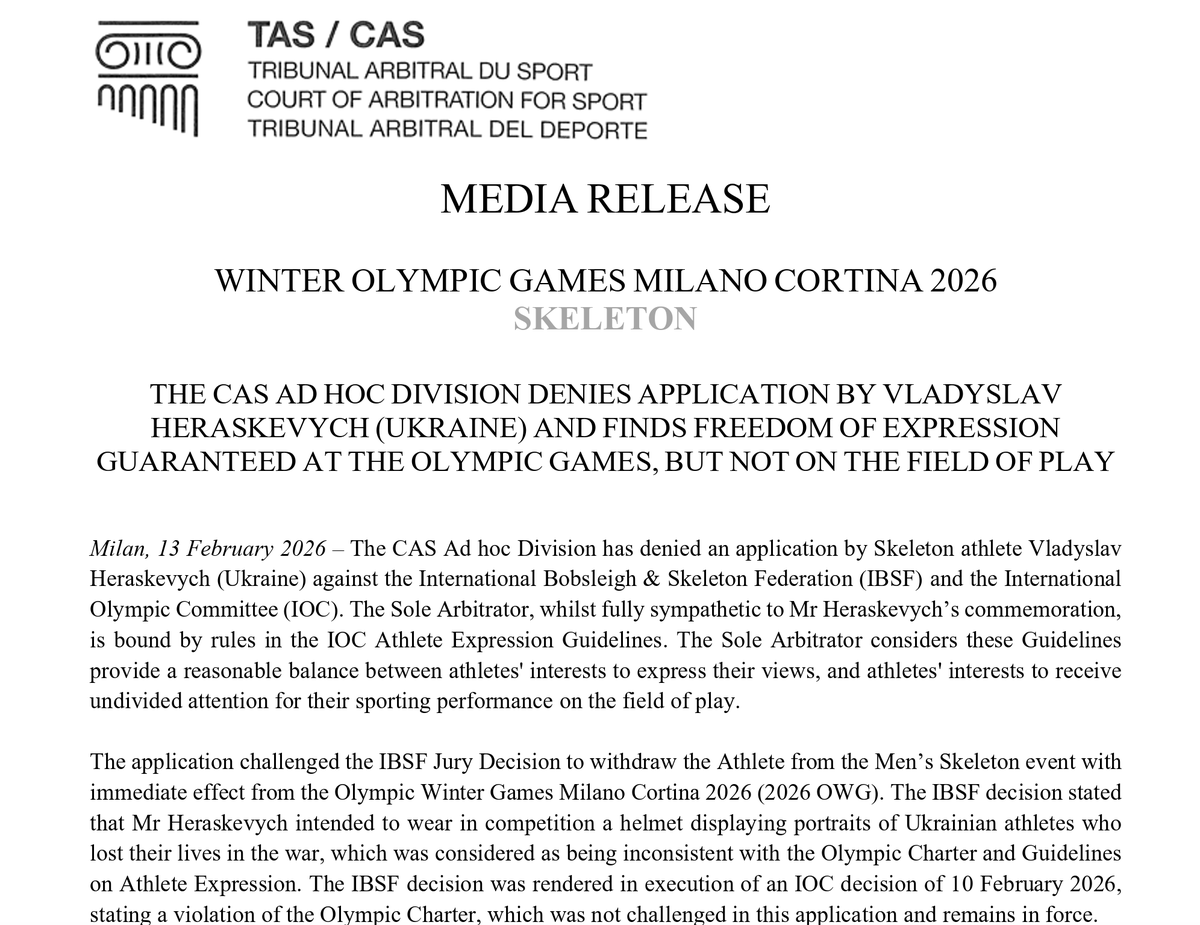
Tribunal rightly - emphasis, rightly - denies Ukrainian skeleton racer @heraskevych a legal 'miracle on ice.' Olympic rules apply to everyone. Which was the IOC's point all along 3 Wire Sports https://t.co/DcHlEPfO6w
Norway's Johannes Høsflot Klæbo wins men's 10k xc race. He's now 3 for 3 gold at these Games ... record-tying 8th gold across 3 games. He could win 3 more here (relay, team sprint, 50k) One of the greatest Olympic athletes, ever, and that's no hyperbole
The IOC had no choice but to DQ Ukraine's Vladyslav Heraskevych. Rules. If it’s about rules, tho, it’s equally if not more about who owns the narrative and, in this context, narrative’s increasingly frequent traveling partner, (raw) emotion 3 Wire Sports https://t.co/FYnuP3cgHR
Oakland is east of San Francisco. Gertrude Stein grew up there. She would write, famously, about Oakland: there is no there there. For Milan and the 2026 Winter Games: there is no here here. These Games have, like, zero buzz 3 Wire Sports https://t.co/DBxPqKw0rz
Last American man to win Olympic medal in xc ski: 1976. 50 years! Dorothy Hamill won figure skating gold in 1976. She turns 70 in July. Tuesday, Ben Ogden, 25, from a Vermont town of 177 people, took sprint silver, a medal no one saw coming 3 Wire Sports https://t.co/XChrnHJQIZ
Alpine ski: so great, so crazy unpredictable. How many times has @MikaelaShiffrin come through? Not today. @_BreezyJohnson had run first in downhill. Shiffrin: 7 wins in 8 slalom races this season. Today she and Johnson 4th, combined. Austria wins. Americans Wiles, Moltzan 3rd
American medal maybe almost no one saw coming: Ben Ogden wins silver in xc sprint classic, first US *men's* xc ski medal since Bill Koch in 1976. Ogden in 3:40.61, +0.87 behind (who else) Norway's Johannes Hoesflot Klaebo
Just 13 seconds in to her Olympic downhill run, @lindseyvonn crashed. For the second time in 10 days: airlifted off a mountain. "It’s like the man in the arena,” her sister said, quoting Teddy Roosevelt. “She dared greatly." 3 Wire Sports https://t.co/41dQOsuNIx
Opening ceremony: IOC president Kirsty Coventry invokes for global audience the African philosophy ubuntu - championed by Mandela, Tutu and more. The IOC is Eurocentric. Now this rooted-in-Africa philosophy? Can Coventry get ubuntu buy-in? 3 Wire Sports https://t.co/NELS6X6c6Q