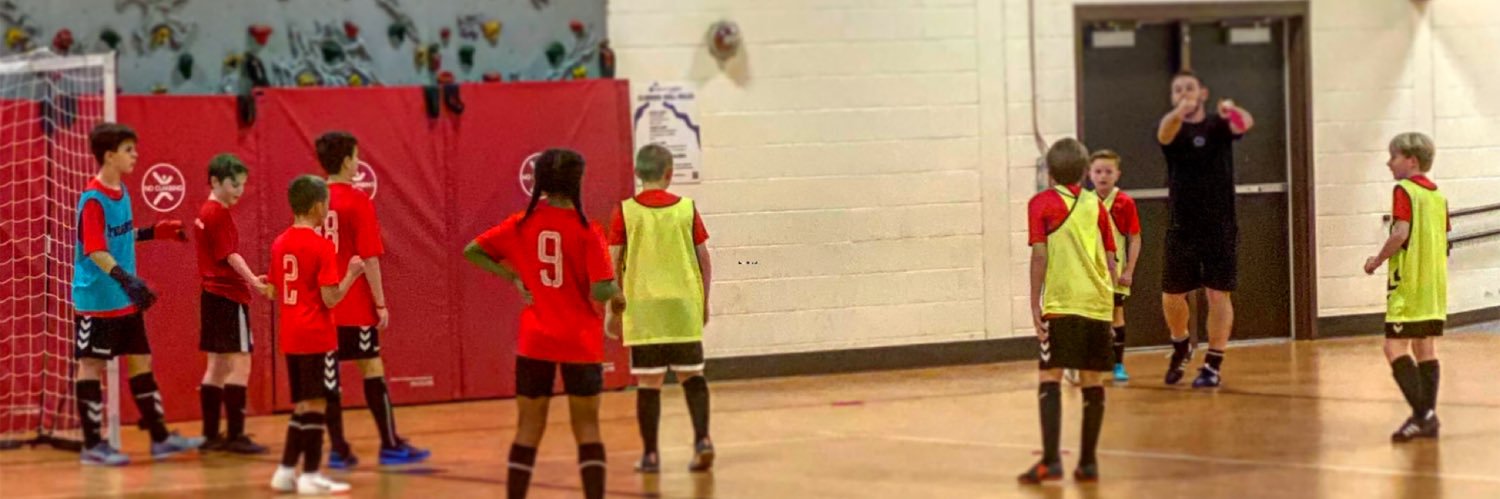
Who wants to start a series of schools based around movement, stoicism and behavior? 1) Having kids move more than sit. 2) learning how to focus on what they can control and 3) that their behavior will determine their success? @PDScoach@ttillette@VerbalVitamins@TonyRobbins
I wonder how many people have actually taken the time to read the Scottish FA's 133-page white paper, Trends in Success in Elite Player Development. My guess would be: not many.
Having worked in youth development for several decades and as the creator and strongest advocate of the Football Starts at Home® approach, I find it particularly satisfying to see the Scottish FA acknowledge what many of us have been saying for years, that this is an area the football world has largely overlooked.
The report reinforces the importance of the home environment in player development, a principle that sits at the very heart of Football Starts at Home®. For too long, the focus has been placed almost exclusively on academies, coaches, and structured training programmes, while the influence of the family and home setting has often been underestimated. It is encouraging to see one of football's leading governing bodies recognising the significance of this often-neglected factor.
--------------------------------------------------------
"It seems to be unavoidable that, in order to become the best player in the work, 2-4 seems to be the 'golden window' for early engagement with the ball."
"The worlds's best players commented that the 'ball was their favorite toy' as a toddler, not that football was their favorite game (initially). Making the ball the favorite toy from the earliest age is the key trend in elite development."
"A key takeaway from this research is that this fundamental phase in elite development happened within the house, and was inspired by a family member, usually a parent, and always before the child was involved in any kind of organized activity. This shows that waiting for the child to enter organized programs is not enough, and the Scottish FA must stimulate a culture shift that encourages children to master the ball as an earlier age and stage."
"For this to occur, the Scottish FA strategy must shift away from thinking about elite development solely in terms of organized activity, towards the families of young children. It is the family, most often a parent or guardian, who decides whether a child will have this early opportunity to master the game."
"There are several theoretical reasons why these players have an advantage from early childhood. The obvious one is that by starting earlier, they will have spent more hours mastering the ball and thus retain an advantage. However, this is only part of the story. It seems to be that this 'golden window' cannot be missed for true world-class performance, regardless of how many hours are spent practicing later."
"There are likely tow potential factors for this. Firstly, because the development of the brain and nervous system is such that whatever a child is exposed to in the early years tends to have a significant impact on their development. These years are fundamental in shaping many aspects of the child's future. Growing up in contact with the ball from such a young age seemingly makes manipulating the ball with the feet feel almost "natural" to the brain."
#FootballDevelopment #YouthFootball #Football #SoccerDevelopment #YouthSoccer #Soccer
@educator4ever36 If PE was taken seriously then they wound have to do a lot of grading. I've been a PE teacher and a science teacher. It comes down to the admin holding the teachers accountable and not letting them commit less to the job.
@ExtremeFootbal4 Most of these kids won't be playing professional soccer. Either they will drop out or be passed by some late developer. Just look at how many U12 players in professional academies in England actually make it.
@puckhead48e@CoachCH14 In high school you can be with your players 5 days a week. It's easier to meet with players as a group or individually in the classroom setting. Forming a leadership team was huge for me. Meeting with & actively involving the booster club & parents is also very important.