EPSO welcomes the EC’s legal proposal on NGTs to the EP & Council. EPSO offers to contribute to clarifying & improving standards for evaluating the equivalence between NGTs & conventional crops on a scientific basis
#PlantScience#EUGreenDeal#EUFarm2Fork
https://t.co/ronNzXQcSL
Now we can map genes in #fababean! The 13Gb reference genome is published in @Nature after an amazing community effort. Thanks to all authors for great contributions! https://t.co/PEqbjSBQmY #legumes#plantprotein
Happy to announce that we published the genome for faba bean today in Nature. This unlocks the path to improving a sustainable protein crop for food security.
Here, the Nature's News and Views on the achievement:
https://t.co/Lz6OhwBcce
#leavingtwitter . Good to engage on science and society, but not where insurrectionists, hatemongers, and serial liars are reinstated. #seeyouonmastodon
Happy to share our efforts towards global #nutritionalsecurity : a high-quality #genome assembly for #fababean ! Will facilitate breeding of this former orphan crop. https://t.co/p3BvDhk9MC
@MarkkuPatynen@LukeFinland The answer is "yes, both, and not only." We need GM, gene editing (GE), traditional breeding, and use of genetic diversity. GE for where then gene variants (alleles) are not available; GM for where the genes are not available to cross in. The complete toolbox is needed.
@MarkkuPatynen@LukeFinland Yes, we need diverse crops for diverse diets and diverse, changing climatic zones to reach food and nutritional security. Traditional crops need breeding programs to increase yield stability and improve agronomic traits in new cultivation areas.
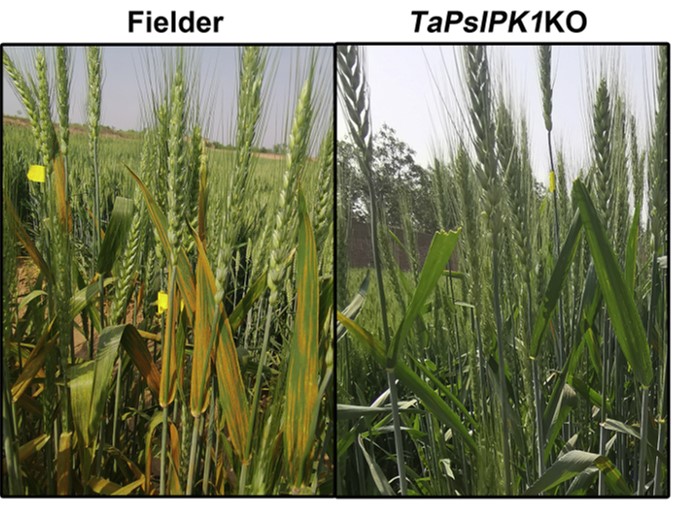
Wheat is frequently devastated by yellow rust. CRISPR-cas9 inactivation of one gene confers broad spectrum resistance. Gene editing for sustainable agriculture!
https://t.co/urAllKZQt4
Nitrogen fixation by legumes is a key sustainability trait. Its extent varies among legumes in the presence of soil nitrogen. Here is insight into why.
How do legumes decide where to get nitrogen––from the soil or from nitrogen-fixing bacteria? https://t.co/QFHBhp41QC
Farm staff at Rothamsted Research has sown seeds of genetically edited Camelina sativa weeks after regulations for scientific field trials in the United Kingdom were eased. Read details in #CropBiotechUpdate: https://t.co/c3aW0pYE4b
A study in China shows that GM herbicide tolerant cotton GGK2 is not harmful to arthropod insects; it has the same abundance and diversity of insects as its near-isogenic line counterpart. Read details in #CropBiotechUpdate: https://t.co/25xcBXHyOU