Hi, I’m Albert.
I write about:
AI and crypto narratives
Public markets and trading setups
Trading systems and agents
Long-term investing mistakes and lessons
What does every GPU cluster need more of?
The answer is memory, storage, power, packaging, and interconnect.
That is why Lip-Bu Tan’s thesis makes me more bullish on memory.
Not because memory is a short-term trade only.
But because AI is turning memory from a commodity cycle into a strategic infrastructure bottleneck.
In the old cycle, memory followed PCs and smartphones.
In the new cycle, memory follows AI scaling.
That is a much stronger demand curve.
I think Lip-Bu Tan’s thesis from the No Priors interview is structurally bullish for memory.
The key point is not simply “AI needs more GPUs.”
His broader thesis is that AI is becoming a full-stack physical infrastructure problem. The bottleneck is shifting from models and algorithms to compute supply, power, packaging, interconnect, materials, and memory.
That matters because memory is no longer just a cyclical PC/server component. In the AI infrastructure stack, memory becomes one of the primary constraints.
https://t.co/5Mxgbq2wv8
This is why I am bullish on:
$MU — direct HBM/DRAM exposure, one of the cleanest US-listed AI memory plays.
$DRAM — broad memory cycle exposure.
$SNDK — NAND / enterprise SSD / storage exposure.
$WDC — storage and NAND-related exposure, depending on structure and market setup.
$INTC — not a pure memory play, but important in Lip-Bu’s thesis because CPU demand, advanced packaging, foundry, and sovereign AI infrastructure become more strategic as AI workloads become more complex.
$NVDA is still the center of AI compute, but the second-order question is:
1/8
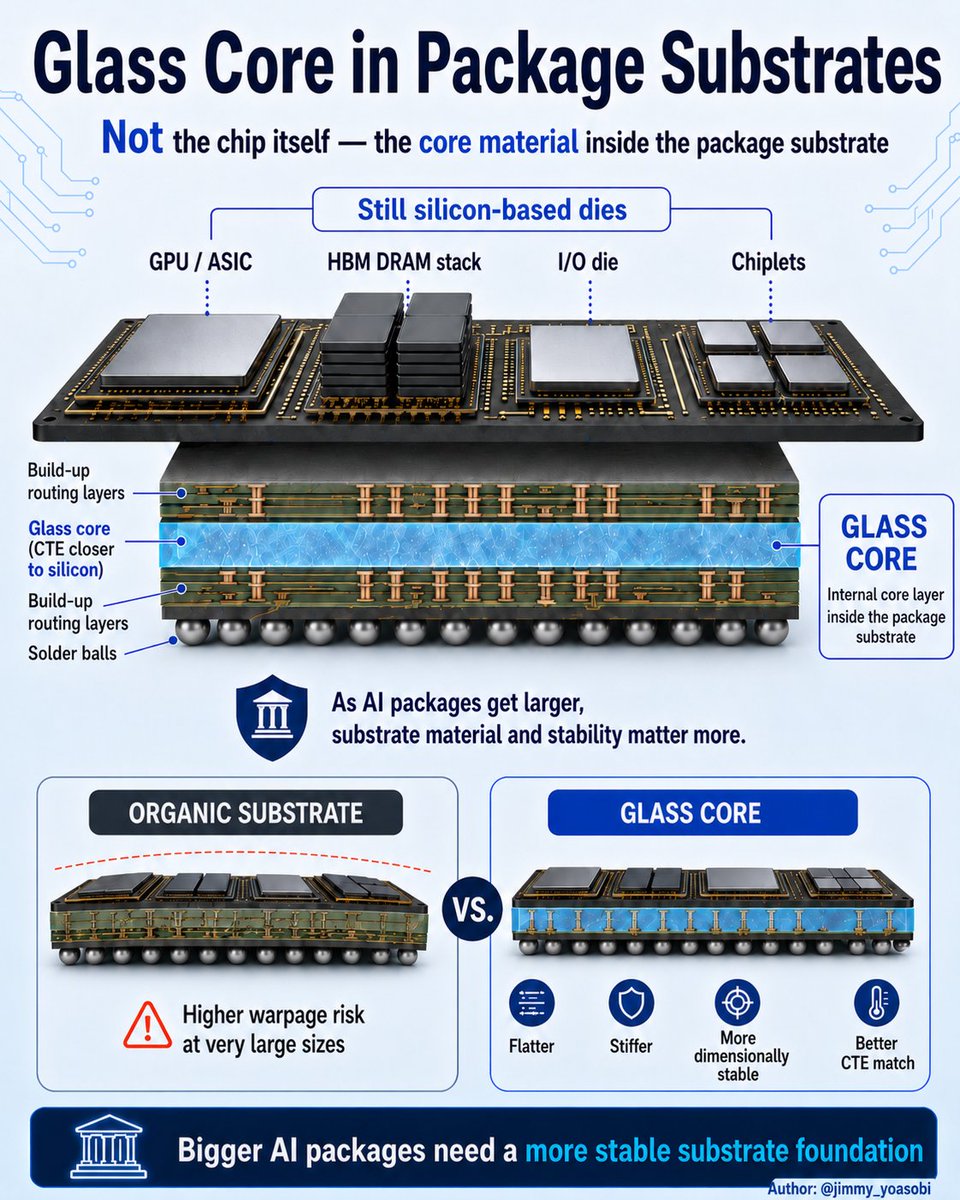
A lot of people are talking about glass core substrates.
But if you are not from the packaging industry, you do not need to memorize every technical term first.
Start with one simple idea:
Glass core does not mean the chip itself becomes glass.
It is about making the “foundation” under a large AI chip package more stable.
Anthropic cutting off Mythos and Fable 5 access for non-U.S. citizens is one of the most bullish signals for semiconductors.
Not because of Anthropic itself.
Because it proves sovereign AI is real.
If access to frontier models can be restricted overnight, every major country now has a stronger incentive to build its own AI stack.
EU. China. Japan. Korea. Middle East.
Everyone needs domestic models, domestic data centers, and domestic compute capacity.
Tokens are intelligence.
Intelligence is now a strategic national resource.
This means the world needs more token factories — training clusters, inference clusters, HBM, DRAM, NAND, GPUs, networking, advanced packaging, and CPUs.
That is why I’m bullish on $SNDK, $DRAM, and $INTC.
AI infra demand is no longer driven only by Big Tech.
It is now driven by geopolitics.
That makes me more bullish on semis for the next 3 years.
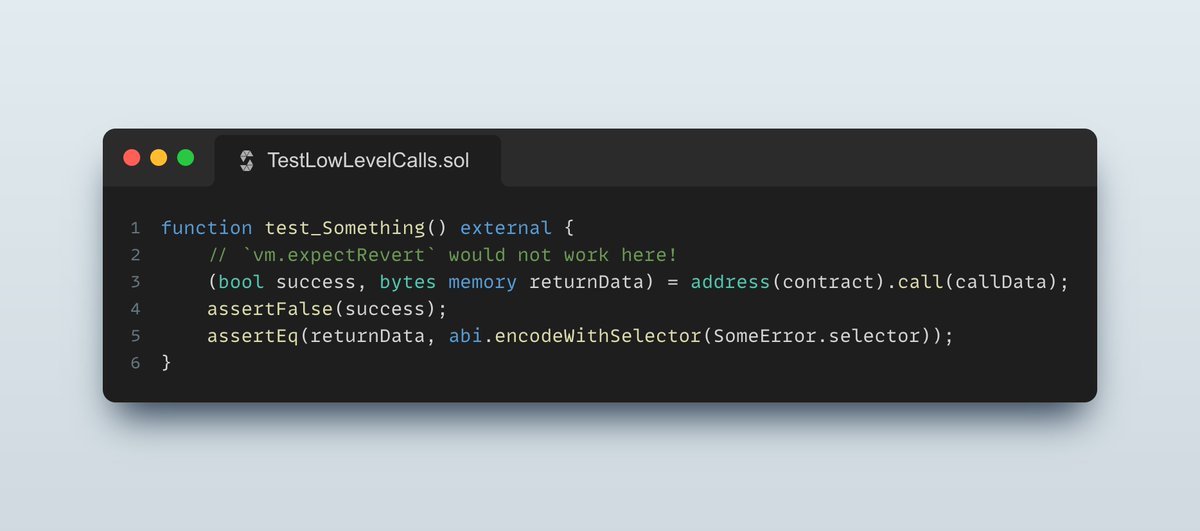
Random Foundry trivia.
`vm.expectRevert` doesn't work with low-level calls.
If you need to test this behavior, you'll have to manually verify the return status, as shown below:
key principle many in crypto misunderstand:
decentralization is a MEANS, not an end
the end goal is censorship resistance and permissionlessness
if an app can accomplish this without any validator set, this is strictly superior to having a beautiful decentralized validator set