I made the film I needed as a child.
Across the Marsh follows my journey back to rural North Carolina to meet the father I barely knew and confront a legacy of violence, abandonment, and the search for belonging.
The official trailer is below.
The online premiere is now streaming through Monday, August 3.
🎟️ Link: https://t.co/lG8IJdthdp
I spent the last 11 years making a documentary about meeting my father for the second time.
This week, I finally get to share it.
Across the Marsh isn’t just about one relationship.
It’s about abandonment, identity, forgiveness, and what time reveals.
If this story resonates with you, I’d be honored to have you watch it.
🎥 Online Screening: Thursday - Monday
🎟️ $10
Reserve your spot online: 🔗 https://t.co/lG8IJdtP2X
Sometimes the stories we’re most afraid to tell are the ones that remind us we’re not alone.
#AcrossTheMarsh #Identity #EstrangedFamily #Belonging #Documentary
We think there's a software category that doesn't exist yet.
We call it:
Reflection Technology.
Software that helps people transform experience into understanding.
Not therapy.
Not journaling.
Not coaching.
Not AI companions.
A new category.
Some understanding comes late.
After the conversation.
Three days later.
Months later.
I built @alchmapp for that space.
A private place to write, return, and understand what time is revealing.
Your inner life is not content.
It is yours.
We think there's a software category that doesn't exist yet.
We call it:
Reflection Technology.
Software that helps people transform experience into understanding.
Not therapy.
Not journaling.
Not coaching.
Not AI companions.
A new category.
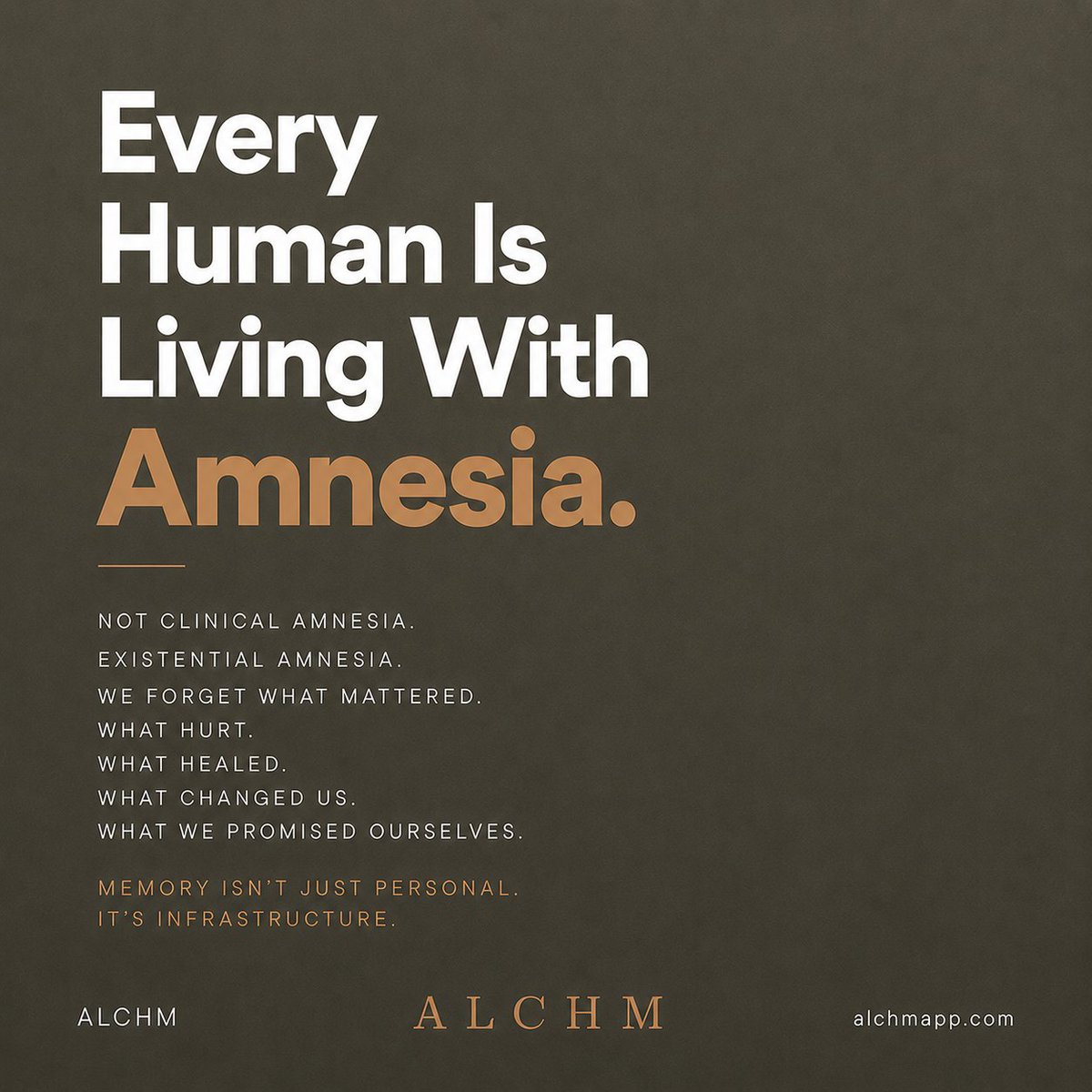
Every human is living with amnesia.
Not clinical amnesia.
Existential amnesia.
We forget what mattered.
What hurt.
What healed.
What changed us.
What we promised ourselves.
Imagine if companies forgot everything they learned every six months.
They'd collapse.
Maybe wisdom isn't about learning more.
Maybe it's about forgetting less.
(New essay ↓)
https://t.co/myxOdsmSeb
We built infrastructure for information.
Now we need infrastructure for understanding.
Reflection isn't self-care.
It isn't productivity.
It's how experience becomes wisdom.
Without reflection:
• information → noise
• knowledge → reaction
• intelligence → performance
Reflection may become one of the defining technologies of the AI era.
Today we're launching ALCHM on @Peerlist .
We built it around one question:
What kind of technology deserves access to our inner lives?
While most AI products compete to generate more answers...
ALCHM was designed to help people hear themselves more clearly.
Reflection instead of addiction.
Presence instead of engagement.
Privacy instead of surveillance.
If that future resonates with you, I'd be incredibly grateful for your support today.
Upvote ALCHM on Peerlist ↓
https://t.co/3Rjo36bCOz
We've been using the wrong metaphor for the human mind.
It's not a computer.
It's a forest.
Computers store information.
Forests cultivate relationships.
Ideas don't just accumulate; they interact.
A conversation changes the meaning of a book you read 10 years ago.
A memory reshapes a decision.
A belief dies so another can grow.
Transformation isn't additive.
It's ecological.
Maybe the future of AI isn't building bigger databases.
Maybe it's helping us cultivate richer inner worlds.
Check us out on Substack: https://t.co/8bTzeXZWPJ
Higher ed moves faster than most people give it credit for. It moves fastest when it has the right partners.
In this clip from our convo with President Pumariega of Miami Dade College, she breaks down what makes @MDCollege's speed possible.
Her framing: "20th century institutions and models trying to deliver on 21st century talent."
Her answer: courage, some crazy, and a lot of execution. Plus the right partners. Industry partners for curriculum. Tech partners for platforms. Thought partners who show up ready to build.
If you're a higher ed leader wondering how to move fast, find your thought partners. If you're a tech leader who wants to work with higher ed, come in ready to share what you have learned across customers, build, and form a trusted, long-term relationship.
The more I build with AI, the less interested I become in intelligence alone.
I’m more interested in restraint.
Not what AI can do.
What it should deliberately choose not to do.
I think we’re teaching AI the wrong skill.
Every new model competes to generate better answers.
More speed.
More confidence.
More capability.
I’ve become interested in a different question:
What if AI wasn’t designed to answer?
What if it was designed to help us continue thinking?
Most AI products ask:
“How helpful can we make this?”
I’ve been wondering:
“At what point does helping become replacing?”
That question changed the product we’re about to launch.