Schools often mistake gifted students’ ability to survive for evidence that they are thriving.
The perfectionist quietly carrying stress receives less attention than the student whose distress becomes disruptive.
That’s part of the tension behind the “former gifted kid” trope.
Gifted students are often the ones adults worry about the least.
They make the grades. Meet expectations. Stay productive. Look fine.
But many become experts at masking anxiety, exhaustion, boredom, and uncertainty behind competence.
https://t.co/874OZTB4Co
“This wasn’t your best work.”
A professor scribbled those words across one of my undergraduate papers years ago, and I still think about them regularly.
This week’s episode explores the complicated balance between challenge and care in education.
https://t.co/9r3EZl4yV3
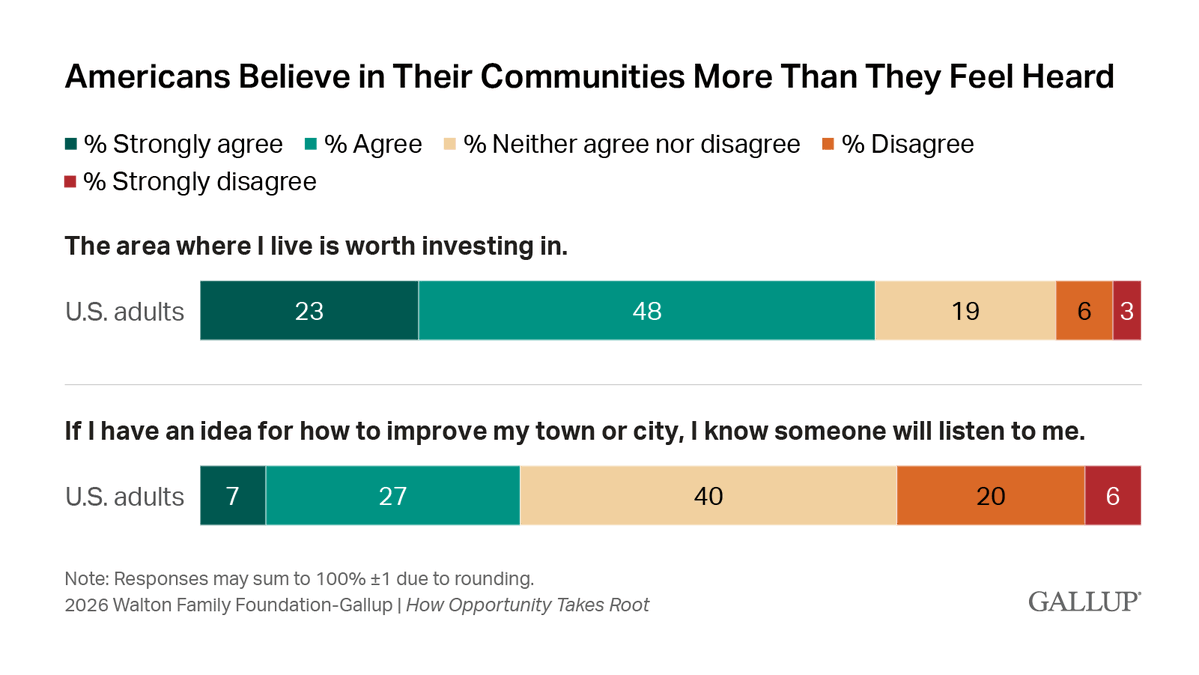
Nearly three-quarters of adults agree that their communities are worth investing in. These communities that build strong foundations and connections among their residents help opportunity take root, and as a result, wellbeing and optimism flourish.
Explore the latest findings from Gallup and @WaltonFamilyFdn: https://t.co/R4JK1sqZ3g
I’ve been adding some older podcast episodes and blog posts to my new Substack this week, which means I’ve also been rediscovering a few favorites along the way.
This one from earlier this year is still near the top of the list.
https://t.co/YveamhzGnK
Tulane, Georgia, and WashU announced in recent days that they're scrapping the "Why Us?" supplemental essay.
As seniors prepare for the next college admissions cycle, they'll need to take note of the shift from *articulated* to *demonstrated* interest.
https://t.co/16zJ2B7M22
The best #STEM schools are not simply places that teach math and science well.
They help students build curiosity, creativity, ethical judgment, resilience, and the confidence to imagine a bigger future for themselves.
During my recent visit to South Korea, I appreciated the opportunity to speak with The Dong-A Ilbo about STEM education, global talent development, and the expansion of Fulton Science Academy Atherton into Jeju Global Education City.
https://t.co/i4mjmkiHJk
One idea from the conversation has stayed with me:
“AI can provide answers, but humans must decide what questions should be asked.”
That is one of the central challenges for education in the years ahead.
Maybe programs like Advanced Placement, dual enrollment, and concurrent credit shouldn’t just be viewed as accelerators.
Maybe they create margin.
Not a head start toward finishing faster but more room to make the most of the undergraduate experience.
A recent piece from The @Chronicle of Higher Education argued that colleges are rewarding curiosity less and efficiency more. I think there’s another lens worth considering.
https://t.co/ffbPFDwUO0
Working with students completing significant college credit in high school, one thing has always stood out to me:
Few are trying to rush through college.
They still want the full experience: study abroad, internships, double majors, exploration, and the chance to grow.
At a time when we focus heavily on rigor and outcomes, a more fundamental question remains:
How intentionally are schools designed to help students belong?
If belonging drives engagement, persistence, and purpose, then it’s not an add-on. It’s infrastructure.
Belonging isn’t a soft idea in education. It’s structural.
New three-part series explores why student success is driven less by where students go and more by what they experience: feeling known, challenged, connected, and part of something meaningful.
https://t.co/J1VDhgtNEt
The series explores three key ideas:
• What research says about belonging and long-term success
• How schools design for belonging (S.P.A.C.E.: Schedule, Purpose, Assessment, Culture, Engagement)
• Why some school models have an edge—and why all schools should prioritize it
It’s not a coincidence that the astronauts who’ve traveled further than any human don’t talk like they know everything. They talk like students and explorers. Their wonder and curiosity are on full display.
That’s what science does to you.
It dissolves your ego and forces you to confront the vastness of the unknown. It makes you more careful with your words, more open to being wrong and more in awe of the questions than obsessed with the answers.
It softens you in the best way possible.
Did Andy Weir, in his wildest dreams, imagine someone at NASA replying, “Amaze! Amaze! Amaze!” to astronauts zooming toward the moon when writing Project Hail Mary?
The research behind this is wild. If you played Pokémon as a kid, you have a tiny region in your brain that exists only because of Pokémon. Not a metaphor. Stanford put people in brain scanners and found it.
The study was published in Nature Human Behavior in 2019. They scanned 11 adults who grew up glued to their Game Boys and 11 who never played. When they showed both groups images of the original 151, the players' brains lit up in one specific spot every time. Same spot across all 11 people. The non-players showed zero response.
That spot is a little fold in the back of your brain that normally processes things like animal shapes and cartoon faces. In the Pokémon players, a chunk of it had been permanently reassigned. Their brains carved out a Pokémon department sometime around age 6 or 7 and just never took it down.
And the reason it ended up in the same place in everyone's brain comes down to the Game Boy itself. The screen was 2.6 inches. Every kid held it at roughly the same distance. So those 151 characters hit the exact same patch of each kid's retina, thousands of times, during the years when the brain is still soft enough to reorganize itself. Where an image hits your retina in childhood is what tells your brain where to build the wiring.
Reading works the same way. Humans invented writing about 5,000 years ago. There's zero evolutionary reason for a brain region dedicated to recognizing words. But every person who learns to read grows one, roughly the size of a dime, in the same part of the brain.
Brain-imaging research from 2018 actually watched it appear in children's heads as they learned their letters. It grew by quietly taking over nearby tissue that wasn't doing much yet. Stanford published a follow-up this year showing this region is way smaller or missing entirely in kids with dyslexia, and that 8 weeks of intense reading practice physically grew it back.
London taxi drivers show the same thing in a completely different part of the brain. Brain scans from a 2000 study found the region that stores mental maps had physically expanded, and the longer they'd been driving, the bigger it got. These drivers spend 3 to 4 years memorizing 25,000 streets before they get licensed. About half wash out.
The common thread is childhood. Harvard researchers trained young monkeys to recognize new shapes and they developed brand-new brain regions in predictable locations. Adult monkeys trained on the same shapes never got those structural changes. The young brain wires itself in a way the adult brain cannot replicate.
If you're wondering whether a Pokémon patch in your brain means you lost something else, no. The region sits alongside your normal visual processing areas, not on top of them. Your brain has hundreds of millions of neurons in that zone alone. The lead author noted that every participant in the study had gone on to earn a PhD.
Masculinity doesn’t need to be maxxed. It needs to be integrated.
Strength and empathy.
Resilience and reflection.
Endurance and connection.
That’s the work—and it’s far more durable.
“Hemingwaymaxxing” isn’t a real thing. But like most “maxxing” ideas, it points to something real.
Young men are handed constant instructions on how to be a man—optimize your appearance, build status, project strength. Every scroll offers a new script.
https://t.co/21DUvmCA3g
At the same time, voices like Scott Galloway highlight a deeper issue—young men falling behind, feeling disconnected, searching for direction.
Revisiting A Farewell to Arms is a reminder: even Ernest Hemingway’s version of masculinity was powerful—but incomplete.