"In idleness, virtue decays; but in war, it is perfected."
— Fra Girolamo Savonarola of Ferrara, Ord. Praed.
(Letter to the brethren of San Domenico in Bologna, in die nativitatis Domini, A.D. 1497)
We are happy to announce the publication of "Was Savonarola Really Excommunicated: An Inquiry" by Fr. James L. O'Neil, O.P. | Edited by Jules Samuels. It was originally published in 1900 by the Irish-American Dominican and is the second book @AroucaPress has published in collaboration with Studio Fratesco and the @Savonarolasoc as part of The Savonarola Project.
It is available for purchase here: https://t.co/25lTk8i4AG
We are happy to announce the publication of 𝑊𝑎𝑠 𝑆𝑎𝑣𝑜𝑛𝑎𝑟𝑜𝑙𝑎 𝑅𝑒𝑎𝑙𝑙𝑦 𝐸𝑥𝑐𝑜𝑚𝑚𝑢𝑛𝑖𝑐𝑎𝑡𝑒𝑑? 𝐴𝑛 𝐼𝑛𝑞𝑢𝑖𝑟𝑦 by Fr. James L. O'Neil, O.P. | Edited by Jules Samuels. It was originally published in 1900 and is the second book we have published as part of The Savonarola Project.
I want to thank Alessandro Norton @ale_norton for such a wonderful job in designing this book.
@Savonarolasoc@ale_norton
Purchase here:
https://t.co/6zV6C16AAD
Amazon: https://t.co/hcCebrrLmq
B&N: https://t.co/TGFmdXlI4u
Book description:
Heretic or saint? Excommunicate or martyr? These questions have been central to the discourse around the person of Girolamo Savonarola since his tragic martyrdom on May 23, 1498. Now, after a century out of print, Fr. JL O’Neil’s excellent canonical defence of Savonarola and his actions has been made available.
Fr. O’Neil brilliantly examines the documentation surrounding the tragic falling out between Pope Alexander VI and the friar, providing a stalwart defence of Fra Girolamo’s actions in the face of tremendous pressure.
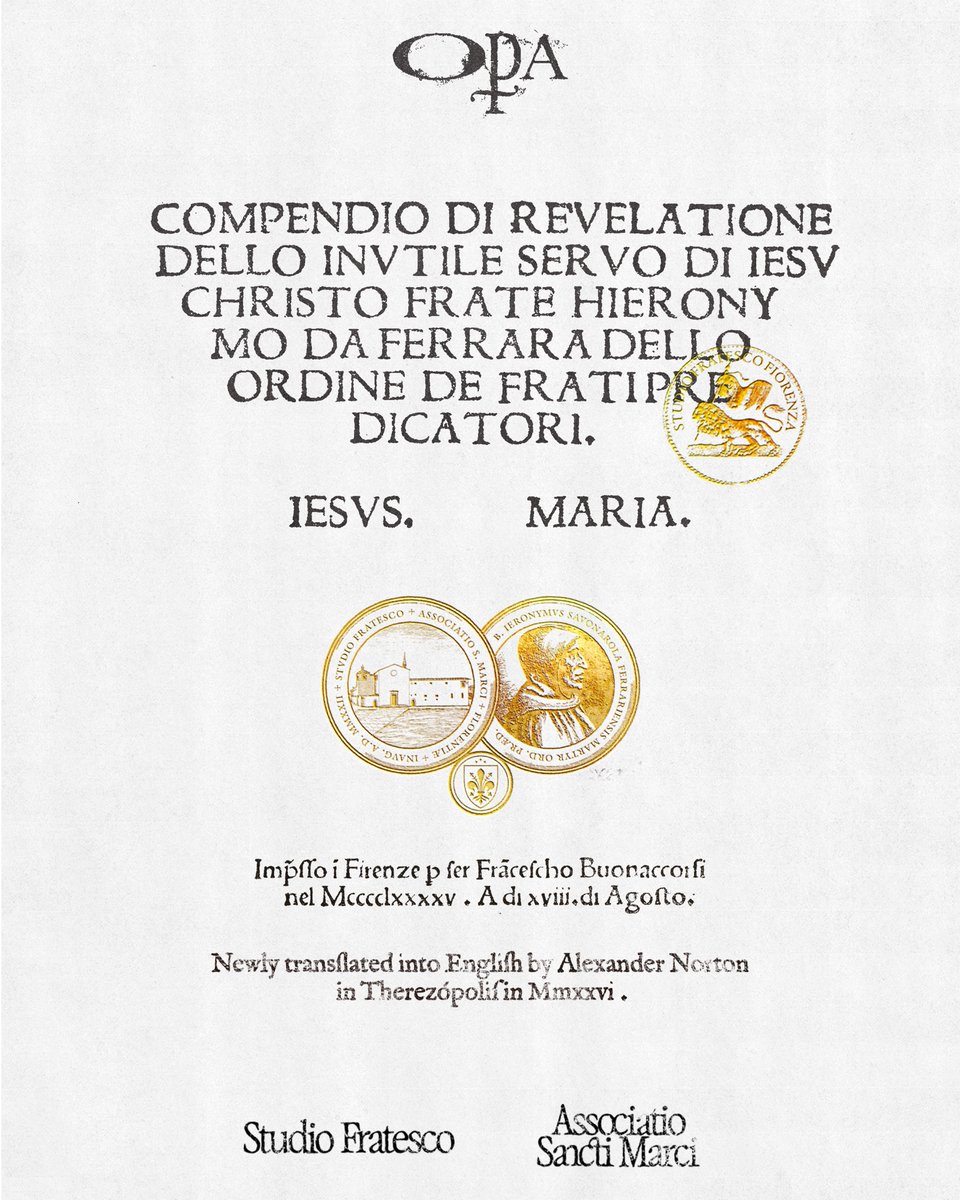
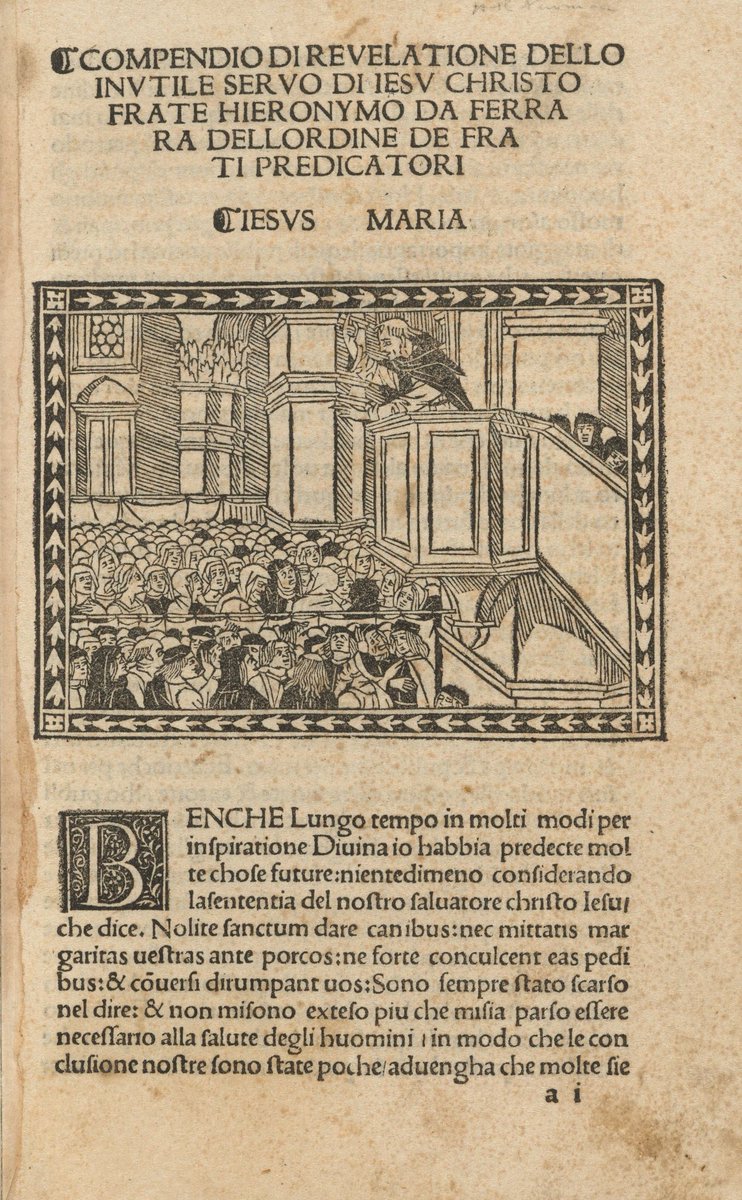
After many delays, I have finally finished translating and editing Girolamo Savonarola's Compendium of Revelations (1496).
Before it goes to print, I'm also considering publishing it digitally in its entirety together with the launch of the Savonarola Project's new website: https://t.co/XyhLtMdu78 (coming soon).
"The works of God proceed slowly and with great opposition." —Fra Girolamo Savonarola (Letter to the brethren of San Marco, 1493)
MAY I LOVE YOU, LORD
A psalm by Girolamo Savonarola
First published in 1495
May I love you, Lord, my courage.
May I love you, Lord, my soul's strength.
May I always love you, my inexpressible joy.
May my whole life be lived not for me but for you:
That life which had perished in my great misery,
That life which was lifted up in your great mercy.
For, had you not helped me, my soul could hardly
have helped dwelling in hell.
You lifted me up from the gates of death that I might
proclaim your praises.
Thanks be to you, my God, because you freed me.
Thanks be to you, my light, because you enlightened me.
Thanks be to you, love of my heart, because you wounded me.
Late have I feared you, O infinite majesty.
Late have I known you, O beauty so ancient.
Late have I loved you, O goodness eternal.
I searched for you, my rest, and did not find you:
I found you not, because I searched the wrong way.
I sought you in outward things, and you dwelt within.
I wandered the lanes and paths, and I did not find rest.
I sought without what was within me.
I thought you were afar off, and you were close and within.
I was far from you, and you were close to me.
You spoke to me, and my heart heard:
"Seek within, and you will find your good."
But in my misery I sought my God without.
I asked the earth if it was my God.
I asked, I say, and it answered me:
"Seek higher than me; I am not your God."
I asked the sea, and it answered me:
"Thales is wrong: I am not your God."
I asked the air, and it answered me:
"Get yourself wings; I am not your God."
I asked the heavens, the sun, the moon, and the stars,
and they answered me:
"Mount up beyond us; we are not your God."
I asked the angels, and they answered me:
"Go deep into your heart; we are not your God."
I asked all the creatures, and they answered me;
They answered me, I say, with a voice great and strong:
"He who made us from nothing, he is your God."
"Where is my God? answer me.
Where should I seek him? teach me, I beg you."
"Your God is everywhere; seek him in your heart.
He fills heaven and earth; he fills your heart too."
Turning to my heart, I say to my God:
"How did you get in here, Lord my God?
By what door did you enter, my sweet love?"
I questioned my eyes, and they answered me:
"If he did not possess color, he did not come in through us."
I awakened my ears, and they answered me:
"If he made no sound, he did not enter through us. "
I checked with my nostrils, and they answered me:
"If he does not have a smell, he did not enter through us."
I checked with my taste, and it answered me:
"If he does not have a flavor, he did not enter through me."
I put my sense of touch under oath, and it answered me:
"If he is without a body, he did not enter through me."
For you were within, but my senses did not know it.
You entered into my soul, but you did not enter through
bodily senses.
Your light shines where place does not catch it.
Your voice sounds where time does not snatch it.
Your scent is there where no breeze stirs.
Your flavor is there where there is no tasting.
Your embrace is felt where there is no separation.
What are you then, my God? What are you, my love?
I asked him, and he answered me:
"Go down into your human heart, and God shall be exalted."
You are truly a great God, surpassing our knowledge.
You alone are mighty and truly happy.
You are king of kings and lord of lords.
You alone have immortality and unapproachable light,
Which no human sees or can see.
We say much about you, but words fail us:
For you are greater than any heart and all praise.
You are the one God rejoicing in your Trinity:
God the Father, God the Son, God the Holy Spirit,
Three persons but not three essences,
One God and Lord, not three gods and lords.
This is my God, who has no need for my goods,
Who created this whole universe because of his goodness.
He lacks for nothing, and he carries and governs all things;
And he emptied himself for us humans:
He took on human nature and was crucified for us.
He rose from the dead and ascended above all the heavens
To prepare for us the place of immortality.
From there he will come to judge the living and the dead.
His kingdom will have no end, and we shall reign with him for ever and ever:
For where my flesh reigns, there I believe that I reign.
If he did not spare his own Son for us,
We believe that he has given us all things along with him.
O unimaginable love of charity:
You handed over your Son to redeem your servant.
Greatly have you loved me, my only love.
You loved me before I loved you.
You created me in your own image;
You put me in charge of all your creatures:
For me you made your angels spirits
And commanded them to watch over me
Lest I dash my foot against a stone.
You did not create me among unbelievers:
You baptized me in water and the Spirit.
You did not give me riches and poverty:
You taught me understanding and wisdom.
When I wandered astray, you kept calling me.
You kept knocking at the door, and I did not open it for you:
I relied on my own strength, but it was not strength.
I kept trying to run and kept fainting;
I fell the most where I believed I could stand best.
I became refuse like a broken jug.
Alienated, I fled to a distant land.
I loved vanity and became vain.
I was blind and I loved my blindness.
I was a slave and I liked my slavery.
I was bound fast, but did not detest my bondage.
I thought that bitter was sweet and sweet bitter.
I was wretched but knew it not.
I sinned, and you visited me.
I fell, and you lifted me up.
I was ignorant, and you taught me.
I did not see, and you gave me light.
I wallowed in sin: I had been sold into it.
You came to me to buy me back.
You loved me so much that you gave your own blood
to purchase me.
You love me more than yourself, for you wanted to die for me.
In such a way you led me back from exile, at so great a price.
You redeemed me from punishment.
You called me by your own name,
You marked me with your own blood,
So that your memory would stay with me
And that the one who for me did not leave the cross would never leave my heart.
May I know you, who know me.
May I know you, strength of my soul.
Show yourself to me, my consoler.
May I see you, light of my eyes.
Come to me, joy of my spirit.
May I see you, joy of my heart.
All who know you love you.
They forget self and love you more than self.
They leave self to come to you.
Drive away, Lord, the darkness of my mind
So that my memory may rejoice in recalling you,
My eye may find joy in seeing you,
My soul may burn with love for you.
It is good for me to cling to my God,
To put all my hope in my Savior.
When I do not cling to you, I pour out my heart
on passing things;
My thought reels, my tongue trips.
I am miserable, I say, miserable!
When will I cling to you alone so that I sin not against you?
When can my twistedness be squared up with your
straightness?
You, Lord, love desert spaces; I love crowded places.
You love quiet, I love racket.
You love verity, I love vanity.
You love cleanness, I love meanness.
Therefore I beg you, Lord, because of your own goodness:
Give light to my eyes; wound my heart with your love.
Steady my stride along your paths
So that my steps do not stray.
Free the captive, gather the scattered,
Sew up the torn, lift up the fallen.
Give me a heart that ponders you;
Give me a mind that dwells on you.
Give me an intellect that understands you.
Give me reasoning that easily clings to you.
Give me a soul that loves you.
Give me a will that never parts from you.
Be near to my heart, near to my words.
Be near to my work, near to help.
Be near to me, for I am faint with love.
Be near to me, because without you I die.
Be near to me, because I am uplifted by the thought of you.
Your scent refreshes me;
Your memory heals me;
Your pleasant light renews my life;
Your gentle voice gives me delight.
Then will I be satisfied when your glory appears.
To you my heart speaks; to you, I say, my soul speaks:
"I have searched for your face; your face, Lord, shall I seek.
Turn not your face away from me,
Nor pass by your servant in wrath.
Be my helper, do not desert me,
Do not despise me, God my savior."
My father and my mother have gone on without me,
But God in his mercy has adopted me.
Set your law before me on your path,
Direct me along the right road, because of my enemies.
Hand me not over to the designs of my tormentors;
For wicked witnesses have arisen against me,
And iniquity has lied to itself.
I believe that I shall see the good things of the Lord
in the land of the living.
Hence shall I sing to the Lord during my life;
I will chant psalms to my God as long as I live.
May my words be pleasant to him;
I, indeed, will be glad in the Lord. Amen.
——————————
Translated by John Patrick Donnelly SJ
Review for Religious, Vol. 52, No. 2 (March/April 1993): 241-46.
"Almighty God, who gives speech to the mute and makes the mouths of little children eloquent, poured such grace upon the lips of the Servant of God that, after dinner and supper, the friars could never satiate themselves with the immense sweetness of the Sacred Scriptures, which flowed from the mouth of the Servant of God in such a way that of him one could sing those words from the Canticle of Canticles: 'Thy lips, my spouse, are as a dropping honeycomb, honey and milk are under thy tongue.'
As his fame and reputation began to spread throughout the city, it quickly reached every corner and the citizens began to come in great crowds to hear the Word of God proceeding from his holy lips. [...] Then he began to expound the Apocalypse, [first in the cloister and then] in the church of San Marco, and so great was the multitude that came to hear him that there was no room left in the church even for the friars. Because of their eagerness to hear him, the friars had to stand upon the wall of the choir. Nor could any friars be found willing to perform the communal duties, such as attending the door, serving in the sacristy, and similar offices, so great was their desire to hear the marvelous things that issued from the mouth of the prophet. The laypeople likewise remained standing because of the crowds, some even clinging to iron grilles, suspended above the ground, in order to hear him more clearly."
Ps.-Burlamacchi, Life of Fra Girolamo Savonarola, pp. 22–23
O Lord, where have You brought me? I say with Jeremiah: "Lord, You have deceived me, and I find myself deceived. You were stronger than I" [...] (Jer. 20:7). In wishing to catch these fish of Yours [...] I now find myself upon this deep sea and can no longer see any harbor to which I might return for my rest. "Woe is me, my mother! Why did you bear me, a man of strife and contention throughout the whole earth?" (Jer. 15:10).
Everywhere I see war and discord coming upon me. Miseremini mei saltem vos [Have pity on me], at least you, my friends. At least you, my friends, O elect of God, for whom I labor day and night, have mercy upon me [...] Do what is good; I ask nothing else of you except that you please God and save your souls [...] See where our ship now finds herself; as yet it cannot be seen where the Lord intends to lead her.
That night I disputed with Him [...] As I was being urged to go forward, I said: Ah, Lord, bring me back to my harbor and to my peace. And He answered: It is not possible to turn back. [...]
Then I said: Since You will not permit it, Lord, You are indeed just; but tell me if I may reason with You a little, though I am but dust and ashes. [...] Tell me, if I must indeed go out upon this sea of the world fishing for You, why here rather than elsewhere? What have I to do with Florence? As You know, I was born and raised in Ferrara, not in Florence.
The Lord answered and said: Do you not remember having read of the man who was going down from Jerusalem to Jericho, who was attacked and wounded by robbers on the road? Men of his own country passed by, yet none of them cared for him, but only the Samaritan. [...] Do you not also know that it is written, "No prophet is accepted in his own country"? [...]
I answered [...]: Lord, I am content to preach ordinarily against vice and for the increase of virtue, here in Florence or wherever it pleases You. But what have I to do with preaching about the government of Florence?
Then the Lord said: Veni mecum [Come with Me]. And I went, and He led me into various workshops: first that of a painter, then of a sculptor, and finally that of a goldsmith, to ask for a work that required both sculpture and painting. Only the goldsmith declared himself capable of both painting and carving [...].
Thus must it be with you, the Lord said to me. The preaching to which you are devoted is a spiritual work. Yet it is also necessary, while attending chiefly to the spirit, to shape all those things that preserve and sustain the spirit, together with the means by which the spirit is governed. Thus you must act with Florence, if you wish her to be good: give her a government that will preserve her goodness, if she herself wills to be good. Then I answered the Lord and said: I am not a suitable instrument for this task. Lord, I would wish that it might please You to choose another who is more capable and better than I. He replied: Do you not know that God chooses the weak things of this world to confound the strong? [...] He does not wish the praise to be attributed to the instrument, but to God. You shall be only the instrument, and I shall be the master builder who constructs the edifice. [...]
Then I, being convinced, said: Lord, behold, I am ready to do Your will. But I would like to know, if it pleases You, what reward shall be obtained for this in the next life? The Lord answered: [...] The reward is eternal life.
And I added: And what shall follow in this world? And the Lord said: The servant is not greater than his Master. You have surely read that after My preaching to the Jewish people, they crucified Me. So shall it happen to you, and not otherwise. Then I said: O Lord, da mihi hoc martyrium [grant me this martyrdom]; grant that I may die for You, as You died for me. The Lord replied: Wait a little while, until those things that must be done have been accomplished; then make use of the fortitude that God will grant you.
(G. Savonarola, Prediche sopra Aggeo, a cura di L. Firpo, Roma 1965, pp. 324-330)