Benchmarking SPHINCS-like signatures: hardware wallets and MPC
Excited to share our latest article, in which we benchmark different parameter sets for SPHINCS-like constructions, such as our own SPHINCS-G.
https://t.co/otV3h4DHlZ
Very grateful for the opportunity to present at Devcon. Ethereum's PQ migration is an exciting challenge and I look forward to continuing our work and contributions alongside the entire @projecteleven team.
After a decade of love for Ethereum, I admit speaking at @EFDevcon has been a dream come true. Today I shared the stage with @alebaiocchi23 to deliver a workshop on leanSPHINCS and PQ signatures for devs. It’s been an amazing experience and I feel excited for Ethereum’s future.
I'm beyond excited for the opportunity to be a speaker at Ethereum's largest event!
Alongside @alebaiocchi23 I will run a workshop on leanSPHINCS and the PQ future the network is heading on.
In my new capacity as Research Lead, Blockchain @projecteleven (following Riva's acquisition) this talk and topic are extremely important to me and a big portion of my time is currently invested trying to move the frontier forward. I can't wait to release our upcoming results, such as SPHINCS-G, and to discuss these developments with the devs community.
See you in Mumbai 🔜
While developing CUTS, we have spent a significant amount of time working out which criteria are the right ones for evaluating schemes of this kind.
Some metrics are obvious, particularly when digital assets are the intended use case. Signature size, signing cost measured in hash evaluations and security level in bits are where any comparison starts. But comparing those metrics one by one can obscure important differences in how a scheme actually behaves.
One less obvious angle of analysis is the distribution of security across reused keys, and in particular its weak tail. Concretely, take a scheme in which each key is designed to sign safely twice, and assume that key has already produced both signatures. How does the security left to that key depend on which two signatures it happened to produce, and how often does it fall well below the published figure? The figure published for a scheme is often an average over all possible pairs of signatures, but each pair overlaps in a different way, exposing different amounts of information to a forger, and some pairs expose far more than others.
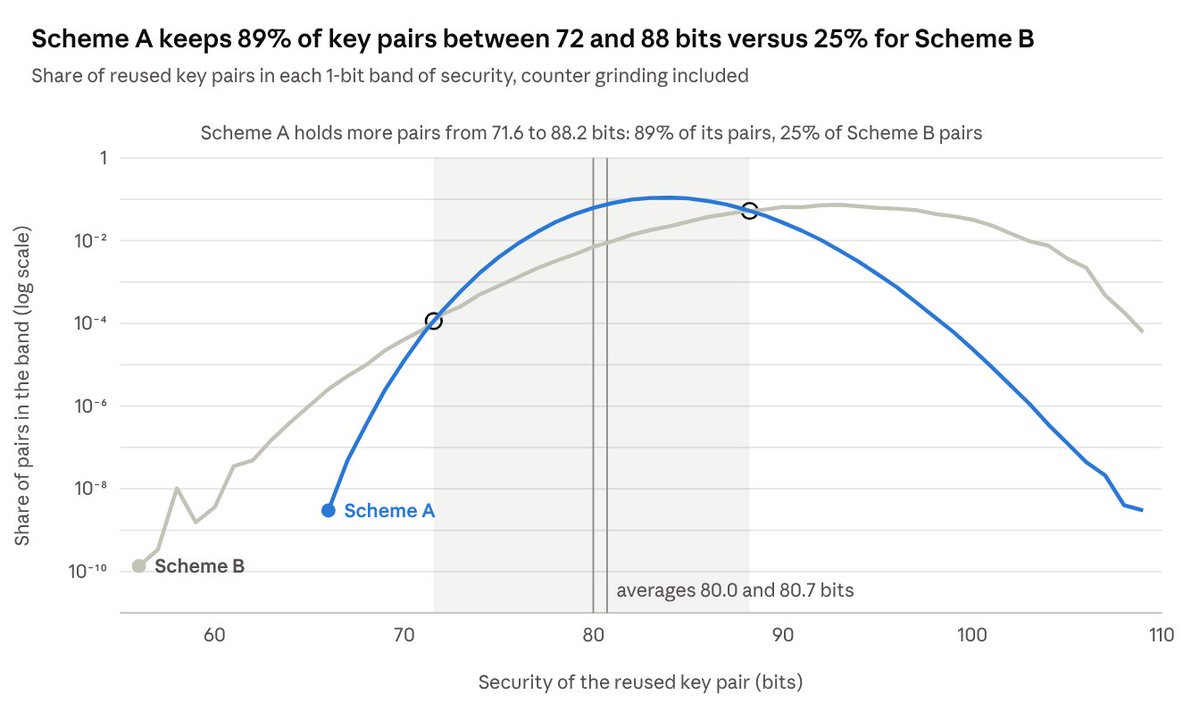
The chart below shows that schemes sharing most of their building blocks can still differ significantly in how far below the average their weakest keys fall. It plots two few-time schemes, A and B, at parameter sets that give both practically the same average security after two signatures. Close to the average, A has more weak keys than B. Further into the weak tail, the curves cross and the order reverses: Scheme B features rare keys whose security falls far below the average, while Scheme A has considerably less in this region.
For a given user, the probability of suffering a potentially catastrophic forgery depends on the computation an attacker can spend against that key and on the security the key retains after its two signatures. Looking only at the average therefore makes the two schemes appear similarly secure for a randomly selected reused key. The picture changes once many reused keys are visible, because anyone can compute a key's remaining security from its two public signatures and an attacker will go after the weakest key first. The more reused keys there are onchain, the more likely it is that one shows up deeper in the weak tail.
The two schemes in the chart use comparable parameter sets and still end up with noticeably different results. A difference of this kind in the security profile can carry significant weight in design decisions, since users of a system or network, given the choice, are likely to accept slightly more expensive signatures in exchange for lower exposure to catastrophic failure, especially when those signatures protect digital value.
Much of our work on CUTS and related schemes goes into understanding tradeoffs like this across the broader few-time signature design space. Signature size, computational cost, and headline security levels are useful metrics, but none tells the whole story on its own. The details of how security behaves in practice can matter just as much when evaluating a scheme for real-world deployment.
The CUTS paper, with the full specification and security proofs, will be published soon.
@projecteleven has acquired @riva_labs . And, it's impossible for me to be more excited about the prospect of working with @matteovena, @matteVicari & team, and integrating their top-notch cryptography research into our post-quantum security infrastructure for digital assets. 🧵
Project Eleven Acquires Riva Labs to Expand Post-Quantum Research and Engineering
Riva Labs joins Project Eleven as the company brings more specialized post-quantum talent and technology under one roof.
Project Eleven, the company building post-quantum security infrastructure for digital assets, today announced its acquisition of @riva_labs, expanding its expertise in post-quantum signatures, wallets, MPC, and account abstraction. The acquisition also brings technology and intellectual property developed through Riva's work across Ethereum and other public blockchains, adding to Project Eleven's capabilities in post-quantum cryptography and blockchain infrastructure.
Riva Labs has built a reputation for translating post-quantum cryptographic research into practical blockchain systems. Its work spans hash-based post-quantum signatures, post-quantum MPC, account abstraction, wallet infrastructure, and hardware signing, including recent demonstrations of post-quantum signing on consumer hardware.
The addition of Riva expands Project Eleven's research and engineering bench as the digital asset industry prepares for the complexity of post-quantum migration. Rather than treating signatures, wallets, key management, and protocol infrastructure as separate problems, Project Eleven is bringing together expertise across each layer required to make that transition practical.
That work is becoming more urgent as AI accelerates cryptographic research and cryptanalysis, allowing new techniques to be developed, tested, and challenged at greater speed. Riva has made AI a core part of its research and engineering process, bringing that capability into Project Eleven's work across post-quantum cryptography and crypto agility.
"Riva Labs is exactly the kind of talent we want at Project Eleven: deeply technical and focused on turning cryptographic research into systems that can actually be deployed," said @apruden08, CEO and Co-Founder of Project Eleven. "Bringing Riva into Project Eleven strengthens an already exceptional research and engineering team, adds valuable technology, and accelerates our ability to lead the transition to post-quantum security across digital assets."
"Project Eleven and Riva Labs came at this problem from different directions and reached many of the same conclusions about what the industry needs," said @matteovena, Co-Founder of Riva Labs. "Upgrading the public networks the future will run on, without compromising the properties that make them valuable in the first place, is a monumental challenge. Our focus is on giving the industry the tools to accelerate that transition, and joining Project Eleven lets us do it at a much larger scale."
The Riva team and technology will become part of Project Eleven's broader research and product efforts across post-quantum cryptography, digital asset custody, and blockchain security. The acquisition deepens Project Eleven's technical capabilities as it builds the infrastructure required for a secure post-quantum transition.
This is our SPHINCS variant (SPHINCS-G) signing on a Ledger Nano S Plus in ~1.5 seconds. 2^24 signatures, 32-byte pubkey. All coming from our hash-based MPC work. We are overwhelmed by the support of legends within the Ethereum ecosystem and will share more soon!
How many signatures will your account ever make? SLH-DSA's defaults plan for 2^64, and every transaction pays for it. Our latest article by @alebaiocchi23 picks SPHINCS+ parameters for realistic budgets: three profiles, from gas saver to fast signing.
https://t.co/E9gJzsqMHZ
Our latest research article is a deep (very, very deep) dive into the design space for post-quantum Ethereum transaction signatures.
A lot of work is being done behind the scenes and we think making it understandable by others it's as important as doing it in the first place.
Working out some optimizations to FORS signing on constrained devices for our infra @riva_labs.
This is a simple idea that improves UX without impacting security.
How to optimize FORS signing through key caching.
Post-quantum wallets have to stay responsive across every setup, including older devices. Ahead-of-time caching helps keep signing fast by preparing the next key before the user needs it.
Writeup: https://t.co/5iQAFRIRoe
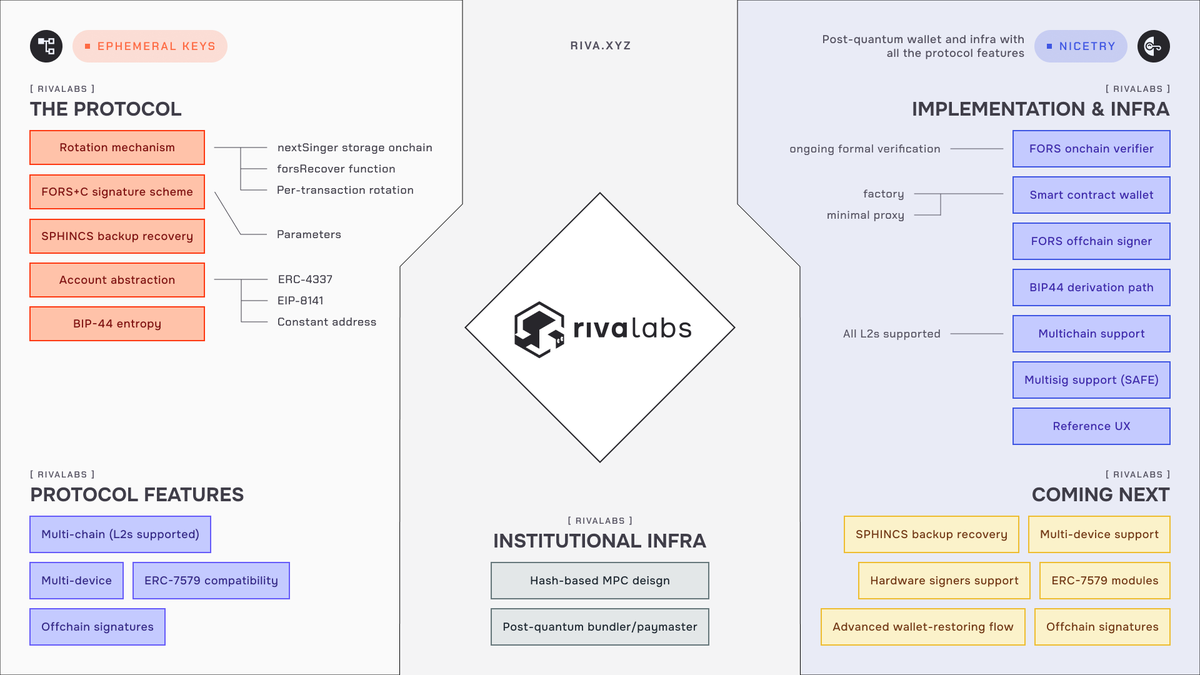
Over the past 3 months, we’ve worked hard to make the Ephemeral Keys Protocol a solid solution for @ethereum’s post-quantum transition.
We now have the protocol, the reference implementation, and a set of WIP solutions for institutions. Reach out if you're planning a pilot.
1/ What happens to bundlers and paymasters in a post-quantum world?
New Riva research analyzes the role of bundlers and paymasters under both 4337 and frame transactions, and introduces "the PQ-anchored middleware" as a possible answer.
Continuing the work at @riva_labs on Ephemeral Keys, we updated NiceTry with FORS and Frame Transactions compatibility. Here the latest updates: https://t.co/IqLX9HkWRy
NiceTry - Quantum-Safe Ethereum Wallet
A quick overview of our wallet implementing the Ephemeral Keys Protocol with FORS signatures: swapping on @CoWSwap, staking on @LidoFinance and showcasing the (very reasonable) gas consumption.
We're pushing the NiceTry quantum-safe ephemeral keys design forward on every front.
PQ signatures, core logic improvements, new demo experiments from community proposals.
EthCC + Fort Mode were a turning point and the feedback and support from the Ethereum community were something else.
We are urrently focused on:
→ Adding PQ signature support
→ Refining the core rotation logic
→ Building out demos and integrations that came from community input
Updates are coming to docs and demos at @nicetry_xyz, and we'll share progress here too.
Huge thanks to @asanso for coordinating the PQ efforts, running the PQ Transaction Signatures call series, and constant feedback. And to @drakefjustin for the ideas, tips, and putting the solution in front of the community. Plus everyone else who contributed.
Shoutout to the @ethrex_client team for helping us test the initial frame transactions-based design, and to @GiulioRebuffo for building an independent implementation of our design.
More soon!