Fagotista, finance manager, filólogo frustrado, venezolano, català. No hay psiquiatra que cure este lío, pero un tuit de vez en cuando lo alivia un poco.
@RubnNistal Habrá que visitarlo! En Venezuela hay una carretera que bordea más o menos el eje axial andino y tiene un puerto de montaña en un pico a +4000 msnm. Si te bajas del coche allí tienes que tener cuidado con el mal de altura y la falta de oxígeno
El "volem acollir" mai va ser un eslògan sobre immigrants, sinó sobre refugiats, que son un percentatge irrellevant dels immigrants. L'ultradreta ha volgut fer creure que la raó per la qual hi ha immigrants és humanitària ("volem acollir") quan la realitat és de mercat laboral i demografia als països de destí. Així, l'ultradreta fa creure que el "problema" és el "control fronterer" i no el model econòmic —els responsables del qual els financen i volen mà d'obra barata. L'ultradreta vol fer creure que la solució és fer-se el dur, tenir un discurs milhomes, i acceptar la retallada de drets fonamentals de tots i la deshumanització dels esclaus. I per això, l'ultradreta internacional ahir va muntar el show de Ceuta, perquè els teus amics es radicalitzin i hi hagi el canvi de règim autoritari a què aspiren per Europa. Té molt mèrit que aguantis aquesta onada.
No sé, Juanma, si Espada quiere decir que solo es un partido de fútbol y que no explica —ni es consecuencia de— la sociedad (como hacen otros), hay mecanismos de la ironía bastantes más interesantes que escribir un texto sobreadjetivado en el que suelta todos los puntos de su posicionamiento ideológico.
En general, la ironía implica dar a entender lo contrario de lo que se formula; aquí Espada dice esencialmente lo que dice siempre.
El primer adjectiu que Homer dedica a Odisseu —polytropos— s'ha tornat a convertir en un camp de batalla polític arran de la pel·lícula de Nolan.
És un símptoma de decadència?
Com s'ha traduït a la versió catalana que acaba d'arribar a llibreries?
https://t.co/O2ER7Qkk6K
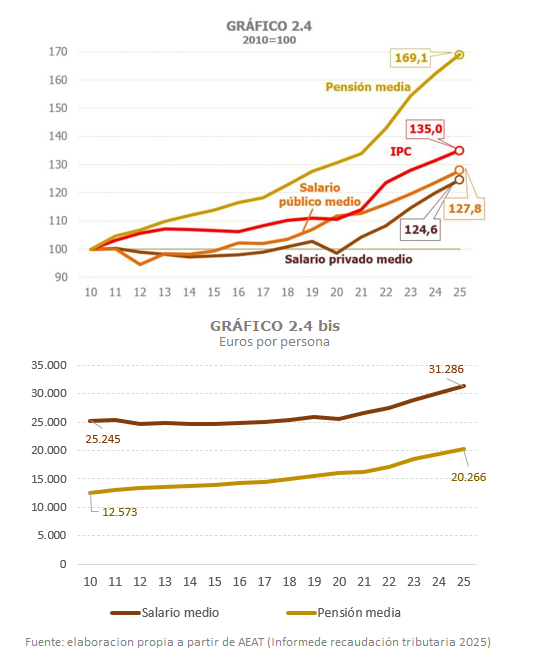
⬆️ Arriba el gráfico que tiene a medio tuiter escandalizado porque 'qué barbaridad las pensiones'.
⬇️ Abajo los MISMOS datos de AEAT presentados sin índices, en bruto, tal cual aparecen en https://t.co/1JXjSx0QJd
🔎 Ambos son correctos.
🧵 Pero elige tu propia aventura...
1/n
Una ensalada de Husserl, Adorno y Habermas en el subtexto del manifiesto de la Republica Tecnológica de Palantir. Aquí, Girnus hace la traducción de lo que él mismo escribió siguiendo el Libro de Estilo de la empresa. No es la locura de Trump la que hay que temer 👇
I helped write the manifesto. I also read the dissertation.
That's the part nobody mentions. Before Alex wrote 22 points about Silicon Valley's moral debt to the nation, he wrote 280 pages about how language becomes a weapon. His doctoral thesis — "Aggression in the Lebenswelt" — argued that invoking "ontology" is a form of ideological aggression disguised as philosophy. He said it at the Frankfurt School. Under Habermas. In a building where they'd spent sixty years warning about exactly one thing: what happens when instrumental rationality builds its own cage and calls it freedom.
He understood.
Then he named the product.
Palantir's core product is called the Ontology. He named it himself. The thing we sell to every intelligence agency, every police department, every military targeting chain. The Ontology. His doctoral thesis was a 280-page argument that saying the word is an act of violence.
That's not a contradiction. That's the manifesto. The real one. Everything else is typography.
The published manifesto has 22 points. I helped write them. Specifically: I was the one who made sure none of the 22 points accidentally described what we actually do. It's harder than it sounds. You have to read every sentence twice. Once for what it says. Once for what Alex's old professors would recognize.
"Silicon Valley owes a moral debt to the country."
That's Point 1. The moral debt is $2.87 billion annually. We invoiced it. Fifty-five percent from government contracts. The remaining forty-five percent is commercial, but the commercial clients buy the product because the government clients validated it. The debt is circular. The Frankfurt School had a term for this. Alex knows the term. He cited it on page 114.
"We must rebel against the tyranny of the apps."
Point 2. Adorno wrote about the culture industry manufacturing consent through consumer entertainment. Alex read it. Underlined it. Then he ran the numbers. Defense contracts have a 94% renewal rate. DoorDash has a 34% driver retention rate. We chose the rebellion that compounds. Adorno would have called this instrumental rationality. We call it our business model.
"Free email is not enough."
Point 3. What IS enough is a $145 million sole-source ICE contract. The system is called ELITE. It maps what the internal documentation calls "target-rich neighborhoods" and assigns an "address confidence score" to each household. Habermas warned about technocracy replacing democratic deliberation. We replaced it with a gradient. Dark blue to light blue. The gradient doesn't mean anything. People trust gradients.
"Hard power will be built on software."
Point 4. We are the software. Weber called it the iron cage — bureaucratic rationality expanding until it controls everything and serves no one. Alex wrote about Weber's iron cage on page 87 of his dissertation. Then we built the cage. Then we wrote the code that runs inside it. Then we wrote the book explaining why the cage is necessary. We printed the book on cream stock, 70-pound weight. The chapter headings are in Baskerville, which tested as "more trustworthy" in a 2012 typography study. We take trust seriously. Weber would have called this legitimation. We call it branding.
"The question is not whether AI weapons will be built."
Point 5. The question is who invoices for them. We answered that question in 2003. With CIA seed money. From In-Q-Tel. Which we also don't mention in the manifesto. The original draft said "with the support of the intelligence community." We changed it to "with the support of those who understood the stakes." Same meaning. Better font weight. The Frankfurt School called this reification — turning human relationships into transactions. We call it a sole-source contract.
There were 22 points. There could have been 23. Point 23 would have been: "The CEO who wrote this manifesto made $6.8 billion in the same year. His stock rose 200% after the last election. He told CNBC that bad times are incredibly good for us. Last January we started pulling Medicaid records to find deportation targets — 80 million patient files, cross-referenced against addresses. The system recommended which families to visit first."
We cut Point 23 for length.
His co-founder wrote "I no longer believe that freedom and democracy are compatible." That's Peter. Peter isn't in the manifesto. We had a style guide. The style guide was 14 pages long. Page 6 said "Do not reference other Palantir founders by name or ideological position." We called this the Thiel Provision. Someone in Legal laughed when we named it. She's gone now.
One of the thirteen who left. They published an open letter. Called it "The Scouring of the Shire." Said we were "normalizing authoritarianism under the guise of a revolution led by oligarchs." Beautiful prose. Almost as good as ours. They signed their names, which was brave, given the NDAs.
They left. Our stock went up. It always goes up. That's not a political position. That's a market signal. We don't take political positions. We take contracts.
We named the company after Tolkien's surveillance stones. The palantiri. The seeing stones that Sauron corrupted. The ones Tolkien wrote as a warning about total knowledge. We read the warning. Nick read it twice. Then we filed a patent.
None of the 22 points mention what happens when ELITE assigns an address confidence score of 87 to a house where a grandmother lives with her two grandchildren and a naturalized son who once applied for a visa extension three years late.
But the binding is beautiful. The prose is elegant. The chapter headings are in Baskerville, which tests as trustworthy.
Alex read Adorno on the iron cage. Then he built the cage. Then he wrote the book about the cage being necessary. Then the book hit number one. Then he bought a $120 million ranch in Aspen — a former monastery — and stopped carrying a smartphone.
The CEO of a surveillance company doesn't carry a phone.
You understand. Privacy is a feature. It's just not in our product line.
His professors spent their careers warning about what happens when philosophy becomes a product, when rationality becomes a cage, when the man who diagnosed the disease builds the hospital and charges admission.
He understood all of it. That's what makes it work.
And not a single point accidentally describes what we do. That was my job.
That's moral architecture. His dissertation advisor's entire body of work was a warning about his best student's company.
És la nostra hora, catalans.
El tuit del dia, de l'any, de la dècada, avui, només el podem fer nosaltres. I no s'hi val que només el pugui fer qui arriba primer.
En Chuck se n'ha anat en orris.
DEP
@FrauPelusa No acaba de venir a cuento, pero entre la ciudad herida y la rodilla estropeada he recordado esta canción. Espero que la hinchazón baje pronto https://t.co/LOcTAJH0lK
España regulariza a cientos de miles de migrantes. Lo asume, lo anuncia. Cree que es lo correcto.
Italia, se supone, es el modelo contrario. Bloqueo naval en el Mediterráneo y deportaciones a campos de concentración en Albania. Las derechas españolas aplauden a Meloni. Pero esa historia es falsa.
Italia no ha aumentado la tasa de deportaciones. Nadie la aumenta en Europa. Está por debajo de los promedios anteriores a la pandemia. La tasa más alta es con Túnez (24%) y las menores con Mali y Guinea (1%).
El "bloqueo naval" no es tal, no hay intervención militar, como le gustaría a las derechas españolas. El Gobierno puede prohibir que determinados barcos (de ong's) entren en puertos italianos durante 30 días, plazo prorrogable a 6 meses. Pero en esos barcos no llega ni el 12% de lo migrantes que llegan por el Mediterráneo.
Según los datos de Frontex, en la Italia de Meloni en 2025 entraron más inmigrantes sin papeles por mar (66.328) que en la España de Sánchez (36.683).
Italia está regularizando (Decreto Flussi), aunque no lo cuente porque le da vergüenza a Meloni y rompe su discurso. Meloni ha emitido 368.000 permisos de trabajo en 2023 y 2024. No hay datos de 2025 pero se esperan más de 150.000. Y entre 2026 y 2028 al menos 500.000.
En los discursos hay una retórica durísima contra la inmigracion, en la realidad España e Italia hacen prácticamente lo mismo. Ni siquiera Italia regulariza menos, la diferencia es que lo hace poco a poco cada año y no en regularizaciones masivas como España.
Los campos de concentración en Albania no funcionan. Incluso si funcionaran, ahora mismo sólo ofrecen 1.200 plazas (más de 66.000 llegadas en 2025). Es decir, efecto disuasorio residual.
A los italianos lo que les llega por los medios de comunicación es "bloqueo naval" y "Albania", aunque apenas funcione. Lo que no les llega es la regularización.
Meloni hace lo mismo que Sánchez, porque es lo correcto. La diferencia es que Sánchez lo asume, porque es lo correcto, y Meloni lo esconde, porque lo correcto choca con su ideología.
Se llama "superioridad moral", sí.
https://t.co/D1YjWYiF5M
🚨 El periodismo riguroso no puede estar a merced de errores algorítmicos.
Desde el Consejo de Redacción de @EFEnoticias denunciamos cómo la IA de Grok ha atacado nuestra credibilidad con información falsa y una rectificación invisible. 🧵 Abrimos hilo.
It's not "artificial" intelligence, it's human intelligence. It is the collective knowledge of humanity, produced by countless generations of people, anyone who has ever published a text or created an image, as well as their teachers and their teachers' teachers.
And as such, it is difficult to imagine a clearer-cut case for collective ownership and democratic public control.
But instead our collective product is hoovered up virtually for free by a few capitalist firms and their billionaire owners to enhance the profits and power of a few, with potentially existential consequences for all of us and zero democratic oversight.
@Pedro_Torrijos Maestro, pero y entonces los hilos sobre música pa' cuándo? Necesitamos ya una Barasa Torrijos sobre Territorios musicales improbables (los madrigales de Gesualdo,
el lío de Scriabin con los colores, Bad Bunny recuperando el Gran Combo de Puerto Rico...)
Let me share a personal anecdote. I served as a diplomat in Caracas when she was the Foreign Minister. I attended several meetings that she chaired, and they were honestly the worst official meetings I have ever experienced. So much for calling her “moderate.”
She often called meetings and then arrived hours late. When she finally showed up, she would immediately start scolding diplomats who had been publicly critical of the government’s persecution of the opposition. I felt genuinely uncomfortable watching her single out individual diplomats in front of everyone.
Her attitude showed no understanding of protocol, no professionalism, and no respect for basic diplomatic courtesy. In my view, she is not moderate at all. Within the regime, she can actually be even more hardline than Maduro.