@NanoCriss@LatinXChem Hello @NanoCriss! We do not yet have the measurement of the surface charge, but it is planned to carry out this study to evaluate the colloidal stability of the nanoparticles.
@IanVioli@LatinXChem Hello!, through the SEM analysis, it is appreciated that most of the NPs are agglomerated, but in order to determine morphology and more precise size, this study will be completed with TEM.
@AldoZarbin@LatinXChem Hello. AgNp will be applied to determine the antibacterial capacity against different strains of Gram-positive and Gram-negative bacteria and thus determine the inhibition of their growth.
@NancyDavilaUANL Although, studies have shown that the use of plant extracts as reducing agents and stabilizers significantly reduces the environmental impact, since the reaction occurs in a short time and at room temperature.
Hello #LatinEnvChemPSE community! I am very happy to share my poster titled "Biogenic synthesis of silver nanoparticles using an agro-industrial effluent". #PSEMatEngAppl
@NancyDavilaUANL Hello, until now the environmental impact assessment has not been considered, but the study could be carried out to demonstrate that it is about green synthesis.
@NancyDavilaUANL Hello, thank you very much!
The application that will be given to AgNP will be to evaluate their antibacterial activity againts different strains of Gram Positive and Gram Negative bacteria.
@GabbyElvir10 And, the factors that determine the morphology of NPs are the synthesis conditions, such as pH, concentration of metallic salt, concentration of the agro-industrial effluent and reaction temperature.
@GabbyElvir10 Hello, thank you!. The agro-industrial effluent contains substances with antioxidant power, such as polyphenols and flavonoids, which are responsible for reducing metal ions for the formation and stabilization of NP.
@LapshinDmitry@IntAdsSoc Hello, the recovery of itaconic acid was in aqueous solution. The itaconic acid adsorption study was not carried out from simplified mixtures, up to now only adsorption with carbonaceous-based adsorbents has been carried out.
Hello, I am happy to share my work “Insights into the recovery of itaconic acid by adsorption: kinetics and equilibrium studies” at the 1st #IASTwitterPoster
Thank you to all community of @IntAdsSoc .
@DavidDanaci@IntAdsSoc Hi David, I did not have the opportunity to determine the surface area or the pore size distribution, but these studies have been considered for further complementary studies. And no other methods of chemical activation were used either. Thanks for your question.
@IsabelMoritz@IntAdsSoc Hi Isabel, the characterization was carried out by structural analysis using infrared spectroscopy (FTIR) and by X- ray diffraction (XRD) techniques.
Thank you :)
@DeischterJ@IntAdsSoc@IsabelMoritz The adsorption capacities obtained are associated with the modification with KOH, because it adds functional groups to the surface of the adsorbent, favoring adsorption. And the pH was evaluated from 3 to 6, and the highest adsorption capacity was obtained at pH 3.
Thank you :)
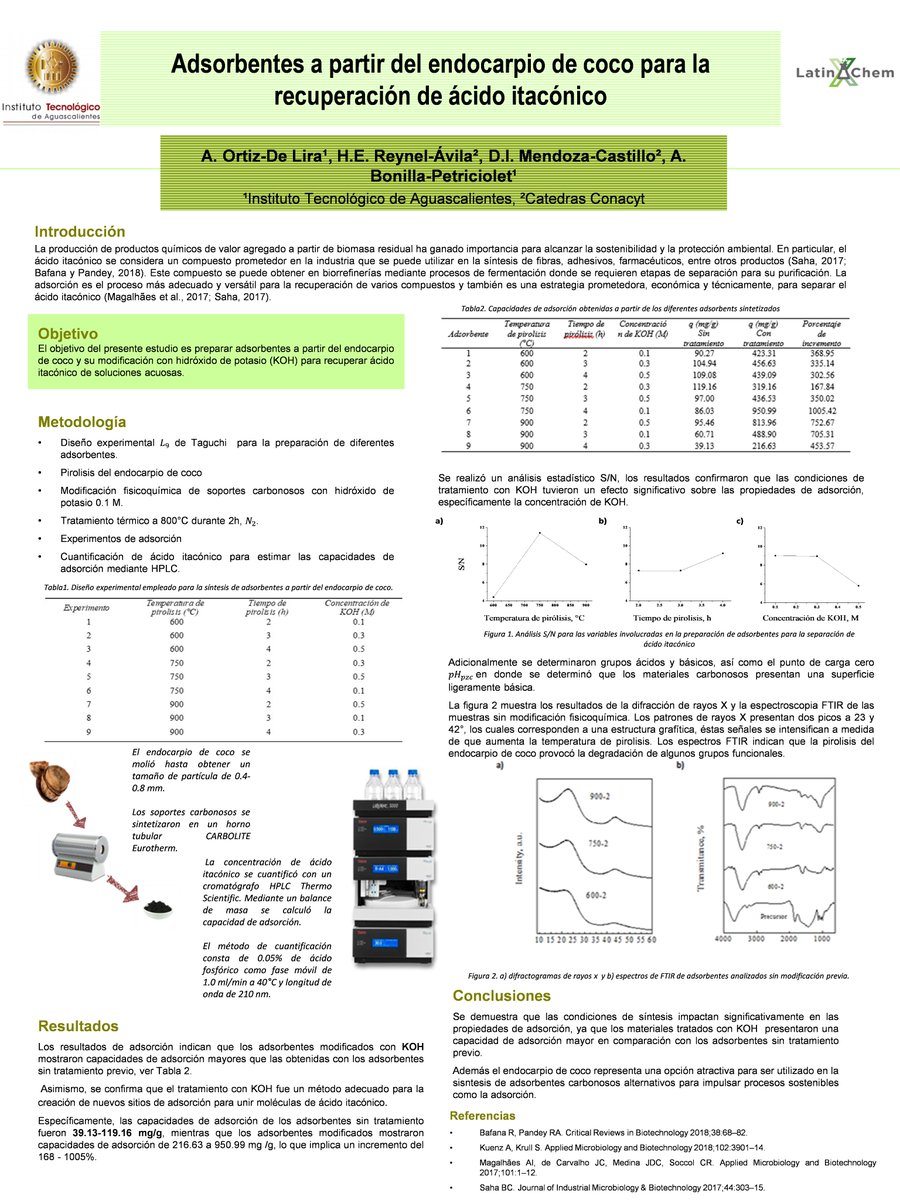
@sbriara@LatinXChem @TecNMcampusAgs Específicamente, los ácidos carboxílicos como el ácido itacónico reaccionan con la presencia de grupos básicos en la superficie del material carbonoso favoreciendo la adsorción, esto debido a que se ha informado en la literatura que el KOH es considerado una base fuerte.
Hola @LatinXChem, éste es mi trabajo "Adsorbentes a partir del endocarpio de coco para la recuperación de ácido itacónico", #LatinXChem#LatinXChemEnv#Env041
@TecNMcampusAgs
@sbriara@LatinXChem @TecNMcampusAgs Claro que sí, la literatura ha informado que el KOH mejora la formación de grupos funcionales en la superficie del material, los cuales juegan un papel importante en la capacidad de adsorción.