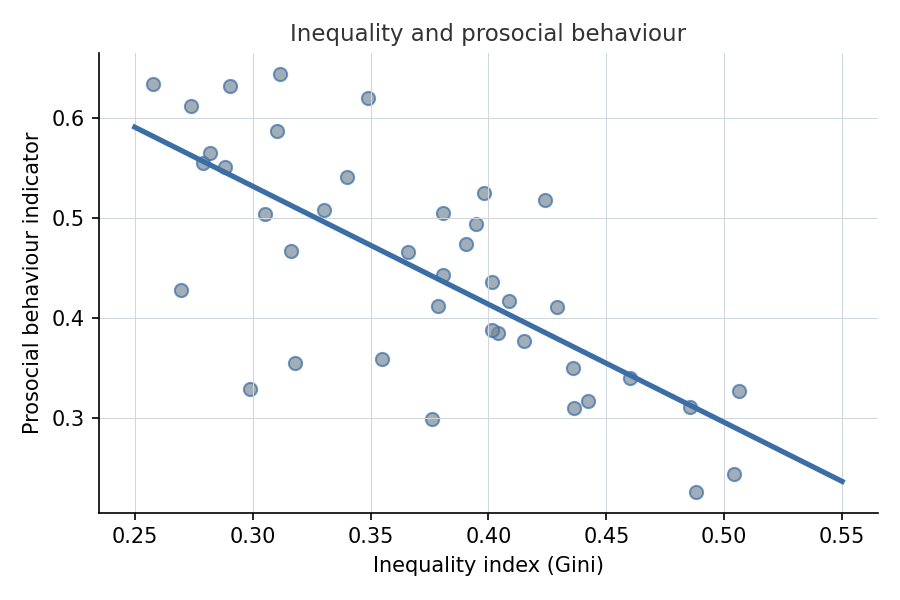
Does economic inequality reduce prosocial behaviour, or is it the other way around? Evidence points to bidirectional relationships, but identifying causality remains a central methodological challenge in welfare economics #subjectivewellbeing#ewaaco#prosocialeconomy#Inequality
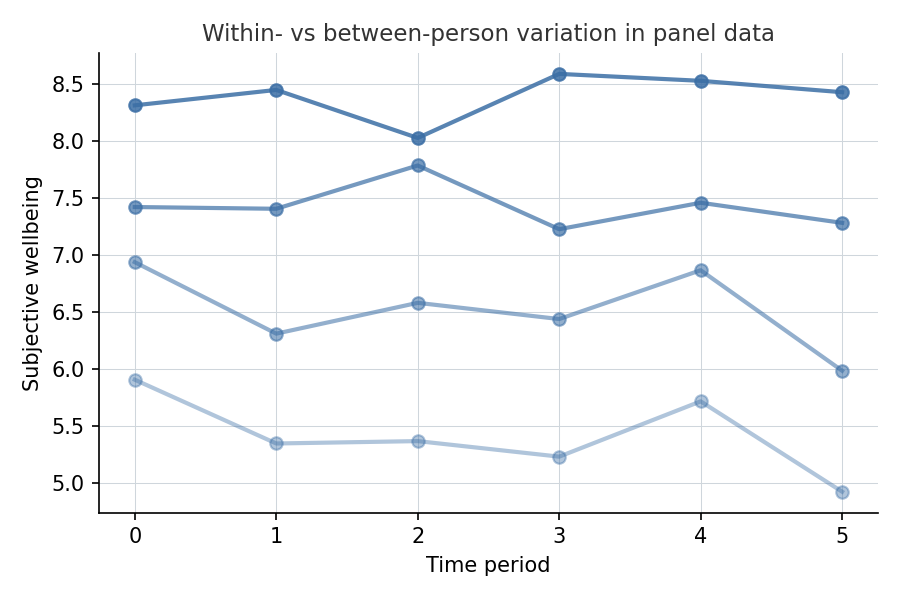
Working with panel data on subjective wellbeing: fixed-effects models isolate within-person change over time, but discard between-person variation that often matters most for policy. Worth asking which question you're really answering. #subjectivewellbeing#ewaaco#Econometrics
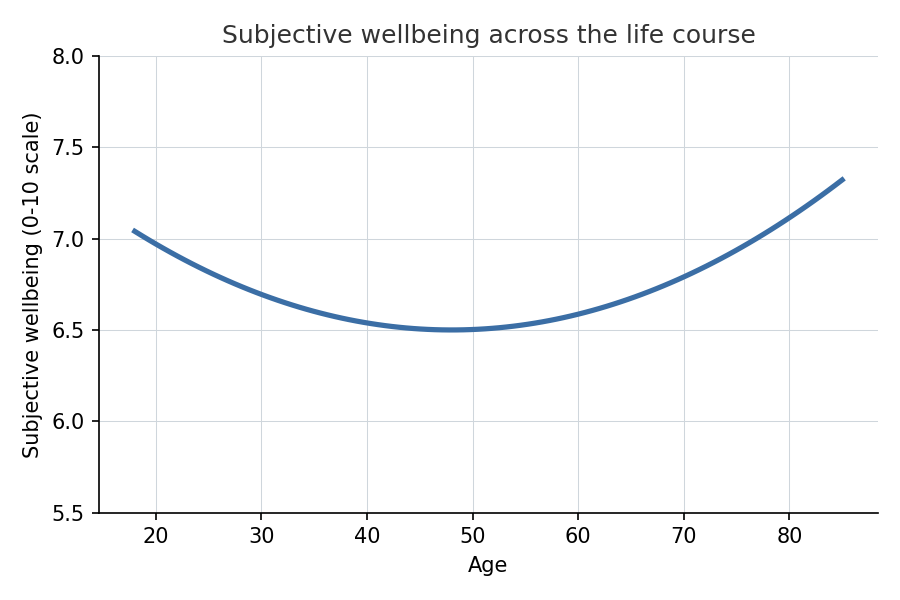
The U-shaped curve of wellbeing across age remains a robust pattern across countries: subjective wellbeing dips in midlife and recovers in older age. Why? Adaptation, shifting expectations and social comparison all offer clues. #subjectivewellbeing#ewaaco#Aging
El bienestar subjetivo suele dibujar una curva en U: cae en la mediana edad y sube en la vejez. ¿Refleja cambios reales en circunstancias, o ajuste de expectativas? Pregunta abierta sobre envejecimiento. #subjectivewellbeing#ewaaco#prosocialeconom
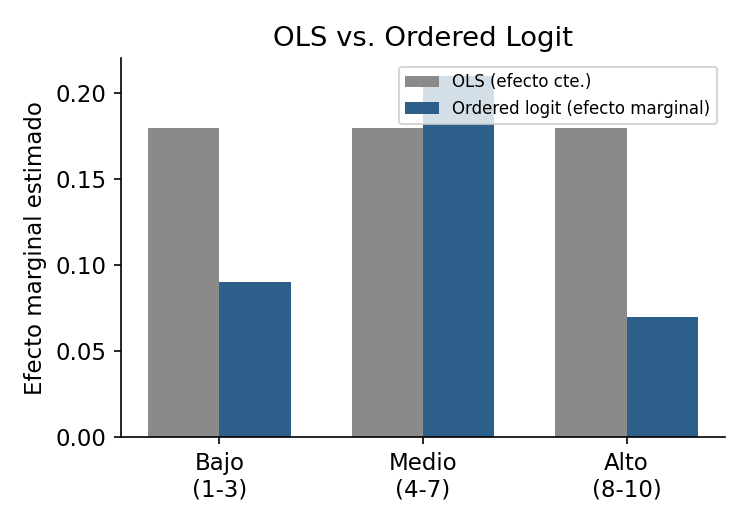
When modeling life satisfaction (1-10), OLS gives a constant marginal effect across the scale. Ordered logit lets it vary by category, often strongest in the middle range. Worth comparing both before reporting a single effect size. #Econometrics#subjectivewellbeing#ewaaco
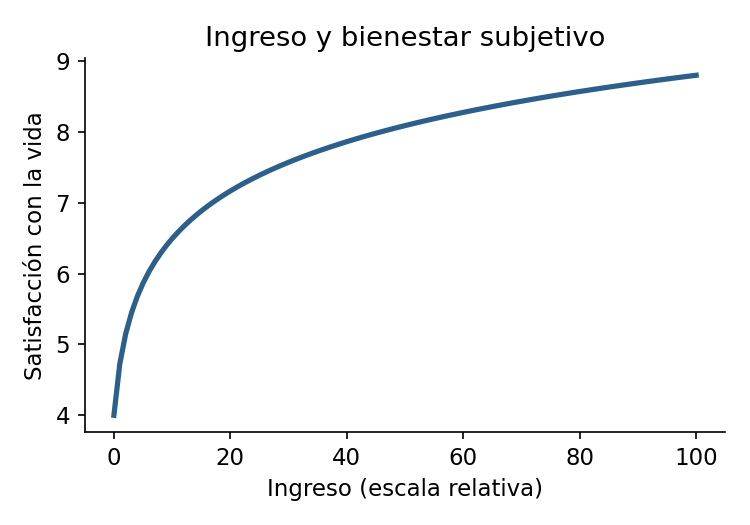
Al graficar satisfacción con la vida vs. ingreso, la curva se aplana: cada dólar adicional aporta menos bienestar. El dinero importa, pero su efecto marginal decrece — clave para diseñar políticas redistributivas. #SubjectiveWellbeing#Econ#ewaaco
“If science were explained to the average person in a way that is accessible and exciting, there would be no room for pseudoscience. But there is a kind of Gresham’s Law by which in popular culture the bad science drives out the good. And for this I think we have to blame, first, the scientific community ourselves for not doing a better job of popularizing science, and second, the media, which are in this respect almost uniformly dreadful. Every newspaper in America has a daily astrology column. How many have even a weekly astronomy column? And I believe it is also the fault of the educational system. We do not teach how to think. This is a very serious failure that may even, in a world rigged with 60,000 nuclear weapons, compromise the human future.
I maintain there is much more wonder in science than in pseudoscience. And in addition, to whatever measure this term has any meaning, science has the additional virtue, and it is not an inconsiderable one, of being true.”
- Carl Sagan, “The Burden Of Skepticism” Skeptical Inquirer, 1987
El problema no es solo el desempleo en Ecuador. El verdadero desafío es la informalidad, que sigue creciendo: millones trabajan sin derechos, sin estabilidad y fuera del sistema. #Economía#Informalidad#Desarrollo
https://t.co/5ZrbfcMaAZ
No stress! Según estos estudios, la curva en U de la felicidad comienza su ascenso a partir de los 47,2 años
#subjectivewellbeing
https://t.co/2j3LzDBsdq
We are in crisis — socially, economically, ecologically.
But naming it isn’t defeat.
It’s the beginning of change.
Every collapse hides a chance to rebuild.
Let’s not fear the truth. Let’s use it.
#HopeInCrisis#RethinkTheSystem#FutureStartsNow
✨✊🌱
https://t.co/JhAtZ28Q8c
Millions of people live in countries that spend more on debt service than health and @Pontifex has named debt resolution a top priority for the year. As I told @VaticanNews, if you spend more writing checks to creditors in the US or Europe, you have less to spend on education, health and development. You are taking food out of babies' mouths. Starts around 3:30: https://t.co/ithl2dsVrT
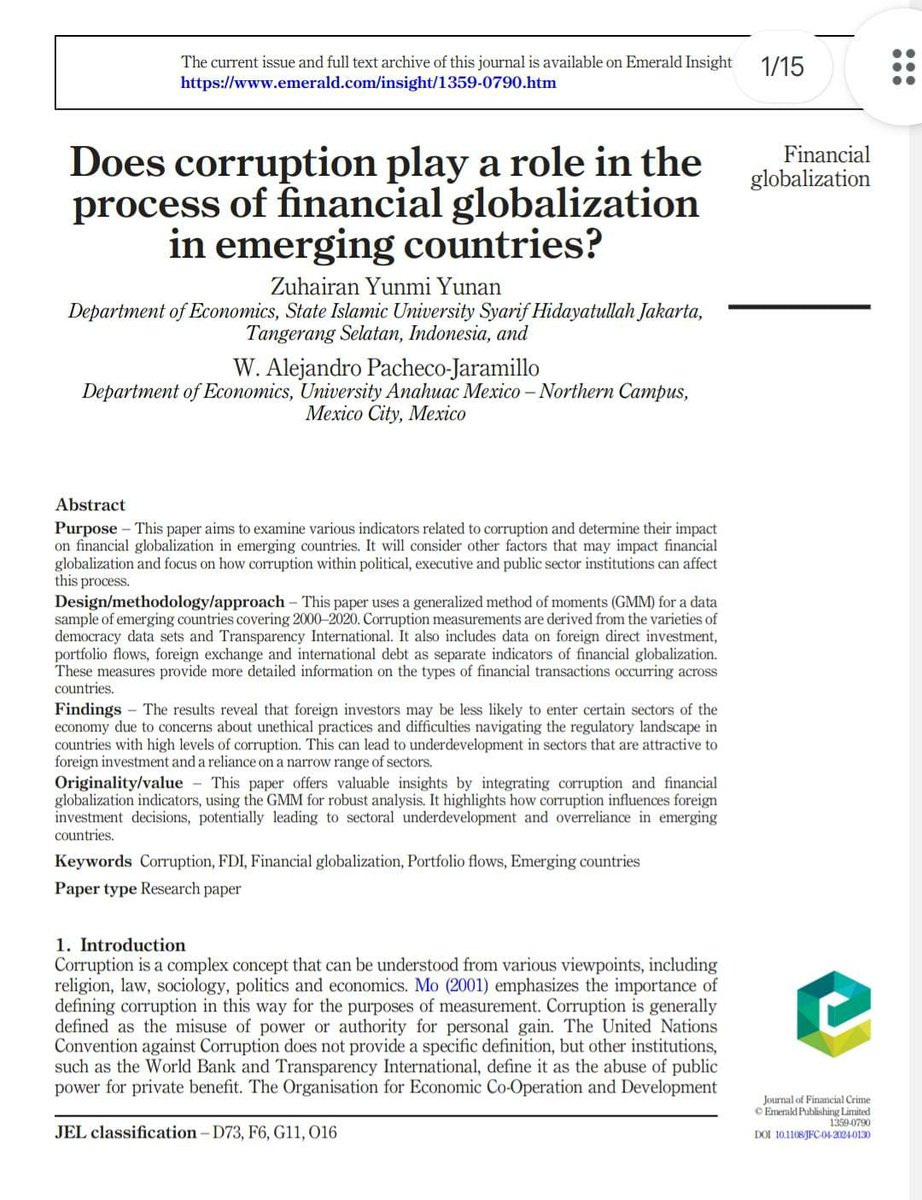
We are pleased to share a new publication as co-author: "Does Corruption Play a Role in the Process of Financial Globalization in Emerging Countries?"
Zuhairan Yunmi Yunan - W. Alejandro Pacheco-Jaramillo
Journal of Financial Crime
ISSN: 1359-0790
https://t.co/2fqekmnKy0