I think I’ll start posting about the lessons I’m learning as part of this new thing I’ve been doing (my attempt to change the landscape of scientific publishing and consequently how science is done)
One lesson I’ve learned (and also unlearned…) is that it’s very convenient to put all the blame on journals. I’ve done it myself for years. And yes, many of the criticisms are valid. They make way too much money at our expense and are often not very good at distinguishing good science from bad science. Some of them (not all of them! There are good journals too!) bring very little value and can even slow scientific progress. They can be inefficient and biased, and journal names are a very poor substitute for quality.
But the more I work on this, the harder it is for me to believe that journals are the only problem (even specifically when it comes just to publishing science). Universities are equally at fault. And I don’t just mean that we, the scientists doing the reviewing, are part of the problem (which we are, obviously). I mean the institutions we belong to, and the way they make decisions. Hiring, promotions, funding allocation - these processes are often opaque, subjective, and not particularly scientific. They are slow, inefficient, and they rely on journal brands as a shortcut.
I used to think journals were driving this, but it’s obviously more like a loop. Journals could not stay the way they are if universities changed how they evaluate quality, because they would lose much of their justification to exist. But universities do not evaluate science directly, because there is too much of it and not enough experts available and time (or money to pay reviewers). So they rely on journal prestige, while journals rely on institutional reputation. Where you do your science ends up mattering more than what you discover, and this affects publication, which affects funding, which determines whether you can even pursue your ideas.
This can be exploited, of course, but I don’t think institutions (or the responsible faculty/management) behave this way because they are evil or greedy. They do it because evaluating science properly is ridiculously hard and time-consuming, and the system does not reward doing it well.
But the important question is can we change the way our universities work, or is it an impossible task? What I've learned working on this problem is that we can. In addition to engaging with management we can influence the system in other ways. In many cases we don’t need their approval. We are the ones who form the committees. I believe we can break the loop, if we target the mechanism of science evaluation. Journals will keep their power, shortcuts will keep dominating, and the same biases will keep reproducing themselves unless we change how we evaluate science (how we do review). If we can find ways to critically evaluate science at scale, rigorously and transparently, we can change how decisions are made.
Have you ever wondered which mosquito transmits #malaria? Find out below!
As World Mosquito Day is August 20th, we are commemorating the day by posting facts about mosquitoes each day this week.
For more information, visit our website: https://t.co/m6j0S8lC0X
#WorldMosquitoDay #MosquitoMinutes #EndMalaria
The death toll of malaria is akin to “crashing two Boeing 747s into Kilimanjaro” every day, says @pndexas.
Our aim is to make a difference with gene drive, a technology that could be a game changer to cut #malaria transmission.
Alekos Simoni from #TargetMalariaUK@imperialcollege@ImperialSci and Krystal Birungi @XtalBirungi from #TargetMalariaUganda @UVRIug also spoke with the @washingtonpost about our research and the science behind #genedrive.
Read this excellent article by @dino_grandoni here: https://t.co/zh5Iy10fuI
#EndMalaria #Science #Africa
"It would be one of mankind's biggest achievements to finish off malaria" - Bill Gates
Netflix's new documentary series "What's Next? The Future with Bill Gates", produced by Tremelo Production, premieres today.
Episode 5, "Can we outsmart disease?", directed by Alex Braverman, focuses on new technological solutions to #EndMalaria once and for all in our lifetime.
Prof. Abdoulaye Diabaté, Principal Investigator for #TargetMalariaBurkinaFaso, is interviewed by @BillGates, highlighting efforts to use the genetic modification of mosquitoes, specifically #GeneDrive, as a complementary tool to fight #Malaria in Africa.
The episode also follows our stakeholders as they visit our lab and insectary at the @IrssDro (Institut de Recherche en Sciences de la Santé (Burkina Faso)).
Target Malaria is a consortium of research institutions in Africa, Europe and North America. @UVRIug, @UnivofGh, @UniofOxford, @PoloGGB, @imperialcollege, @CDCFound, @IrssDro.
We are grateful to be featured alongside malaria advocates:
Philip Welkhoff, Dr. Timothy Winegard, Michael Specter, Dr. Robert Seder, Laura Steinhardt, Titus Kwambai, Helen Jamet, Jennifer Gardy, Dr. Anthony S. Fauci, @gatesfoundation, @CDCgov, @KEMRI_Kenya, @NIH.
We are delighted to announce that we are part of Netflix's new show "What's Next? The Future with Bill Gates". Prof. Abdoulaye Diabaté and his team at #TargetMalariaBurkinaFaso are featured in the episode on #malaria.
The preprint on the Y-linked editor is out! A novel, powerful self-limiting tool for vector control. This was the main focus of my PhD and I’m very happy that it finally sees the light of day! Great mathematical modelling by @Bio_Katie. @TargetMalaria
https://t.co/9lPkCI49kv
It's #WorldMalariaDay! 🦟
This year, our campaign highlights the importance of #StakeholderEngagement for responsible research by sharing the voices of our stakeholders in Africa.
Read the blog by Yann Pablo Corminboeuf to find out more: https://t.co/W74wT1vDzb
Today is #WorldMalariaDay🦟
#Malaria is treatable & preventable, yet a child still dies every minute. No one should die from this disease.
We can be the generation to #BeatMalaria. We need to join together the battle against malaria and empower the people most affected.
Grown ups take a seat, because children of the world have a story to tell us. 📖🦟 #ZeroMalaria
As told by 13-year-old climate and malaria champion @EllyanneCGithae, to David Beckham.
It's time to Change the Story.
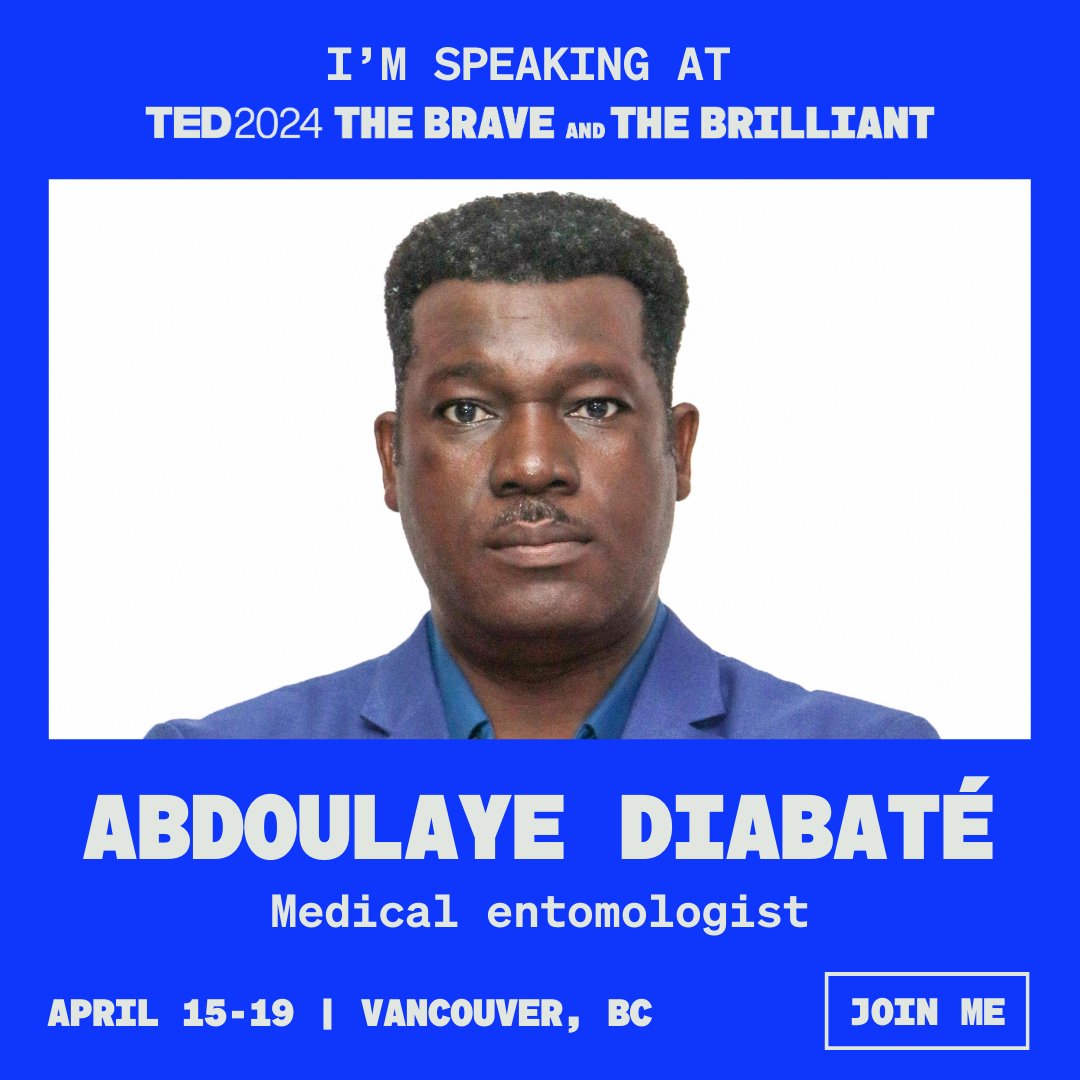
It's #TED2024 week! Stay tuned as we post updates from Prof. Diabaté at TED.
He will be talking about the potential of #GeneDrive research to #EndMalaria in Africa and the work of Target Malaria in Burkina Faso (@IrssDro) .
For more information: https://t.co/GYmiTza7U3
We are hiring. Genome editing to decipher insecticide resistance in Anopheles funestus - oft neglected but the dominant malaria vector in many areas of Africa. One RA and one PDRA.
https://t.co/wrptAxNWFw
and
https://t.co/1B5VdpAO4f
In this fascinating @NYTimes article, @snolen shares how an international team of scientists, including @TargetMalaria, is using cutting-edge technology to fight an ancient disease. https://t.co/OJ3cE9VIT7
Target Malaria insectary tour - Terni, Italy https://t.co/CMk1QG3SIT
Scopriamo assieme il laboratorio di Genetica e Ecologia del Polo GGB a Terni dove si studiano tecnologie innovative per controllare la malaria. 🦟🔬
@TargetMalaria@Alekos_Simoni
@IC_CEP researcher Prof Megan Quinlan and late director Prof John Mumford edited a Scientific and Technical Review for @WOAH around the trade of live insects 🧵
#InsectWeek23