@PedroInsua1 citar algunos.
Todo ello hoy día es patrimonio español, y así se debe de valorar.
Y lo más importante, es la lengua en la que bajo diferentes denominaciones, piensan, transmiten y sueñan millones de españoles.
Sois los tontos útiles que necesitan el separatismo.
@PedroInsua1 en el medievo, siendo lengua de la cancillería junto al aragonés.
Fue la lengua del comercio en el mediterráneo occidental (Consulado del Mar). En su haber hay un sin fin de obras, brillantes por su repercusión a nivel europeo, Ramón Llull, Joanot Martorell, Ausiàs March, por 👇
📍Every major conflict that has defined Anatolia and the eastern Mediterranean since 1920 flows directly from the decision to abandon the treaty of Sevres. One of the greatest strategic failures of the twentieth century.
The Treaty of Sevres (1920), if implemented, would have decisively resolved Anatolia’s root tensions and delivered provided long-term regional clarity, minority security and lasting stability, ending years of forced coexistence and violence.
The abandonment of Sevres was not a diplomatic setback - It was a century of bloodshed authorised in advance.
The destruction of Smyrna.
The Cyprus occupation.
The Kurdish wars.
The endless Aegean disputes.
Each one a direct invoice for abandoning Sevres.
‼️ Instead of a multi-ethnic empire held together by force, Sevres offered stable nation-states built on demographic reality-confronting the issues that would define the next hundred years: unresolved nationalisms, contested frontiers, and unpunished atrocities.
‼️The alternative-the unitary Turkish Republic -delivered a century of forced assimilation, repeated Kurdish uprisings, the denial of the Armenian Genocide, the eradication of Anatolia’s remaining Christian communities, and enduring territorial disputes with every neighbour.
❌The Sevres treaty would have formalized Greek-Turkish boundaries in Thrace and Western Anatolia, removing the tensions that still poison the Aegean today.
❌Sevres would have granted Kurdish autonomy, averting the decades-long Kurdish conflict that has claimed tens of thousands of lives and destabilised the region.
❌It would have secured an Armenian state, closing the genocide’s open wound before denial became state policy.
❌It would have internationalized the Bosporus Straits, eliminating a perennial flashpoint for unilateral control, promoting secure maritime commerce for decades.
🔺Sevres was the only framework that could have worked. The region has been paying the price for its abandonment ever since.
@LauraOr35440247@leonXIV Qué enorme estupidez, más nos valdría a unos y otros de ambos lados del Ebro, estar pendiente del mensaje de Su Santidad, independientemente de la lengua que pueda utilizar.
@aleonrom@ToIkienverse ... es entonces cuando se ve.
Feligres: Qué su Santidad, qué se ve?
Leon XIV: la blanca orilla y, más allá, la immensa campiña verde tendida ante un fugaz amanecer.
@Raggiomoral Misma pregunta me hice ayer al ver al hijo del imperio Mango entrando en los juzgados de Martorell.
Es decir, qué necesidad real tiene ese señor de querer abarcar más, si decidiese no hacer nada, igualmente no podría quemarse toda la pasta.
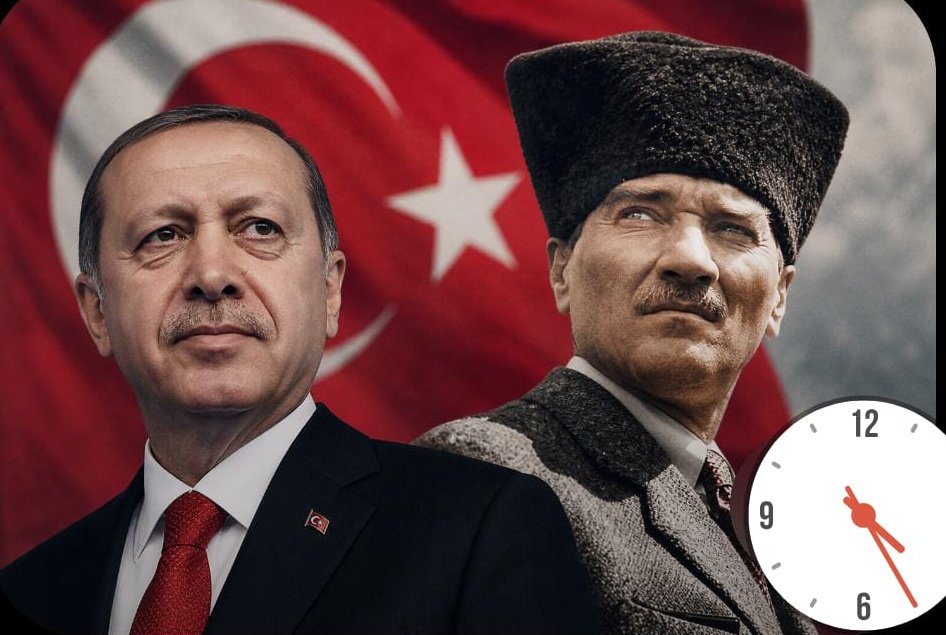
Türkiye Between the Caliphate’s Memory and Atatürk’s Republic
Between the Empire and the State
Modern Türkiye is governed by two deep historical currents. The first looks backward toward the Ottoman-Islamic imagination: empire, caliphate, religious legitimacy, and a civilizational role stretching from the Balkans to the Arab world. The second looks forward through the republican project of Mustafa Kemal Atatürk: secular law, nationalism, Westernization, institutional discipline, and the construction of a modern Turkish state after the collapse of the empire.
Recep Tayyip Erdoğan did not invent the Islamic current, but he gave it political confidence. Under his leadership, religion returned visibly to public life. Ottoman memory was rehabilitated. Mosques, symbols, ceremonies, television dramas, and foreign-policy language revived the idea that Turkey is not merely a nation-state, but the heir of a wider Islamic and imperial mission. For many conservative Turks, this was not a regression but a restoration: the return of a silenced identity after decades of strict secularism.
Yet the Atatürkist current remains powerful. It lives in the army’s historical culture, the judiciary’s instincts, the urban middle class, universities, opposition parties, and the memory of the republic itself. Atatürk’s project was not only anti-clerical; it was a survival strategy. After the Ottoman defeat, he believed Turkey could only endure by becoming a disciplined, sovereign, secular republic, protected from imperial nostalgia and religious fragmentation.
The tension between these two currents defines Turkish politics today. Erdoğan’s Türkiye seeks strategic autonomy, speaks the language of faith and history, and dreams of influence beyond its borders. Atatürk’s Türkiye insists that the state must be rational, centralized, national, and modern, not absorbed by dreams of a vanished caliphate.
But the conflict is not simply Islam versus secularism. It is a struggle over the meaning of power. Is Türkiye a republic born from the ruins of empire, or an empire temporarily reduced to a republic? Is Islam a social identity under the state, or a source of state legitimacy? Is the Ottoman past a museum, a wound, or a political project?
Türkiye today lives inside this unresolved duality. Erdoğan embodies the revenge of memory; Atatürk embodies the discipline of state-building. One speaks to the soul of the old empire, the other to the architecture of the modern republic. The future of Turkey will depend on whether these two forces can coexist, or whether one will try, once again, to erase the other.