Two finance pros. One real portfolio since 2020 📈
Institutional analysis, explained like we’d tell a friend✍️
Educational only, we hold what we write about.
Aletheia's August 2026 Factsheet is out!
🟢 +3.0% over the month (after a positive July with falling $SPY and $NDX)
🟢 +26.7% YTD
🟢 One new position at 4.1% of the fund
What did we buy?
A business trading 25% below its December high, sub 13x forward FCF, 0.6 PEG, buying back shares, with no AI capex bill to fund.
The market sold it on a fear we believe won't materialize.
Read our Free and Premium Factsheet here:
https://t.co/ePxzdfXfgA
- The average LBO has 50 to 80% LTV > let's assume 65%
- Primary fund Nav lending LTV is between 15 and 25% (source Preqin) > let's assume 20%
- secondary fund Nav lending ltv in the prospectus can go to 35% (15 to 25% on average) > let's assume 20%
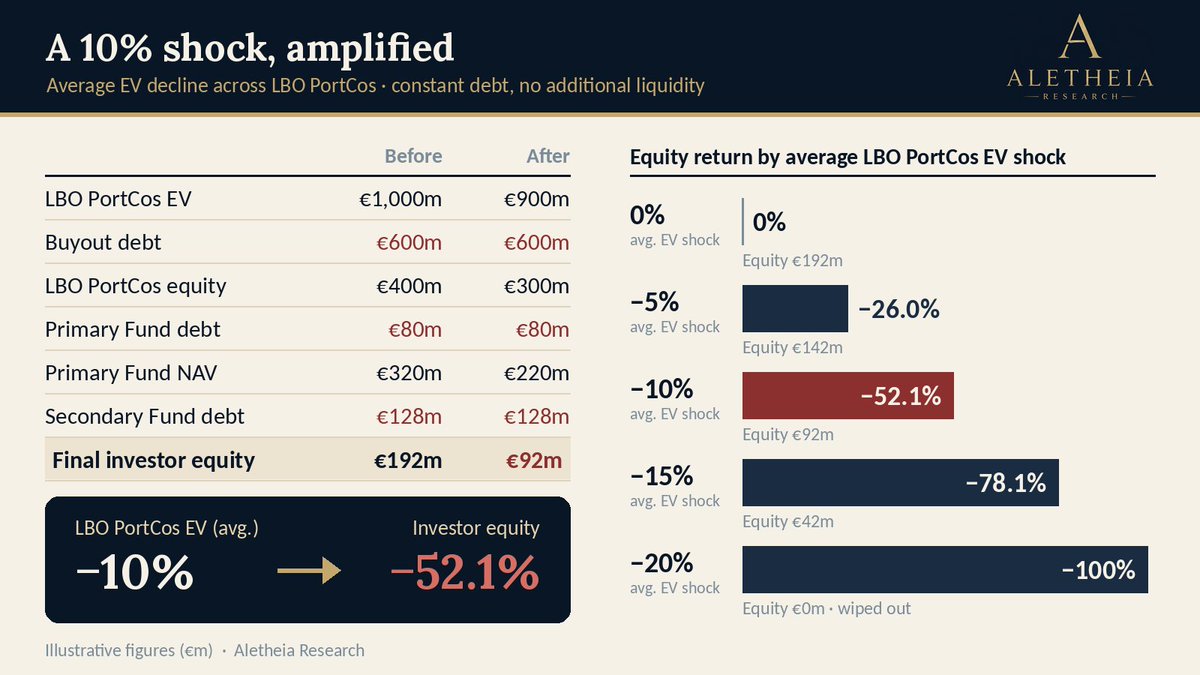
This structure gives to the secondary equity stake a 4.5x leverage.
So an average loss of - 10% across the portfolio becomes - 45% for the secondary fund LP.
Is it too pessimistic? Are there covenants to prevent it or any aspect to consider?
A - 10% PE market drawdown is not that extreme right?
$OSCR
“oscar health announces thrive capital’s completion of oscar health common stock distribution to its limited partners”
Kushner continued, “With Oscar Health’s strong execution, we believe this is an appropriate time to return a small portion of Thrive’s investment through an in-kind distribution. I remain fully committed to Oscar Health for the long-term.”
Joshua Kushner informed the Company that he has no plans to sell any shares of Oscar common stock that he holds in his personal capacity. He will remain Oscar’s Vice Chairman and controlling shareholder, with no change to his role or personal commitment to the Company.”
https://t.co/zdBJZ20QX8
True. Incentives are not easy to balance: too much management fee relative to performance fee and the manager could be too conservative safeguarding the income stream. Too much performance fee realtive to management fee and moral hazard could lead to excessive risk taking.
Best way is the manager having a relevant amount invested in the same portfolio...
The Tremble Factor
"In the building practices of ancient Rome, when scaffolding was removed from a completed Roman arch, the Roman engineer stood beneath. If the arch came crashing down, he was the first to know.
Thus his concern for the quality of the arch was intensely personal, and it is not surprising that so many Roman arches have survived.
Why should investing be any different? Money managers who invested their own assets in parallel with clients would quickly abandon their relative-rerformance orientation.”
― Seth A. Klarman, Margin of Safety
Probably not.
Secondaries are potentially very diversified among sectors, vintages and geographies, so the single underlying PortCos are easily thousands. The secondary fund GP should know the leverage of the underlying funds and maybe also that of single PortCos.
But LTV at every layer is not something usually shown in factsheets... They only declare the max allowed LTV at the secondary fund level, which is the one investors subscribe
@LeylaKuni is shining a light on the staggering layers of leverage embedded in the private markets ecosystem.
But what happens when asset values start falling?
In a highly leveraged structure, a mere 10% decline in portfolio companies' enterprise values could wipe out over 50% of secondary fund investors' equity.
And with a 20% decline your entire investment is gone.
That's before accounting for covenant breaches, margin calls and forced deleveraging, which could amplify the downturn.
Would be interesting to know the average industry LTV of every layer involved.
An example below... are we too pessimistic?
$BX $KKR $HLNE $STEP
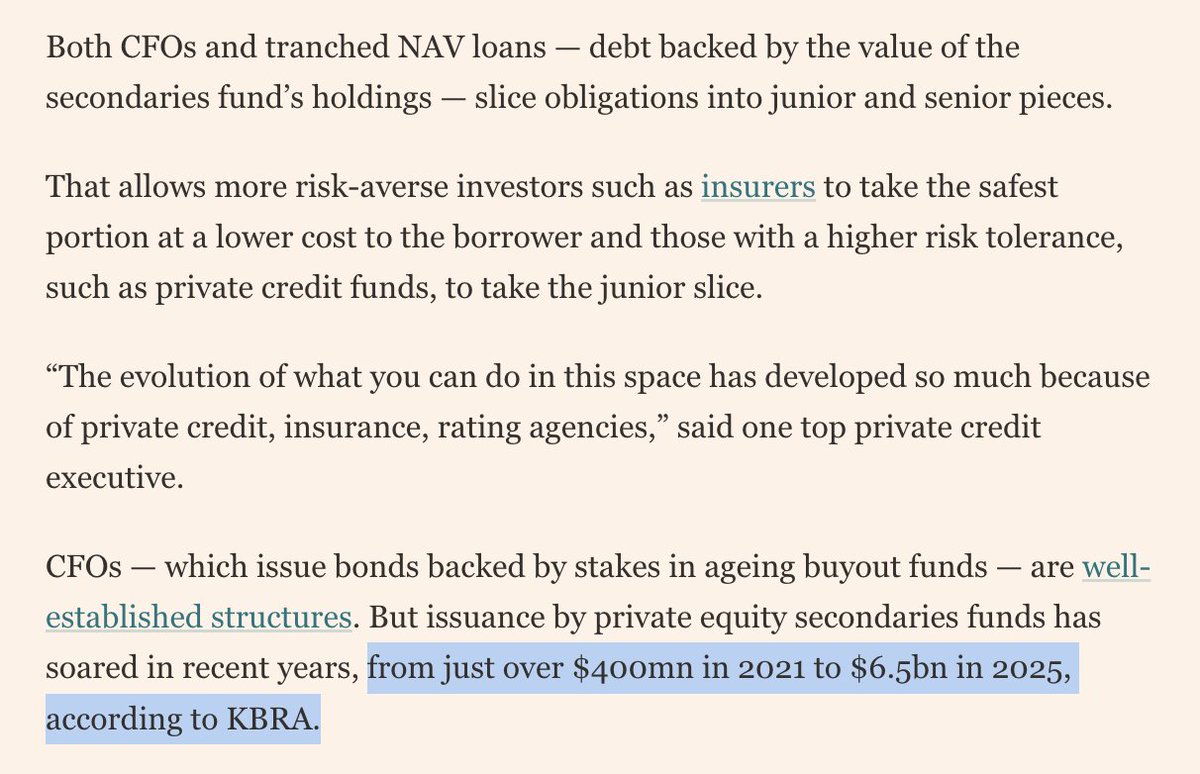
PE funds are securitizing their fund obligations, and now NAV loans.
So in a secondary fund the layers of leverage are as follows:
- buyout loan to purchase a portfolio company (PortCo)
- primary fund holds multiple PortCos and borrows on the fund level (LOC, bonds, you name it)
- secondary fund comes in and buys stakes in primary fund
- secondary fund borrows on the fund level (let's say NAV loans)
- now these NAV loans are tranched up, and upper tranches sold (as IG?) to insurers
amazing things..
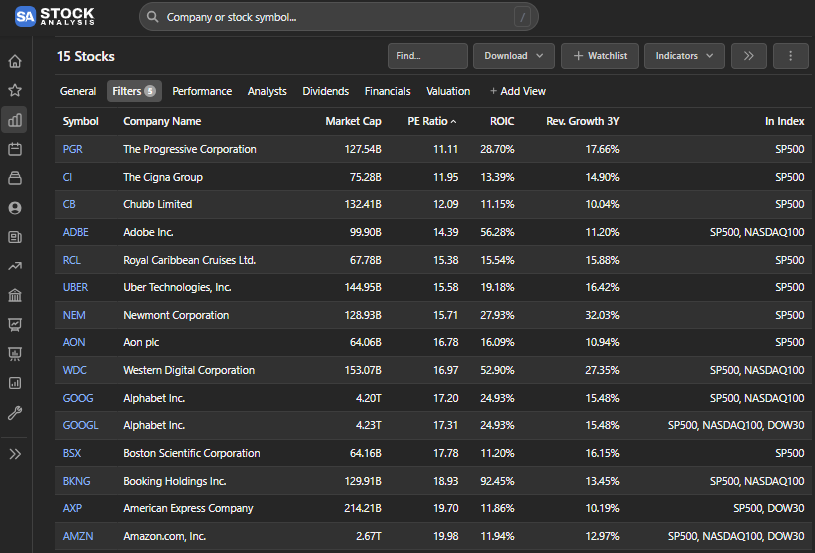
Only 15 stocks in the SP500 currently have:
- 3Y Revenue CAGR > 10%
- ROIC > 15%
- P/E Ratio < 25
- Market Cap > 2bn
Our portfolio (+37.9% CAGR since 2020) holds 4 of them.
Here the disclosed positions:
https://t.co/ze678I3oUu
$SPX $SPY $QQQ $NDX
Solo 15 acciones de todo el S&P500 cumplen con esto:
* Revenue Growth (3 años): > 10%
* ROIC (Retorno sobre el capital invertido): > 15%
* P/E Ratio (PER): < 25
* Market Cap: > $2B (Mid, Large o Mega cap)
Calidad a precio razonable.
@bugur0008yahoo1 Street PTs usually chase the price, especially on $OSCR. Whether fair value is +50% or more depends on whether the ACA market actually grows toward 23M by 2029, as management communicated yesterday.
A street PT at 34 tells us even the skepticals are recognizing value.
ACT III live right now on $OSCR! 🎭
Analysts raise their Target Prices:
Barclays $39→$49
Piper $36→$48
GS $30→$34
Baird $27→$33
Jefferies $26→$31
New Avg PT $31→$34.64
Following the script.
🚨 $OSCR raises its 2026 guidance!
What's improving:
• Medical Loss Ratio: Now 81–82%, down 50 bps from the previous 81.5–82.5% range.
• Operating earnings: Raised by $100M to $600–800M.
What's unchanged:
• Revenue: $18.7–19.0B.
• SG&A ratio: 15.6–16.1%.
Higher expected profitability on the same revenue outlook.
Look's solid.
🚨 $OSCR raises its 2026 guidance!
What's improving:
• Medical Loss Ratio: Now 81–82%, down 50 bps from the previous 81.5–82.5% range.
• Operating earnings: Raised by $100M to $600–800M.
What's unchanged:
• Revenue: $18.7–19.0B.
• SG&A ratio: 15.6–16.1%.
Higher expected profitability on the same revenue outlook.
Look's solid.
GEORGIA INSURANCE COMMISSIONER JOHN F KING LAUNCHES GEORGIA ACCESS FOR BUSINESS.
LETTING EMPLOYERS OF ANY SIZE FUND EMPLOYEE HEALTH COVERAGE VIA TAX-FREE CONTRIBUTIONS (CHOICE/ICHRA)
BULLISH $OSCR / CHOICE/ICHRA
@zerohedge Fed isn’t forced to raise now according to the economic data we have seen so far. But honestly this could be their last chance, next FOMC would be too close to elections
7/ This bottom-up view confirms the momentum: adoption is accelerating, infrastructure is improving and employers are increasingly asking for it.
That bodes well for the next OEP.
And tomorrow's $OSCR Investor Day may give us further confirmation.
Full conversation here:
ICHRA Explained: When It Actually Fits a Small Business https://t.co/E7yoPhBo3r
1/ After plenty of calls with analysts, investors and insurance executives, it's time to look at ICHRA/CHOICE from the ground.
From a professional who works every day at the intersection of employers, employees and insurers.
And what he's seeing is quite bullish for $OSCR and the broader segment.
It also gives more credibility to several points $OSCR management has made around ICHRA's economics, adoption ramp and potential cost savings.
(Link to the full conversation in the last post.)
6/ The other big change is infrastructure.
A few years ago, ICHRA was too messy to administer at scale. Now software is making enrollment, payments and administration much smoother.
And we know $OSCR is at the forefront of this, especially through Lucie and Oswell.
One of the biggest frictions to adoption is being solved.