when you think about the average person in society this makes sense, people spend 4-6 hours a day on tik tok/instagram/X, how many hours a day do people spend in their banking app? maybe 5 minutes
dogecoin went so high because it attracted a set of buyers who were simply never going to buy stocks, but they would buy a memecoin attached to a person that they know and a meme that they can relate to, & it also attracted large funds who started trading it once it was large enough to make money on, once an asset reaches escape velocity it becomes tradable for a much larger set of individuals
boomers dont like memecoins because they dont understand how much the younger generation relates to memes/culture/content on the internet, but crypto is very unique in that tokenization is one of the only ways people can speculate on these societal trends, the next unlock will be how do you convert this kinetic energy of attention from retail speculators and turn it into something that also generates long term value outside of just the pure meme being popular
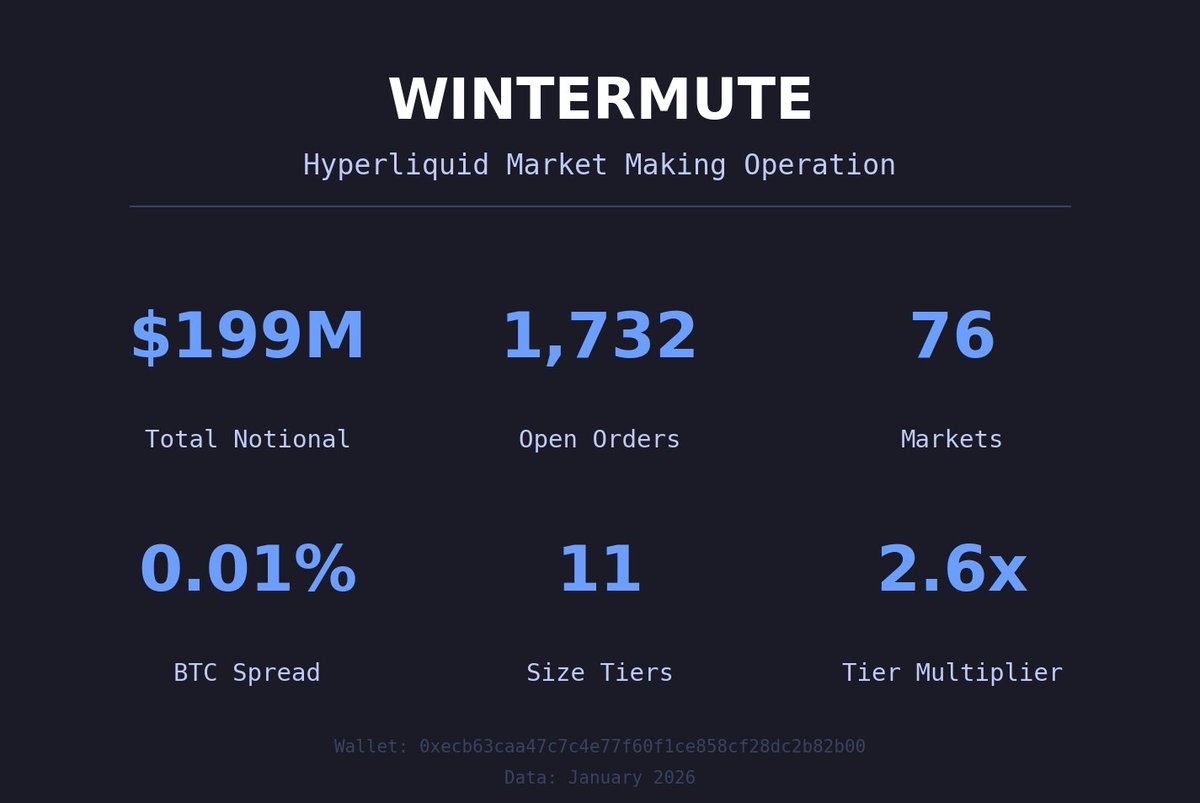
REVERSE ENGINEERING WINTERMUTE'S $100M MARKET MAKING WALLET ON HYPERLIQUID
One thing nobody talks much about is that, since everything is on-chain, you can just LOOK with your own HUMAN EYES at what the tier 1 market makers like Wintermute are doing on Hyperliquid (or fetch it with a Claude script like me). Positions, Balances, Orders, everything.
Wintermute's Wallet: 0xecb63caa47c7c4e77f60f1ce858cf28dc2b82b00
I pulled Wintermute's full account state on Hyperliquid - positions, balances, and open orders. Here's the complete breakdown.
---------------------------
1/ THE SETUP
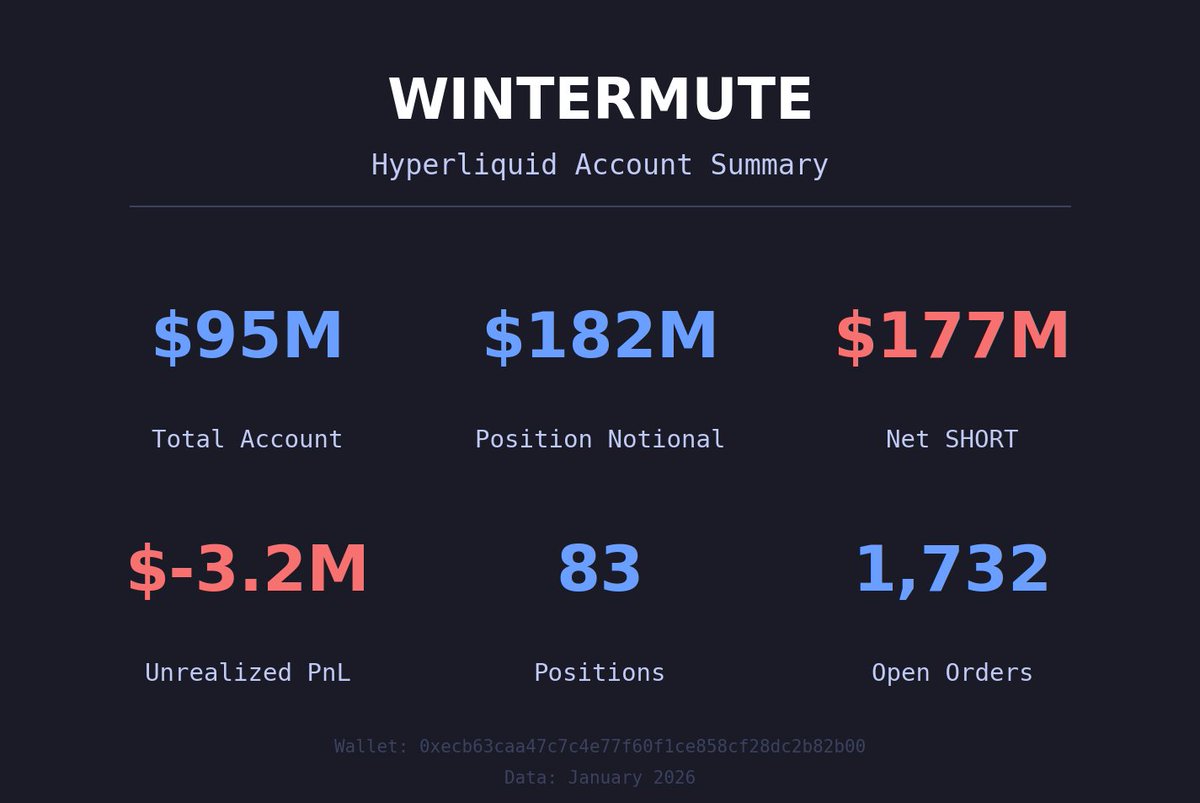
Wintermute runs a ~$95M operation on Hyperliquid:
- $57.8M perp account
- $37.4M in spot holdings
- 1,732 resting orders
- 76 markets quoted
- $199M total quoted notional
Wallet: 0xecb63caa47c7c4e77f60f1ce858cf28dc2b82b00
---------------------------
2/ QUOTING OVERVIEW
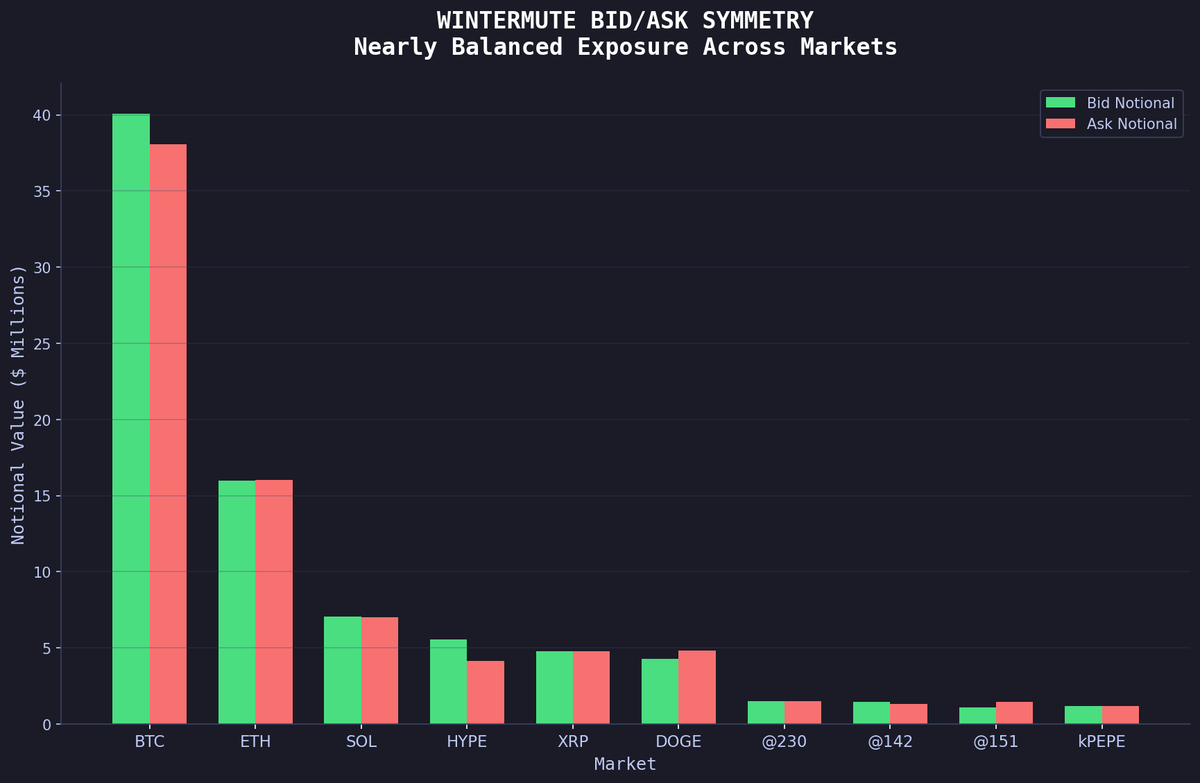
Total bid notional: $101.7M (51%)
Total ask notional: $97.2M (49%)
---------------------------
3/ TOP MARKETS BY QUOTED NOTIONAL
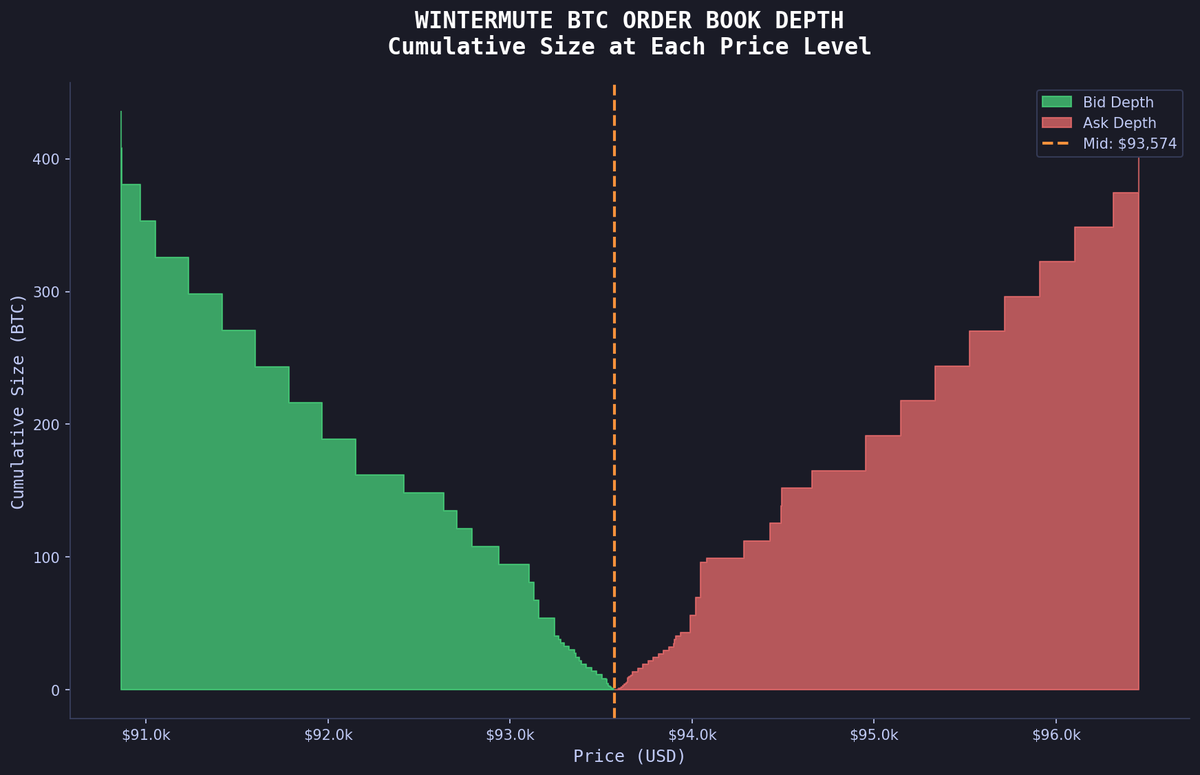
BTC: $78.1M (105 orders, 0.96 bps min spread)
ETH: $32.0M (103 orders, 2.19 bps min spread)
SOL: $14.1M (54 orders, 1.39 bps min spread)
HYPE: $9.7M (27 orders, 23.8 bps min spread)
XRP: $9.6M (58 orders, 8.07 bps min spread)
DOGE: $9.1M (38 orders, 4.18 bps min spread)
---------------------------
4/ THE TIERED SIZE STRUCTURE
Wintermute uses up to 11 size tiers per market with a consistent 2.5-2.8x multiplier (geometric) between tiers.
Smaller sizes near mid with tight spreads.
Larger sizes further out with wider spreads.
---------------------------
5/ BTC QUOTING LADDER
Distance Size Notional
0.001% 0.05 BTC $4.7K
0.003% 0.11 BTC $10.3K
0.010% 0.37 BTC $34.6K
0.030% 2.67 BTC $250K
0.080% 13.4 BTC $1.25M
0.200% 27.5 BTC $2.57M
---------------------------
6/ SPREAD ANALYSIS
Large cap (BTC, ETH): 1.6 bps avg spread
Mid cap (SOL, XRP, etc): 8.2 bps avg spread
Small cap: 45 bps avg spread
Tighter spreads = more volume expected
Wider spreads = adverse selection protection
---------------------------
7/ INVENTORY POSITION
Total perp positions: 83 markets
Net exposure: $177M SHORT
This is accumulated inventory from market making, not a directional bet.
They're quoting across venues and inventory accumulates where the flow is. Offset on other CEXs/DEXs.
---------------------------
8/ TOP POSITIONS (accumulated inventory)
ETH: $88.3M SHORT
SOL: $22.2M SHORT
HYPE: $21.2M SHORT
XRP: $8.8M SHORT
DOGE: $5.7M SHORT
BTC: $2.0M LONG
---------------------------
9/ SPOT HOLDINGS
UBTC: $9.5M
USDC: $9.1M
UETH: $6.4M
HYPE: $4.2M
USDH: $2.2M
USOL: $2.2M
USDT: $1.7M
Total spot: ~$37M
---------------------------
Lots more you could glean from the available data but I'll leave it there for now. Also it's not really "reverse engineering" since it's just saying what their balances and orders are. But I'm going for clicks here.
Data source: Hyperliquid public API
Analysis: January 2026
Live View: https://t.co/nkpjojR59y
Full Raw Data & Graphics: https://t.co/K0jgDRaW0g
In ingegneria dei sistemi esiste un principio semplice: quando un’architettura distribuita manifesta più overhead che benefici, la soluzione non è aggiungere nuovi layer, ma semplificare.
A volte il miglior upgrade è un rollback controllato.
L’Unione Europea oggi assomiglia a un cluster mal progettato: nodi eterogenei costretti a sincronizzarsi con protocolli che non scalano, dipendenze circolari, latenze decisionali ingestibili e una governance che funziona più come un bus condiviso congestionato che come un sistema modulare.
Quando un sistema così perde efficienza, il refactoring non basta.
La vera ottimizzazione è tornare a componenti autonomi, ben definiti, che parlano tra loro solo quando serve, tramite interfacce chiare e contratti di scambio specifici.
Ovvero: uno stato singolo, ben configurato, funziona meglio di un meta-sistema che pretende di coordinare tutto senza avere un’architettura solida.
Non è nostalgia: è ingegneria dei sistemi. Quando il design è sbagliato, il miglior upgrade è tornare a unità robuste, indipendenti e interoperabili, non forzarle dentro un framework che non regge.
@systematicls why do you think there is an inverse correlation between useful info/alphas and ID? why should you give alphas without your real ID btw? just curious about this idea
@mi_prisco@VitoLops il sistema on chain è trasparente, rendi liquidi asset che di per sé non lo sono, togli la presenza di una terza parte per gli scambi (notaio), puoi utilizzare asset come collaterali, crei un sistema aperto e trasparente per lo scambio.
È partita la corsa a tokenizzare (portare in blockchain) asset reali (oro, azioni, bond, immobili, ecc). Un processo che nei prossimi anni potrebbe ampliare di molto la liquidità in circolazione trasformando qualsiasi asset investito in una forma di collaterale finanziario. Nella nuova puntata di Cripto ne discuto con @PietroVentani . Buon ascolto! https://t.co/i8hR9Sly1M
Il giornalista che mi ha intervistato per FarWest qualche giorno fa, mi ha fatto 36 minuti di domande a cui ha ricevuto risposte estremamente dettagliate. In onda sono andati 2 minuti e 25 secondi. Probabilmente tante mie risposte erano scomode a chi finanzia la trasmissione.
Hanno perso un'occasione di educare i telespettatori, ma questo è semplicemente una riconferma di un trend che in Italia funziona sempre di più.
Argomenti:
- cosa è Tether USDt
- USDt e l'inclusione finanziaria di più di 400 milioni di persone lasciate indietro dal sistema finanziario tradizionale. I nostri utenti sono persone che vivono in Paesi ad altissima inflazione che hanno una moneta estremamente instabile (lira turca, peso argentino, ...). Qui ci sarebbe infinito di cui parlare. Esistono 3 miliardi di persone al mondo che vivono senza accesso ad una moneta stabile e Tether sta facendo più di chiunque altro nel portare una soluzione reale e tangibili che funziona già per centinaia di milioni di utenti.
- come gestiamo le riserve di USDt
- solidità di Tether (over-reserved) contro quella delle banche che fanno riserva frazionaria (in media del 90%) mettendo a rischio i risparmi dei correntisti
- attestazione delle riserve (standard per ogni stablecoin), progressi in merito all'ottenimento di un full audit. Qui ho spiegato come stiamo lavorando verso un full audit (annunciato pubblicamente), ma che la nostra attestation è estremamente dettagliata ed è validata indipendentemente (anche dall'istituzione finanziaria americana presso cui sono depositate le riserve, Cantor Fitzgerald). Inoltre ho spiegato come la full audit è estremamente importante ma non è sufficiente, tante banche (silicon valley bank, credit suisse, ...) erano tutte audited. Tether ha più riserve di quanti sono i dollari digitali emessi, essendo di fatto il primo istituto finanziario fully-reserved (e questo da fastidio al mondo tradizionale perché dimostra che si può fare finanza senza mettere in pericolo i propri utenti)
- come mai abbiamo deciso di rinunciare all'Europa. Il giornalista mi fa una domanda (da uno che ha studiato zero l'argomento Tether prima di richiedere un'intervista, o si è documentato su "cioè" o "il fatto" , probabilmente stessa attendibilità): "è vero che l'Europa vi ha escluso perché non avete un audit?". Lì ho risposto molto dettagliatamente in merito a come mai riteniamo (non solo noi) che la MiCA ponga un rischio sistemico alla stabilità bancaria Europea. Quindi abbiamo preferito proteggere i nostri utenti attuali che usano Tether USDt come unica opzione di moneta stabile. Sono stato veramente pubblico innumerevoli volte sulla questione (tantissime interviste e articoli) ma sempre contento di dare ulteriori chiarimenti. Ho fatto tanto di esempi pratici e tangibili. Questa risposta è durata un bel po' di minuti per poter elaborare il pensiero in pieno senza fraintendimenti
- e molto altro
Sorrido quando vedo online chi commenta dicendo di essere un consulente della trasmissione, tutto tronfio perché "mamma sono in TV", senza rendersi conto di aver prestato il proprio nome ad un atto di giornalismo poco interessato alle miei risposte (dato che poco è stato effettivamente incluso) ma più interessato al folclore e alla propaganda mediatica.
Quindi prima di attaccare supponendo che io non abbia voluto rispondere alle domande, sarebbe il caso di chiedersi come mai in onda è andato 1/15 dell'intervista. Non il 70%, o il 50% o nemmeno il 20%... Hanno mandato in onda il 6.6% dell'intervista.
Per non parlare di una singola mia domanda che ha dimostrato la poca trasparenza dell'intervista... "100 milioni di..."?
Grazie invece a tanti che hanno aperto gli occhi. Bitcoin e Tether danno fastidio a chi è servo delle banche e del sistema.
WHY TF BERKSHIRE HATHAWAY HAS A TICKER $BRK.B WITH THE FUCKING POINT IT RUINS EVERY TIME MY PYTHON MODELS AND HAVE TO WASTE TIME TO CREATE EXCEPTIONS FOR THAT FUCKING POINT IN THE NAME FUCK YOU WARREN
A tale of a quant intern who loves discrete signals
Meet John. John is a grinder. He did leetcode, probability questions for like 20 hours straight for 40 days ignoring his mom and now he finally got the dream.
A quant internship at a hedge fund. The big deal. He got assigned to a systematic desk. His first project is to find some momentum signal.
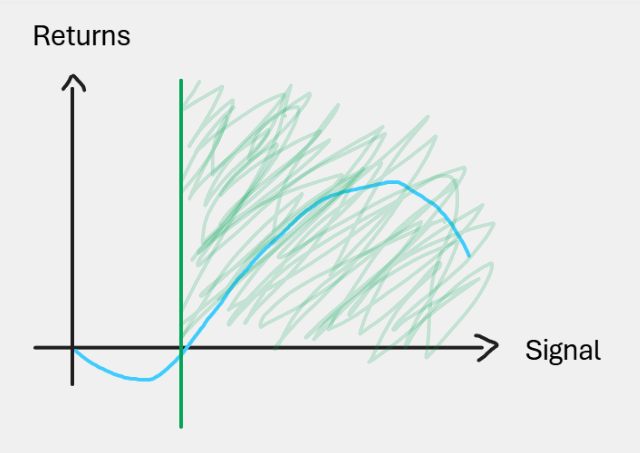
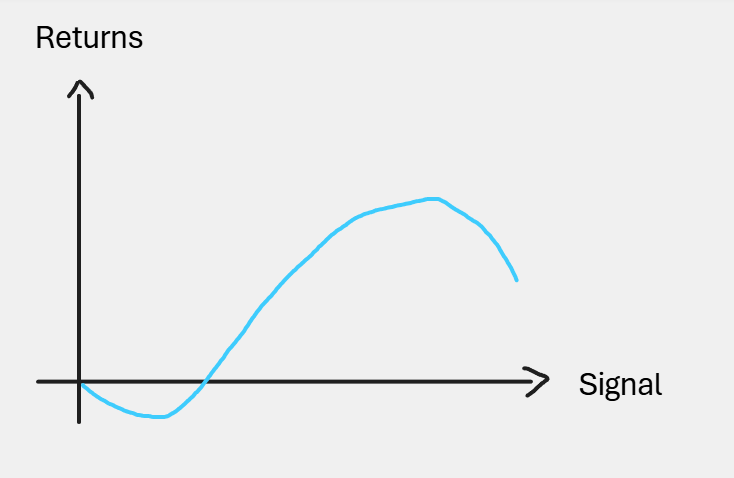
Luckily for him, momentum effect does exist. The real effect looks something like this:
John is an active lurker on quantwit. He has read all the discussion and debate about continuous vs discrete signals. After long contemplation, he thinks the discrete camp is way more persuasive. After all, financial market is non-linear and fat tailed, and complexity is bad so it's obvious that discrete signals are the way to go.
A simple rule would work best, he thinks. So the rule as simple it is.
If signal > 0:
long
The pnl is positive. Sharpe 0.6. Ok that sounds cool, but surely to get a return offer the Sharpe can't just be 0.6. He will have to present this to the Head of Quant Research (the actual one, not the 20yo one). So it gotta be better than this.
"Hmm ok how do I make it better.... what do discrete traders do to make their signal better?" Ah yes a discrete filter. That's the way to go.
"Hmm ok so maybe momentum doesn't work all the time". Maybe it only works when it has stronk trends. In short timescales mean reversion tends to dominate. So you know instead of just long when signal >0, we will have another filter, that only if signal has been positive for the last 5 days, we're gonna go long.
That filter has an effect of this in reality. It filters out the "unprofitable trades". He's only trading in the green area after the filter. Lucky him.
Now the Sharpe is 0.8. LFG. He can already imagine the return offer right in front of his eyes. He has browsed Blind before (he had to beg for his alumni to share his account) and seen all the TC discussion. 400k+ for a new grad. That's gonna make him like a top dawg. He's kinda a loser IRL like he's only relevant on twitter but it's all gonna change now. All this time girls in uni never even looked his way. But they all gonna make a 180 to look at him when he rocks the Citadel swag to uni.
Ok, ok, focus John. 0.8 Sharpe is good but you need to seal the deal big John. What else can I do?
Oh he remembers listening to podcast on Trend Following (he can't remember exactly which one, there's too many of them), and they mention stuffs about how trend can get overextended, and will eventually reverse and crash.
"Overextended trends? BIG if true". He doesn't want that. Who wants their profit to reverse? No no no no, not under big John's watch.
Okay what do I do?
Well, if one filter helps, surely 2 is gonna help even more. 1+1 =2 quick maths. So you know, let's add another lil cheeky filter. To help quantify overextension, he wanna use ATR. So after the asset goes up above 3 ATR or something, he will exit his position because the trend could be overextended.
Well, lucky for him, now the filter actually makes things look like this:
Sharpe 1.3. Hell yeah. Surely this is gonna land the return offer.
-----------------------------------------------------
Presentation day comes. John walks into the room. The Head of Quant Research and a senior quant PM are sitting inside. He's a bit nervous, but confident.
"Hi guys, thanks for the opportunity. My name is John and I've been working on this momentum strategy. So basically, you wait if the signal is positive for 5 days and that's your entry rule, and then you go long, and our exit rule is when the ATR goes above-"
----------------------------------------------------
It's next summer. Joe is the summer intern this time. He also looks into momentum. He just assumes the signal strength is linear. Slap a straight line through the plot no biggie.
Returns
^
| __________
| / * * *
| / * *
| / * *
| / *
| / *
| /_____*_________________> Signal
| * *
* *
He also cap the signal strength. Because yknow, outliers or whatever
Sharpe 0.9. He finished it quite quick and worked on another project. Got a return offer. He works for Citadel now. The end.
This is a work of fiction. Names, characters, places and incidents either are products of the author’s imagination or are used fictitiously. Any resemblance to actual events or locales or persons, living or dead, is entirely coincidental.