Based on my very good relationship with Maje Culluh of the Kazon, I have ordered a reduction in the Joint Military Exercises with the Talaxians. I recently asked the Talaxians if they would like to join us against the Gorn, and they said, “No thanks!” #StarTrek#Sisko197
⚠️ Sound ON is a must! 🚨
A kitten unexpectedly kicked the baby... Here is the mama cat witnessing it and delivering some merciless "I won't let you get away with that!" discipline 😂
The way the kitten goes to hug the baby at the end saying "I'm sorry..." is so sweet—it moved me to tears 🥺💕
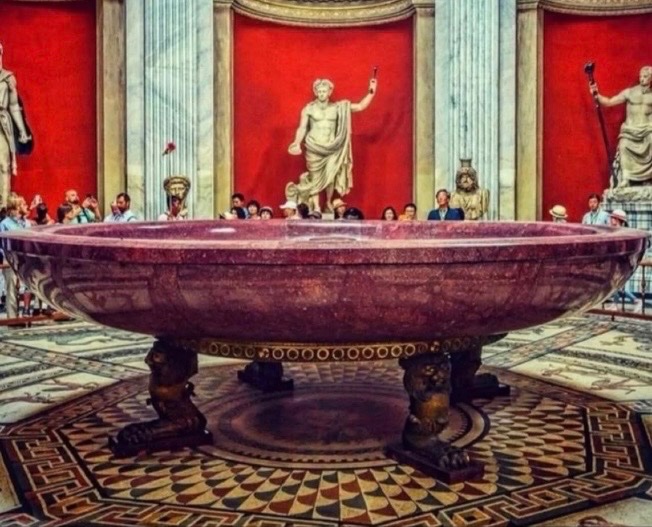
Emperor Nero’s 2,000-year-old bathtub was carved from one of the rarest stones on Earth and is estimated to be worth around $1 billion today.
Before modern luxury, this monumental bathtub represented the height of imperial prestige. Traditionally linked to Emperor Nero, it was carved from a single block of imperial purple porphyry, one of the rarest and most prized stones of the ancient world. Mined exclusively at Mons Porphyrites in Egypt’s Eastern Desert, the deep purple stone was reserved almost entirely for Roman emperors as a symbol of absolute power and divine authority.
Several meters wide and weighing many tons, the massive basin is a remarkable example of Roman engineering and craftsmanship. Since the ancient quarry has been abandoned for centuries and imperial purple porphyry is no longer commercially available, experts estimate that sourcing an equivalent amount of the stone today could cost around $1 billion, making it one of the most valuable bathtubs ever created.
#tbt: Years later and people still come up to me and call me Pedro Cerrano! We had such a fun time shooting Major League. What is your favorite scene in the movie?
In 2024, archaeologists excavating an ancient Gallic village in Dieppe, France, made a surprising discovery: a handwritten note left by another archaeologist nearly 200 years earlier.
Student volunteers working at the site known as “Caesar’s Camp” found a small glass bottle buried in the ground with a rolled-up note tied inside. As the archaeology students watched, the lead archaeologist, Guillaume Blondel, put on white gloves and carefully unrolled the paper.
The note read: “P. J. Féret, a native of Dieppe and member of various intellectual societies, conducted excavations here in January 1825. He continues his research in this vast area known as the Cité de Limes or Caesar’s Camp.”
The researchers were amazed by the unusual connection between two archaeologists separated by two centuries.
Experts say that Féret was the first known archaeologist to study the site and identify evidence of an ancient Gallic occupation there.