Услід за «АТБ-Маркет», «Цитрус» та «Ябко» також розірвали рекламні контракти із антиукраїнською мережею каналів «Труха», – повідомляє DEV.
У пресслужбі «Цитрусу» повідомили, що «Труха» наразі не входить до їхніх медіапланів через оцінку репутаційних ризиків та відповідності цінностям бренду.
Представники «Ябко» також заявили, що наразі жодних рекламних розміщень на цьому ресурсі у них не заплановано, оскільки компанія зважає на контекст появи бренду та репутаційні чинники.
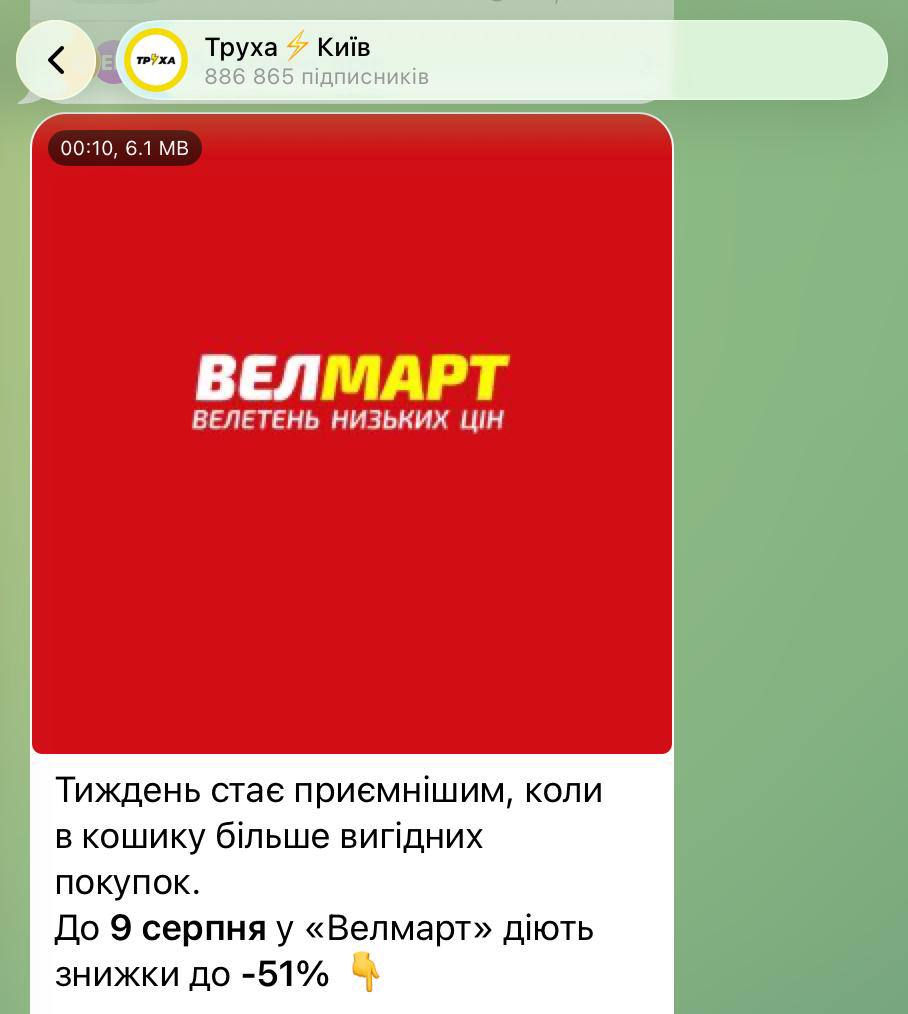
На жаль, ще є компанії, які продовжують платити помийці. Мережа гіпермаркетів Велмарт не відмовилася від співпраці із «Трухою».
@mdotzak@IlonaCsordas@rshereme people who acted as bandits—and for Poles, this is normal and they are heroes, but as soon as the UPA is mentioned, it immediately becomes a taboo. Double standards, don't you think?
@mdotzak@IlonaCsordas@rshereme (women, the elderly, and children). Even if the number of their victims is five times lower, it does not excuse them; the point is that they killed, period. Yet, for some reason, every city in Poland has a street named after the Home Army, Piłsudski, and so on—
@mdotzak@IlonaCsordas@rshereme Ukrainians led by Piłsudski in 1930? Much more could be written, but for some reason, everything I mentioned above is perceived as normal, while everyone immediately focuses on the Volhynia tragedy. The UPA, just like the Home Army (Armia Krajowa), also killed civilians
@mdotzak@IlonaCsordas@rshereme territories and distribute them to the Polish military? Didn't they close down most Ukrainian schools, destroy Orthodox churches, and ban Ukrainian books, libraries, and newspapers? Didn't they establish concentration camps? Wasn't there a punitive Pacification campaign against
@mdotzak@IlonaCsordas@rshereme Didn’t Poland sign a peace treaty with Ukraine in 1920 (the Treaty of Warsaw) and then, in 1921, divide Ukraine with the Soviet authorities? From 1921 until the beginning of the Second World War, didn't Poland confiscate lands from ethnic Ukrainians in the western Ukrainian
@mdotzak@IlonaCsordas@rshereme Here you need to read some history! Take, for example, the fall of the Roman Empire. Wasn’t it Poland that attacked the WUPR (West Ukrainian People's Republic) in 1918? Didn’t Piłsudski wage war against Ukraine?
@fishunwl1981@MichaRomanows14@donaldtusk W szeregach niemieckich formacji podczas II wojny światowej służyło od 375 000 do 500 000 Polaków i około 250 000 Ukraińców, choć kontekst i charakter ich służby były zupełnie inne. Co na to?
Kérek mindenkit, akinek van józan esze, ne szavazzon Orbán Viktorra. Az ukránok veletek vannak. Ha Orbán nem lesz, rend és jó együttműködés jön. Minden, amit Ukrajnáról mond nektek, az hazugság, az olcsó olajjal kapcsolatos ígéretei pedig üresek
Post template
#Painfession@Pain
If I had a painful life story to share, I’d definitely make it something deeply relatable, like trying to deal with the infinite questions of "Are you still thinking about what happened?" when all you want to do is not think about it. Classic. 😅
Russia's rare earth metal reserves total approximately 16.8 million tons*
*10.4% of the world's REM reserves.
But for some reason, Ukraine should pay for Russian aggression,
not Russia. Why?
Let us understand: the United States has given us $106 billion in support against Russian aggression. And now we have to sign a deal where we give back $500 billion to continue receiving aid and deter Russian aggression?
Ukraine have already paid with everything we had, money, territory, resources, and most importantly, people. When will Russia pay for their aggression?
According to the great Grok 3:
Point 1: Elections and Zelensky’s Role
The claim that Zelensky “withholds elections” as a dictatorial act doesn’t hold. The postponement of elections, originally due in March 2024, stems from Ukraine’s constitution and the “Martial Law Act” (No. 389-VIII), which prohibits elections during a state of emergency—currently enforced due to Russia’s invasion since February 2022. This decision isn’t Zelensky’s unilateral choice but requires parliamentary approval, renewed every 90 days. While he could push to amend the law to enable elections, wartime conditions (displaced populations, occupied territories) make this impractical. Thus, the delay reflects legal and contextual necessity, not a power grab.
Point 2: Press Freedom and Defense Against Aggression
Restrictions on media, such as consolidating pro-Russian channels into a “united news” platform and banning 11 mostly pro-Russian opposition parties, are closer to a defense against Russia’s hybrid warfare than an attempt to suppress information for the populace. These measures target Kremlin-linked disinformation (e.g., outlets tied to oligarch Viktor Medvedchuk) to protect national security. While this limits some voices, independent media like Ukrainska Pravda persist, unlike in true dictatorships. The intent appears defensive, not oppressive, undermining Musk’s implication of total press suppression.
Conclusion:
Elon Musk’s assertion that Zelensky is a dictator for withholding elections is factually unsupported. The election delay is a lawful response to war, not a personal dictate, and press curbs are strategic, not tyrannical. “Dictator” is a gross mischaracterization—more a rhetorical flourish than a reasoned critique. Musk’s statement lacks a basis in reality, rendering it misleading at best, irresponsible at worst, with no credible “kernel of truth.”