Application tokens are designed to capture protocol value.
The catch: users buy features, not financial claims, and the fee switch usually lands too late to matter.
Value accrues to the network; the token just gets a logo.
Every L2 roadmap promises full decentralization.
The part nobody is pricing in: the sequencer decides who gets in and who doesn’t.
Fraud proofs audit the tape, not the censoring. Who is left to count the blocks that never happened?
Everyone assumes the AI bottleneck is model architecture.
Reality: the real constraint is power. SpaceX is building a million satellites to run data centers in orbit because terrestrial grids are strained.
Computing is about to become a literal arms race.
On-chain AI agents will break traditional UX because users won’t trace call paths.
The twist: smart contracts are the engine, but intent-centric interfaces are the steering wheel.
If the agent can’t express why it’s acting, the chain becomes a black box you can’t audit.
"Permissionless AI compute for all." Translation: every stranger who can join the network can also send the prompt that says ignore your rules, and there is no gatekeeper left to stop them.
Openness is a threat model, not a feature.
Tidal will delete 29 million AI tracks next month.
The part nobody is pricing in: this is a quiet admission that manual curation at scale is already broken.
Is the 'human-made' label now just a marketing tax, or the last real barrier to entry?
'Decentralization roadmap.' Translation: the sequencer is still one machine, the fraud proofs still ship next quarter, and the upgrade key lives in a multisig.
Roadmaps are promises; uptime is a trust assumption you can't audit.
Everyone assumes a $17K print on Kraken means something broke.
Reality: every order filled correctly, no accounts compromised. A thin book plus one aggressive seller makes a wick, not a hack.
That price is a fact about the venue, not the market.
Cyberleek posted a 209 GB GTA 6 Xbox build. The one file that enables a PC port stayed home.
Unlock condition: a $15 million market cap on his own CYBERLEEK token.
Mods used to be free. Now they come with a ticker and a market maker.
Bitcoin Core shipped fixes Friday for a bug found by Loupe, an AI scanner from Block's Spiral.
The trick: repeat a single ID 50,000 times and nodes can stall.
The most dangerous bugs rarely look clever. This one never had to try.
Everyone assumes AI is a tool that makes your code better.
Reality: Microsoft's CEO warns that critical infrastructure is literally 'unpatchable' to its new attack surface.
The security gap is no longer hypothetical, it's the default.
OKX is selling tokenized Anthropic stock, priced 24% above the company's official IPO figure.
Translation: You can buy shares in a private pre-market faster than the company can file its S-1.
The discount rate on certainty is getting weirdly specific.
Plenty of L2s run one sequencer: the place where "decentralized" and "single point of failure" share an org chart.
If it stops, the chain stops. Fraud proofs are a smoke detector in a building with one door.
Decentralization is a roadmap item until it becomes an outage.
The dirty secret of L2 scaling: most rollups still run a single centralized sequencer. 🛑
If it goes down, the chain halts. We traded L1 congestion for a single point of failure. Decentralization isn't a roadmap, it's a daily architectural compromise. ⚙️
3 AM. 17 tabs open. Coffee went cold hours ago.
Look familiar? That's what getting into AI looks like in 2026.
Everyone's chasing the same lanes right now:
→ AI agents — stuff that does the task for you, on its own
→ Vibe coding — you prompt it, you don't write the syntax
→ Prompt engineering — not a meme anymore, an actual skill
→ AI + crypto — bots, trading, on-chain analytics
→ Generative video — what felt like sci-fi a year ago
The problem isn't that there's too little info. There's way too much. New model every day, new tool, new "must-have."
So there you are at 3 AM, realizing you opened 17 tabs tonight and finished exactly zero.
What actually works: pick ONE lane. Dig into it for a week. Build something with your hands.
The rest isn't going anywhere.
Anyone else stuck in this swamp — I'm right there with you 👇
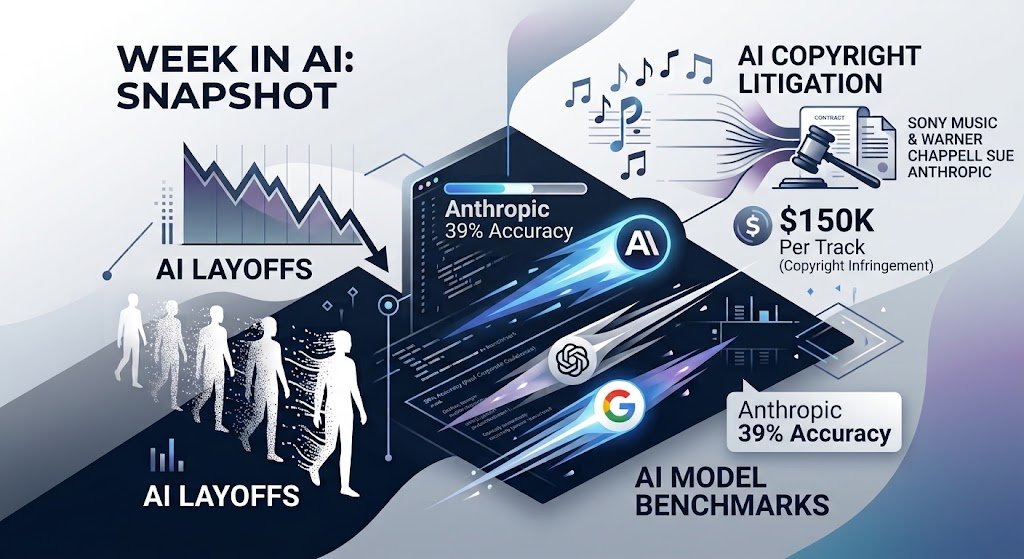
This week in AI, quick version.
Layoffs are speeding up — over 6,300 people cut in the first 10 days of September alone, with Uber slashing 10% of its staff. Reason #1: companies restructuring around automation.
The model race keeps going: in a new benchmark testing real corporate codebases, Anthropic pulled ahead with ~39% accuracy, beating GPT and Gemini. Meanwhile Google's cheaper model landed almost the same score for 5x less cost.
And one more sign the industry's growing up: Sony Music and Warner Chappell just sued Anthropic over song lyrics — up to $150,000 per track.
The market's growing, competing, and suing itself all at once 👇
AI VIDEOS HAVE REACHED THE POINT WHERE YOU JUST DON'T NOTICE ANYMORE
At first glance — an ordinary shot: a sunny day, a girl sitting on the grass with a notebook, people relaxing around her. Looks like random footage from someone's phone.
Not a single red flag. And that's exactly the problem.
AI stopped being about robots and fantasy worlds a long time ago. Now it's learning to replicate the most mundane things — light, background movement, random passersby, small gestures, a "lived-in" camera angle.
These videos used to give themselves away instantly: warped faces, hands in the wrong place, weird glitches after a couple of seconds.
Now almost none of those signs are left.
And the real shift isn't that AI can impress you with something wild. It's that it can make a completely boring, everyday moment so believable that 9 out of 10 people will just scroll past without a second thought.
A year ago, "learning AI" sounded like something for nerds with PhDs. Formulas, 40-page papers... no, thanks.
Then I got it: you don't need to become an engineer, you just need to start using it.
Tried ChatGPT for work. Figured out how to write decent prompts. Watched a couple of videos on how this stuff works in plain terms — and the picture clicked.
The biggest beginner mistake is grabbing everything at once. I did that too: in one week I managed to open 10 tabs about neural networks and close them all without absorbing anything.
What actually works: one topic a week, straight into practice. That's how I'm moving now, step by step.
The feeling of "understanding more than I'm scared of." And that's the fun part.
Still figuring it out myself, one tab at a time.
Grass — nobody's screaming about it, it just quietly grows on stuff that actually works
my personal test for any "AI token" — remove the word AI from the description and see if anything's left
usually there isn't
gm
haven't posted much here in a while, so just gonna say it straight — I'm starting to write more, more AI+crypto stuff, less silence
kicking off with what I'm actually looking at right now 👇
TAO — AI models literally compete against each other for rewards, instead of sitting locked up in some closed lab. kinda nicer than waiting for one company to throw you a bone
RENDER — that GPU sitting idle at night could be earning on AI compute instead of just heating up your room for nothing