The promise of educational choice is not that, tomorrow, schools will magically be “better.”
The promise is that, over time, choice-based systems create room for educators & families to build better solutions.
It bears repeating that the intellectual heart of the resistance to structured literacy is not “I have a better way of teaching reading…”
It’s “teacher autonomy.”
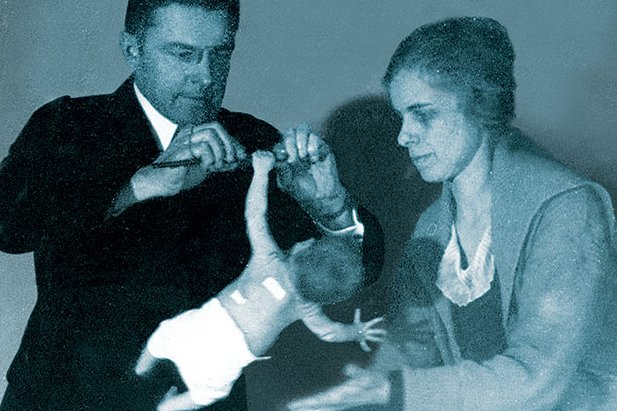
When Experts Go Wrong🧵
In 1928, a professor wrote a parenting guide. It became a best-seller...
THEN 3 of his own kids committed suicide
Meet John Watson: the father of Behaviorism
A story of scientific arrogance, the meaning of love, and one expert with blood on his hands👇🏻
This is why I went to @RedeemerUniv. In the big world, people say “where is that?” But the truth is I received a stellar, rigorous, profoundly formative education there. It changed my life for the better. I didn’t leave w much of a Rolodex but I left wiser, which is the point.
Math as evidence for God:
A widely quoted essay by Eugene Wigner is titled “The Unreasonable Effectiveness of Mathematics in the Natural Sciences.” Wigner asks why the mathematical formulas we devise in our heads work so well in describing the external universe. The match between them “is something bordering on the mysterious.” Indeed, “there is no rational explanation for it.”
No explanation, that is, within scientific materialism. “It is difficult to avoid the impression that a miracle confronts us,” Wigner muses. At the very least, “certainly it is hard to believe that our reasoning power was brought, by Darwin’s process of natural selection, to the perfection which it seems to possess.”
By contrast, a biblical worldview offers a perfectly reasonable explanation for the effectiveness of mathematics—namely, that a rational God created humans in his image to think his thoughts after him.
In fact, looking at history, we find that a biblically inspired confidence in the mathematical structure of the universe came first, before any actual scientific discoveries. Mathematician Morris Kline writes,
“The early mathematicians were sure of the existence of mathematical laws underlying natural phenomena and persisted in the search for them because they were convinced a priori that God had incorporated them in the construction of the universe.”
People must first be convinced there is a mathematical order in nature. Otherwise they will not go searching for it—and science will not get off the ground.
(from Finding Truth)
A 35-year longitudinal study asked how parents pass on their spiritual and religious convictions.
The study found 2 surprising results:
First, “having a close bond with one’s father matters
even more than a close relationship with one’s mother.”
In other words, fathers have influence, whether they want to or not.
Second, the relationship with the father must be warm and close.
A father can be a pillar of the church, a moral exemplar, and have perfectly correct theology, but if he is perceived as cold and distant, the child will not follow him--will not adopt his religious convictions.
https://t.co/RfLuPJYeQe
I really appreciated this insight and vulnerability from @drmikeida in EdSurge today.
Professional Development Is Dying — and It's Most Evident in My Local Teacher Community
https://t.co/LWriBQELgm
I feel like I say this annually or so...
...but man: the Ts out there who don't use textbooks because, well, they're *textbooks*, are really missing out.
💡 There is no such thing as “learning styles.”
💯 Students benefit from more testing.
🧠 Information that's harder to learn is retained longer.
Educational psychologist Jonathan Tullis dispels some of the most widespread misconceptions in education.
https://t.co/GUawr7yDqK