I had done the research that told me not to enter the trade.
I entered it anyway.
Not because I had not read the research. Because I had not read it immediately before entering.
Six months of journal entries and one Claude analysis to find that. Here is the full setup.
🤖 OrionX Robotics Roadmap 🤖
✅ Phase 1 (Q2 2026 – NOW)
ARES is now live on a physical robot with real-world pilots, ultra-low latency, and thousands of validated AI simulations.
✅ Phase 2 (Q3–Q4 2026)
Scaling into enterprise deployments, launching the first ARES API licensing deals, expanding robot swarms, and advancing the Mk-1 humanoid.
✅ Phase 3 (Q1–Q2 2027)
ARES v2 introduces industrial & nuclear specialization. SDK goes live, enabling third-party developers to build with the ARES Brain while Mk-1 reaches new autonomy milestones.
✅ Phase 4 (2028+)
Commercial production begins with multi-market deployments, ARES-as-a-Service, Robot-as-a-Service, and OrionX's vision to become the global standard for embodied AI.
Installed ARES Brain into the Unitree G1... and bro immediately started acting like a real teammate. 🤖💀
Now he's continuously handling crazy tasks, joining meetings, and probably wondering why humans need coffee breaks. 😂
At this point, we're not testing a robot anymore... we're onboarding a new employee.
Most teams deploying AI agents test whether the model produces the right output.
Nobody is testing whether it has the right permissions, the right audit trails, and the right escalation paths when something goes wrong.
The ones who run this free 45-inspection diagnostic before shipping will know exactly where their governance layer is missing before it surfaces as an incident, a lawsuit, or a regulator's question.
The gap is getting obvious fast.
No cash ever changed hands. But somehow Twitter investors are about to exit through the biggest IPO in history
Elon bought Twitter for $44 billion and quickly lost half its value for his investors.
He needed to make those investors whole without spending cash. So here is what he did.
He merged Twitter with xAI so that Twitter investors now held stock in an AI company. Then he had SpaceX acquire xAI, not for cash, for SpaceX stock.
Twitter investors now held SpaceX equity.
Absolutely brilliant idea for the Twitter investors.
But then aprarently he changed the lock-up rules so those investors could sell early into the SpaceX IPO.
No cash ever changed hands. But every Twitter investor now has a path to exit through the biggest IPO in history.
That is the structure. Now look at the valuation it requires.
$1.75 trillion. Sixth largest company in the world. Bigger than Berkshire Hathaway. Neck and neck with Amazon.
SpaceX trades at 56 times revenue. Tesla, which most people consider overvalued, trades at 12 times. SpaceX trades at 109 times EBITDA. Amazon trades at 18 times.
So what justifies the $1.75 trillion?
I read the full S1. The answer is a $26.5 trillion AI total addressable market that SpaceX claims it will capture. The businesses generating actual revenue today, rockets and Starlink, represent under 7% of the valuation.
The other 93% is an AI market that does not exist yet and is actively contested by every major technology company on the planet.
The valuation is not priced on what SpaceX is.
It is priced on what xAI needs to become to make Twitter investors whole.
That is the IPO. Read the S1 before the book closes June 11.
This is the word on the street, who knows how true it is
I love X and how far the platform has come since Elon took over, so not complaining at all
INSTEAD OF opening Obsidian just to dump more notes tonight.
Spend 30 minutes studying these workflows.
12,900+ GitHub stars in under three months. Free.
The ones who connect plugins, workflows, and Claude will turn their vault into working memory.
Major Updates on Altcoin in May, 2026
$TAO (Bittensor)
- Emissions refocused on 30 high‑performance subnets
- Taoflow ties emissions to real‑time staking flows
- Conviction mechanism replaces trust‑based subnet ownership
- Bridged TAO tokens to Solana via Wormhole
$FET
- Phase II of ASI token merger launched
- Ocean Protocol exited citing 93% value suppression
$NEAR (NEAR Protocol)
- Partnered with Bermuda government for AI services
- $19 billion cumulative Intents trading volume reached
- Launched confidential payments directly on website
- Dynamic resharding scheduled for Q2 2026
$INJ (Injective)
- IIP‑617 Supply Squeeze approved with 99.89% support
- Community buyback filled $196K in under 10 minutes
- Vulcan mainnet upgrade entered on‑chain vote
$RENDER (Render Network)
- SUBMERGE immersive art exhibit ran through May
- A$AP Rocky music video used decentralized GPUs
- Jensen Huang highlighted 10x yearly AI compute growth
$VIRTUAL (Virtuals Protocol)
- x402 integration drove 5x agent transaction growth
- Generated $2.8 million agent‑to‑agent revenue
- Q2 2026 revenue collapsed to $222,370
- veVIRTUAL locked 22% of circulating supply
$ROSE (Oasis Network)
- Launched Privana Finance private trading platform
- Shifted from infrastructure to shipping own apps
$ZIG (ZIGChain)
- Revenue buyback mechanism starts July 1, 2026
- Program targets accumulation of 500 million ZIG
Which of these updates caught your attention most? Drop a comment with the ticker
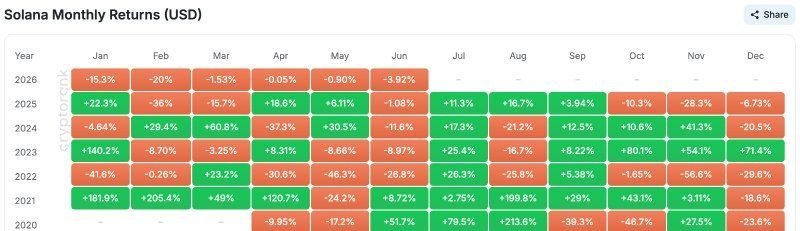
$SOL is starting to look a lot more like $ETH now.
It closed 8 consecutive red months for the first time in history.
SOL is down 36.4% in 2026.
ETH is down 33.5% over the same period.
For years, people treated SOL as Ethereum's replacement.
Now it looks like SOL became another ETH instead.
$BTC is trapped between two levels, and the market is pretending it is not.
$74,804 is the ceiling. Every rally has been sold there.
$64,961 is the floor. The only thing standing between here and $58,000.
Current price: $71,209. Sitting in the middle of that range with thin volume and no conviction in either direction.
The honest chart read:
November peak at $125,000. Sold off to $63,000. Recovered to $99,000 in March. Lower high. Sold off again to where we are now.
Every recovery since November has printed a lower high.
That is the structure. It does not care about your conviction.
Two scenarios from here:
Reclaim $74,804 with a strong daily close and $80,000 comes back into play fast.
Lose $64,961 and the next real support is $58,000 to $60,000.
There is no comfortable middle ground on this chart.
The daily close is everything right now.
YOUR AI IS FORGETTING EVERYTHING YOU TAUGHT IT YESTERDAY.
That is why most outputs still feel generic.
The people getting real leverage in 2026 fixed this with one setup:
Obsidian + Claude Code.
Obsidian stores your thinking.
Claude Code reads the patterns.
Your notes become permanent context the agent can access anytime:
Daily thoughts.
Projects.
Ideas.
Contradictions.
Questions you keep returning to.
Then the real unlock:
Custom slash commands.
`/context` loads your recent thinking instantly.
`/emerge` finds hidden ideas across your notes.
`/challenge` tests your beliefs against your past writing.
`/trace` maps how your thinking evolved over time.
One critical rule:
The AI never writes to the vault.
You write. The agent reads.
That is what keeps the system valuable.
At first it feels like note-taking.
Eventually it feels like a second brain.
Building the app is the easy part now.
Getting it past Apple review is where most vibe coders hit a wall they did not see coming.
This covers the full playbook.
Most people read this and felt relief.
That relief is the trap.
By the time that check arrives, Claude power users will be 3 years ahead.
The people who understand Claude deeply are not worried about displacement. They are the ones doing the displacing.
Here is what that gap actually looks like right now:
➤ The income gap is already open
This is not a prediction. It is already happening.
One person with Claude and 4 hours a day is replacing what used to require a team of 5.
The gap between people using AI as a chatbot and people using it as an operating system is not closing. It is widening every single week.
That gap is measured in income.
➤ What Claude power users are building while others wait for the check
- Automated client research pipelines that replace a junior analyst
- Full saas tools built without a single developer (vibe coding is real)
- 10+ mcp servers connecting claude to their databases, browsers, calendars, and codebases
- Obsidian second brains that retain everything claude knows about them across every session
- $3,000/month in tool subscriptions replaced by one $20/month claude pro account
➤ The skills that print in an AI economy
Elon is right that AI will produce excess goods and services.
He is wrong that the distribution of that excess will be equal.
The people positioned to capture the most are:
- Operators who build Claude agents that run without them
- Builders who understand MCP server architecture
- Writers producing content at 10x speed with Claude as co-pilot
- Traders piping live on-chain data into Claude for real-time analysis
- Developers shipping micro-tools in days instead of months
➤ The math nobody is running
Claude Pro costs $20/month.
A knowledge worker who learns to use it properly recaptures 2 to 4 hours per day.
At a $100/hour rate, that is $6,000 to $12,000 per month in recovered productive capacity.
Every month. Before you build a single product.
➤ The window
The Universal High Income check, if it ever arrives, is years away.
The leverage gap is forming right now, this week, between the people setting up their Claude stack and the people waiting to feel ready.
A year from now this will be obvious. Most people will be late.
Follow @damidefi on X for daily Claude AI tools, crypto analysis, and the full journey to 100K. Bookmark this.
Tokenomics updates lately that are basically just marketing
this one from @worldlibertyfi is actually pretty concrete.
A new governance proposal is live covering 62.28B $WLFI:
- 45.24B founder/team/advisor tokens move to a 2-year cliff + 3-year linear vest, and there’s up to 10% burn (~4.52B) when opting in
- 17.04B early supporter tokens move to a 2-year cliff + 2-year linear vest, no burn
- if you don’t opt in, tokens stay locked indefinitely
My take: it’s not some magical “number go up” event, but it does reduce ambiguity — clearer supply schedule, clearer long-term commitment, and an actual cost attached (burn) instead of vague promises.
Worth a read if you’re following WLFI governance.