New pre-doc positions: @arpitrage and I are hiring for two pre-docs, one to start ASAP and one to start next Fall, to help expand our work using LLMs to measure and study zoning codes in the US.
Please apply here: https://t.co/LdclIM9LAg
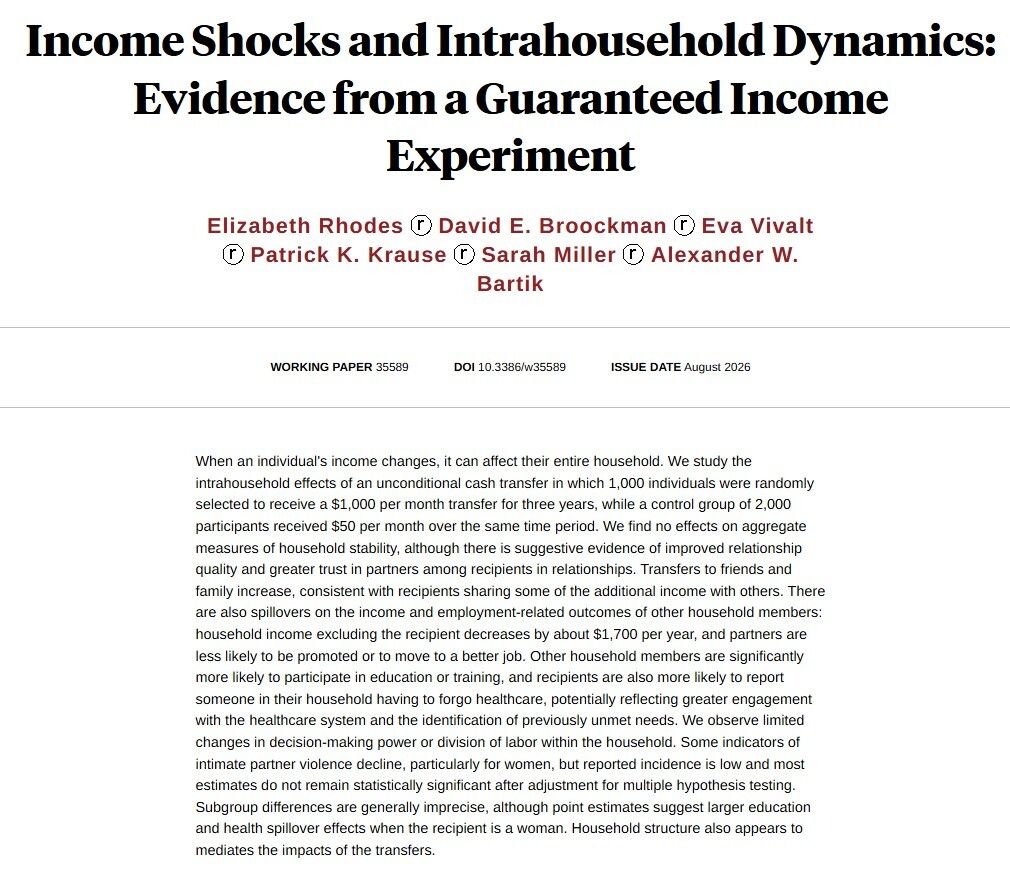
A randomized unconditional cash transfer of $1,000 per month for 3 years had spillover effects onto non-recipient household members but did not change household structure, from @elizabethrds, @dbroockman, @evavivalt, @pat_k_krause, @smilleralert, and @alexbartik https://t.co/PSlBykSyI2
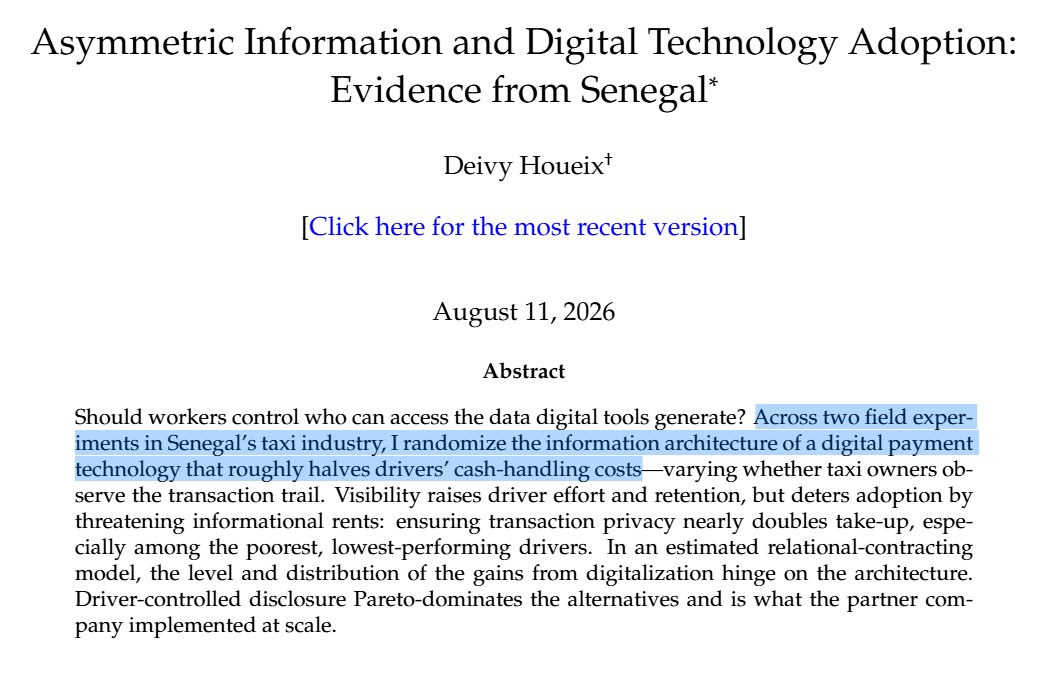
Yes! The first-order effect of AI on academic work is "the ambition should be higher". I am still trying to get this right myself - it isn't easy. @DeivyHoueix's job market paper is a great example. Read that highlighted text carefully...
New paper:
Cautious Careers: Job Mobility under Incomplete Markets
w/@PDenderski@alexclymo@ayusufmercan
Idea:
1) Switching jobs is risky.
2) We are risk-averse.
3) Insurance markets are incomplete.
=>Workers avoid risky jobs
=>Lower wage growth & productivity
=>UI can help
Excited to see this in print after many years of work! Check out our experimental estimates of the effect of unearned income on both traditional measures of labor supply, and also usually difficult to measure margins of adjustment, such as time use, job quality & job search.
Recently accepted by #QJE: “The Employment Effects of a Guaranteed Income: Experimental Evidence from Two U.S. States,” by Vivalt, Rhodes, Bartik, Broockman, Krause, and Miller: https://t.co/ajM7dJzVY4
Recently accepted by #QJE: “The Employment Effects of a Guaranteed Income: Experimental Evidence from Two U.S. States,” by Vivalt, Rhodes, Bartik, Broockman, Krause, and Miller: https://t.co/ajM7dJzVY4
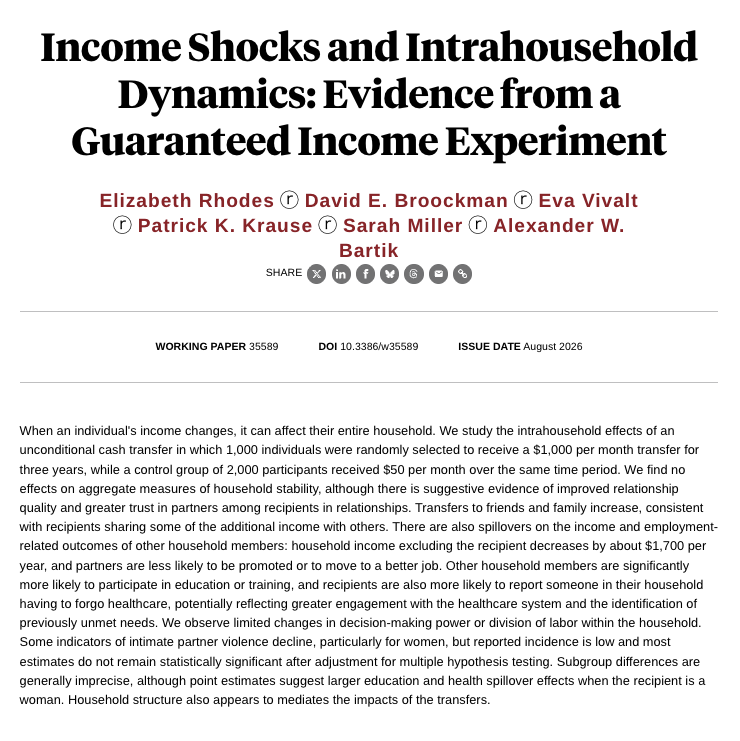
What happens when someone receives $1,000/month for 3 years? The effects don't stop with the recipient.
In this new NBER working paper, we examine what changed for partners, households, friends & family after 1,000 people received $1,000/month with 2,000 in a control group. 🧵1/
We are introducing a very early research preview of Letta Code.
Letta Code is our solution to the terminal-based coding assistant, but with state and learning built in.
No more compactions. Just specialist agents that learn your code with every commit.
New pre-doc positions: @arpitrage and I are hiring for two pre-docs, one to start ASAP and one to start next Fall, to help expand our work using LLMs to measure and study zoning codes in the US.
Please apply here: https://t.co/LdclIM9LAg
🚨New predoc positions!🚨
Join @AlexBartik and me to work on developing LLM tools to analyze zoning regulations and their impacts on housing affordability.
One position starting at the "normal" cycle next year, and another ASAP.
Apply here: https://t.co/4ipNLuQ8zi
And here are older threads by coauthors @smilleralert@AlexBartik and @dbroockman on...
Health effects: https://t.co/Yde1jaIkoa
Financial health: https://t.co/WaWv6WNAnN
Political views and behavior: https://t.co/sI0b2dIqrh
We wrote a lot of papers. 😅
Forecast the results of a randomized controlled trial designed by @alexbartik, @bryanstuart, and @SChizeck that evaluates the impact of labor market information on potential job seekers in Pennsylvania. Link in thread below. (1/3)
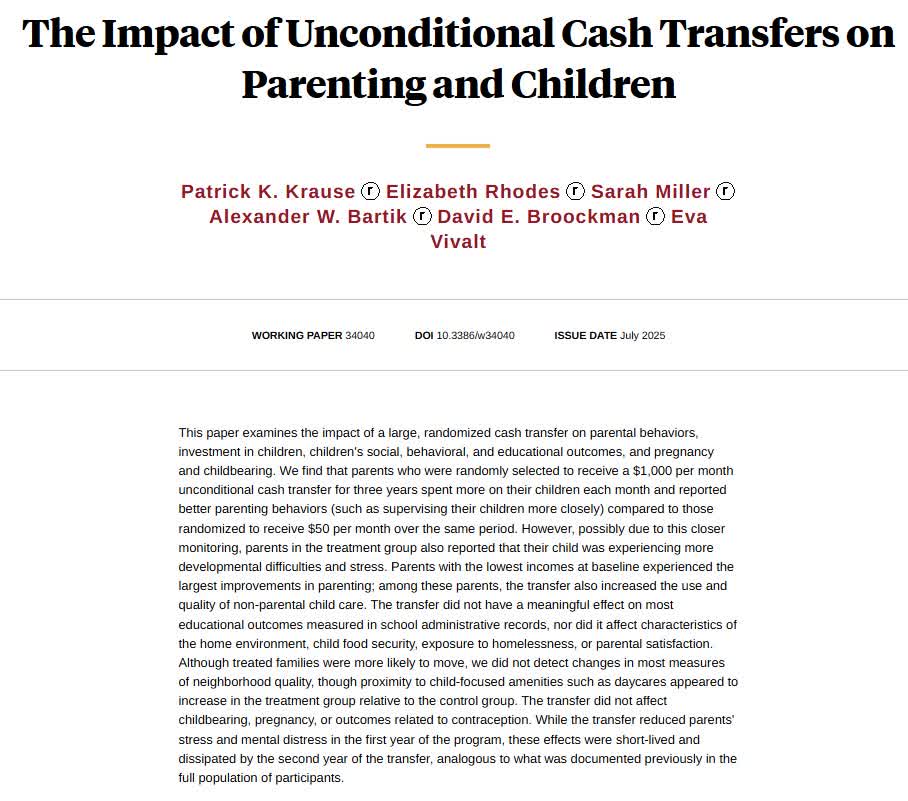
1000 low income adults were randomly selected to receive $1000/month for 3 years, with a control group receiving $50/month over that same period. Many of them had children in the household. How did it affect how they parented and their kids?
Forecast the results of a randomized controlled trial designed by @alexbartik, @bryanstuart, and @SChizeck that evaluates the impact of labor market information on potential job seekers in Pennsylvania. Link in thread below. (1/3)
Forecast the results of a randomized controlled trial designed by @alexbartik, @bryanstuart, and @SChizeck that evaluates the impact of labor market information on potential job seekers in Pennsylvania. Link in thread below. (1/3)
About 3,500 individuals in the treatment group received access to a website that provides information about tailored occupations based on the individual's preferences and experiences, while around 3,500 individuals were assigned to a control arm. (2/3)