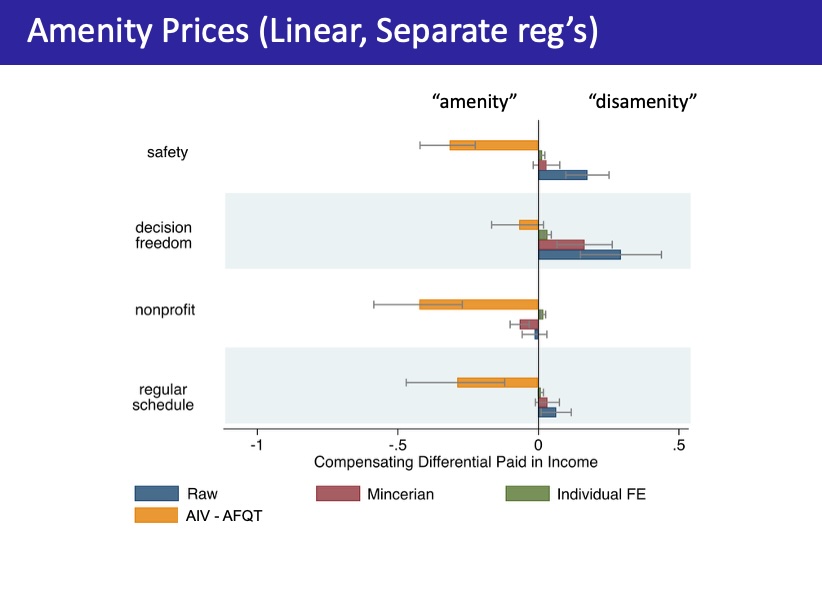
Why do compensating wage differentials often come out "wrong-signed?" Safe jobs that pay more, not less. I just posted my PhD lecture notes — here’s a roadmap of the literature and where I see it headed.
If you teach or study labor, here’s the full deck: https://t.co/BilTTrRpai. Would love to hear how others present compensating differentials and the puzzles that remain!
Why do compensating wage differentials often come out "wrong-signed?" Safe jobs that pay more, not less. I just posted my PhD lecture notes — here’s a roadmap of the literature and where I see it headed.
Important new frontier will be to bring job amenities into standard income decompositions. Ex: costly amenities account for ~2/3 of gender pay gap in the US — suggesting policies targeting how labor markets price non-wage amenities could have major traction.
Just out: my new column for @equitablegrowth on how to estimate the price of job amenities using the “anti-instrument” method—and why traditional approaches miss what workers actually give up for meaning, safety, and schedule stability.
#EconTwitter#laborecon
"When workers choose jobs with predictable schedules, safer conditions, or greater autonomy, they are often paying a price: lower wages."
@alexbellecon on a new approach to measuring job amenities, and how amenity trade-offs relate to the gender pay gap:
https://t.co/bv7oT2JFoV
In 2020 and 2021, the U.S. government responded to an unprecedented public health emergency with unprecedented investments in income supports.
Researchers moved quickly to study the effect of these investments. Too fast, in fact, for most of us to digest their conclusions! 1/15
A great read: my latest piece on early evidence surrounding pandemic spending programs, just released as part of @equitablegrowth's new series "The Recovery Reports." See the full series here https://t.co/LxFh0ZlEZO
NEW 🚨 We just released the #RecoveryReports, a collection of four reports examining key aspects of some of the most important public policy decisions in 2020 and 2021, from the Child Tax Credit to the Paycheck Protection Program.
*Alert* New research finds sig. differences in access to unemployment benefits during pandemic. Research was funded by @USDOL's Summer Equity Challenge. Authors: @alexbellecon@TJ_Hedin Peter Mannino, Roozbeh Moghadam, @GeoffSchnorr@TillvonWachter. https://t.co/cJmJaz7BS2 (1/10)
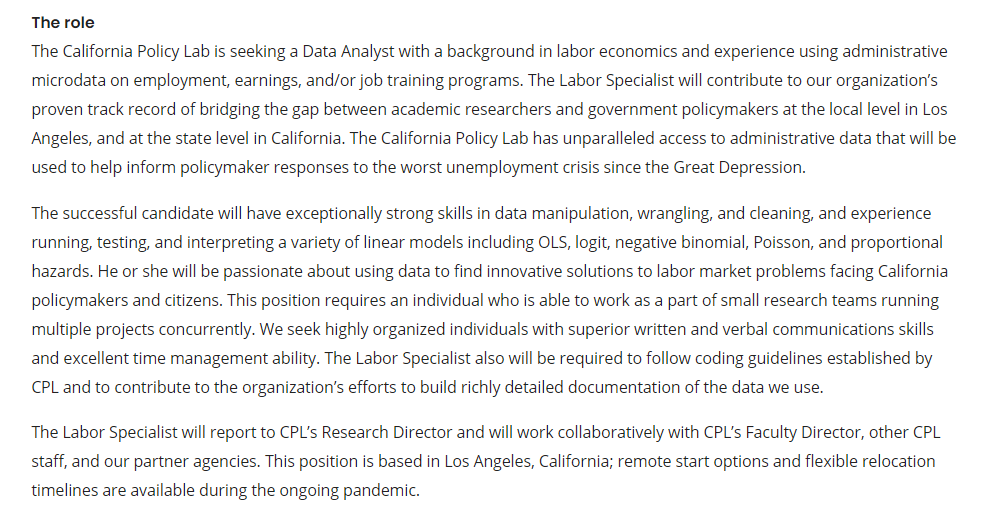
*Hiring Alert* We (@CAPolicyLab's UCLA team) are hiring a Data Analyst w/ a background in labor economics. The analyst will work with me + our team to study the labor market by leveraging CPL's access to multiple sources of administrative data
https://t.co/XAKLLjbSmY #EconTwitter
Today is the 1 year anniversary of CPL's 1st UI Report, released April 29th, 2020. Since then, our team (@alexbellecon@TJ_Hedin Roozbeh Moghadam, Geoff Schnorr, & @TillvonWachter) has written 15 more pieces, shedding light on the unemployment crisis in real time. Thread: (1/14)
@RussellGraceIR@ENPancotti That sounds very shocking and frustrating. In case it's of help, we have a state-level appendix. In IL, TUR fell below the threshold for HUP in mid-Jan, so that might help explain why the 7 extra weeks suddenly stopped being available for February.
https://t.co/YpyEDRBKF5
Why have Extended Unemployment Benefits already "turned off" in 33 states? New report by @alexbellecon@TJ_Hedin, Geoff Schnorr, and @TillvonWachter: https://t.co/WPdLsAg0qe Thread (1/x)