Two Kinds of Free Speech
Chinese nationalists love telling the West: "You don't have real free speech either."
Okay. Let's compare. Not slogans, cases.
In China, the powerful have a name that can't be touched.
Luo Changping, a former investigative journalist, wrote one sarcastic post about Chinese soldiers in the Korean War movie hype. Sentenced to 7 months in prison (2022) for "damaging the reputation of heroes and martyrs."
Qiu Ziming, a blogger with 2.5 million followers, questioned the official death toll from the Galwan border clash. Sentenced to 8 months (2021), and made to apologize on state TV.
BYD sued a car blogger for trashing its cars and won ¥313,800 plus a public apology. Regulators shut his account down on top of that.
And when a car review site proves a problem? In October, Dongchedi bought brand-new Huawei-backed Zunjie V800s with its own money and slammed the brakes from 100 km/h. In three cars out of three, the brake pedal bracket snapped. One car had 3 km on it.
The government did open an investigation into the car. But within about a week, the test videos had vanished from Douyin, WeChat, Bilibili, Weibo, even Dongchedi's own app. No one has explained who ordered it.
A broken brake is a safety issue. A video of a broken brake, apparently, is a bigger one.
But ordinary people have no name at all.
Zheng Linghua, 23, dyed her hair pink and posted a photo with her grandfather to celebrate getting into grad school. Strangers called her a whore, a "demon," an old man's mistress. She tried to fight back legally: months of collecting evidence, chasing platforms, finding lawyers. She was diagnosed with depression. She died in January 2023.
No 7 months for anyone. No state TV apology. Her abusers just moved on to the next target.
Now look at America.
You can call the President an idiot, a fascist, a clown, every day, on TV, and nothing happens. That's not a loophole. The Supreme Court built it on purpose. New York Times v. Sullivan (1964): public figures must prove "actual malice" to win a defamation case. Hustler v. Falwell (1988): you can even mock a famous preacher in a vulgar parody. The more power you have, the more criticism you have to take.
But there's still a line. Threats aren't speech. Last month in Kansas, a 24-year-old commented "Let's shoot Trump" on Facebook before a rally. Federal agents arrested him within days.
And when the powerful attack the powerless? Two Black election workers in Georgia, Ruby Freeman and her daughter Shaye Moss, were falsely accused by Rudy Giuliani, Trump's own lawyer, of rigging the 2020 election. They got death threats. They sued. A jury awarded them $148 million.
Sandy Hook parents were told by Alex Jones that their murdered children were "actors." Courts ordered him to pay over $1.4 billion.
Ordinary people, beating the most powerful men in the room.
So here's the difference.
In China, freedom points down. You can't touch the people above you, so you're "free" to crush the people below you. Free to bully a girl with pink hair. Free to call a foreign athlete a monkey. Free to dox a stranger. That's not freedom. That's permission.
In America, freedom points up. Mock the President all you want. But if you lie about a nobody and wreck her life, the law, and usually a crowd of strangers online, comes for you.
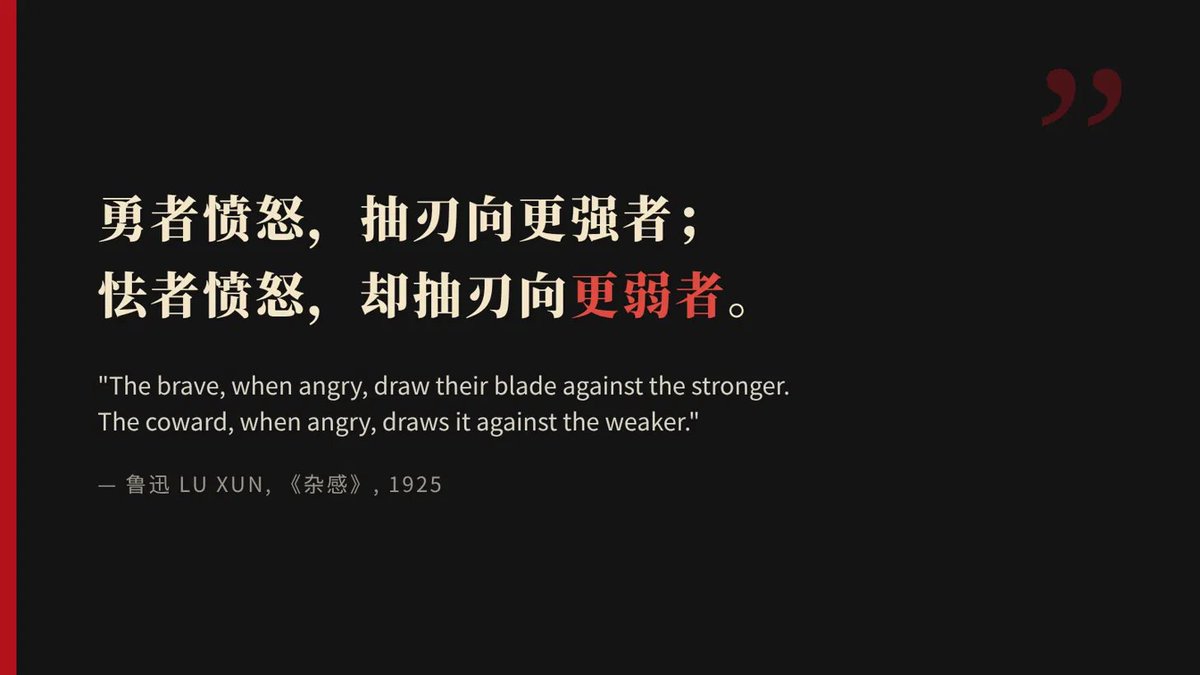
Lu Xun wrote this almost exactly 100 years ago:
勇者愤怒,抽刃向更强者;怯者愤怒,却抽刃向更弱者。
"The brave, when angry, draw their blade against the stronger. The coward, when angry, draws it against the weaker."
A civilized country isn't one that bows to the strong and stomps on the weak.
So I'll ask you: which freedom would you want? The freedom to criticize those in power, or the freedom to bully those who can't fight back?
The China I love is made of people who stand up for what's right, not social Darwinists who kneel to the strong and prey on the weak.
The CCP is sending bots to attack anyone who posts this story today:
Rahile Omer was just 14 years old when she was sent to a Uyghur re-education camp for "illegally gathering to disturb social order."
Now, she's dead, and the CCP won't say how or why.
Her case was widely publicized in 2022 when thousands of secret Chinese police files were leaked.
She spent nearly half of her life in the camp. Dead at age 23 for the crime of being Uyghur.