We release our:
- blog (https://t.co/P5IT51rB5y) and
- code (https://t.co/4jjN0YanSs)
for how we solved the ARC-AGI-3 preview games in 1,069 actions, the fewest publicly reported.
Many thanks to @duke_nlp and @arcprize!
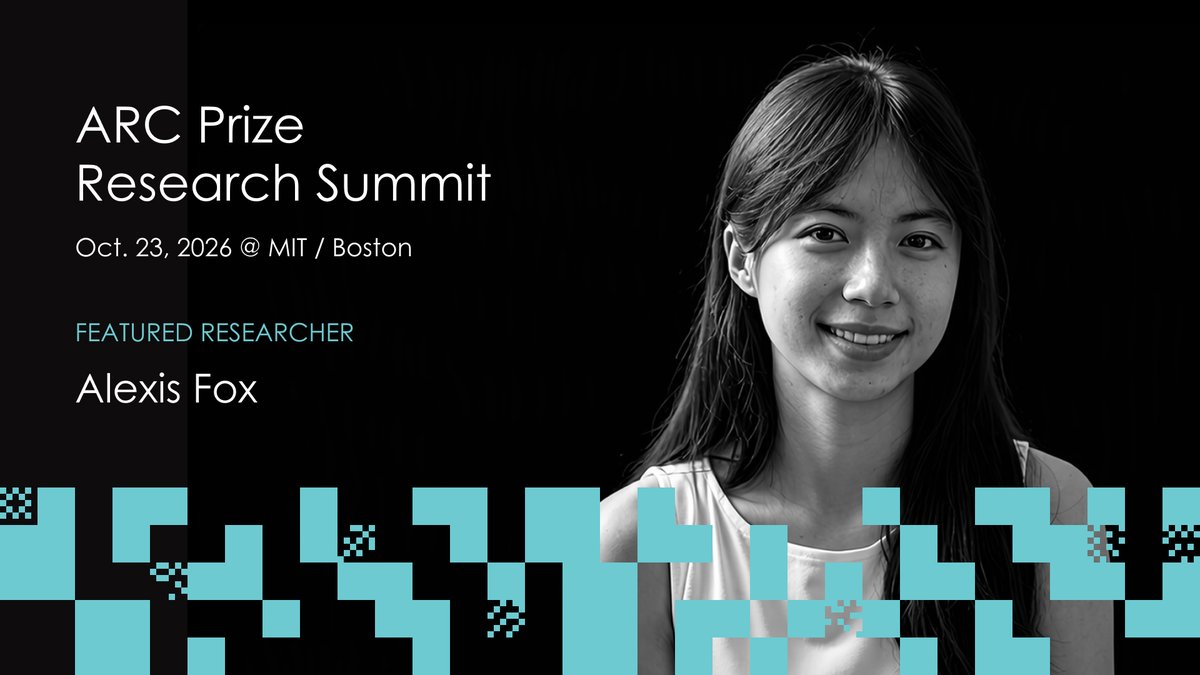
ARC Prize Research Summit - @alexisxfox
On programatic memory for long-horizon agents. Alexis and her team made key contributions to the early ARC-AGI-3 red teaming efforts.
Announcing ARC Prize Research Summit 2026 Research Speaker
@alexisfox is a researcher at Duke University exploring how AI can reason over longer horizons, and lead author of PRO-LONG, which uses programmatic memory to support long-horizon reasoning.
@DavidDAfrica is this an attention sink effect? also definitely can believe that models could (if not already) re-encode in a way that makes concepts much less linearly decodable.
Thoughts on AVO:
* Access to full memory - This is a becoming a common mechanic across all harnesses that are doing well on v3. It makes sense, using an unlimited memory store is an advantage computers have over humans. Humans had to externalize their memory store over thousands of years (written down knowledge / population memory).
* Their architecture image says that AVO gets "Solution lineage + candidate + scores." It's unclear if this meant human guidance on how to solve v3? or other v3 like games with thoughts on beating it? The paper focused on their CUDA attention kernel w/o more detail
* Code execution is key, as also seen by @alexisfox in the Prolong paper
* I wish they shared scorecards + replay links so we can view the replays manually. The cool graphic they posted doesn't have the detail per step to analyze the game.
* I appreciate the authors clarification that his is the public set and not the verified private set. I want to play around with this system
some quick thoughts --
(1) I would note that it’s difficult to overfit to ARC-AGI-3 with a harness that the model wasn’t “trained” in. 90%+ of harnesses changes we tried were not (or barely) better than a simple agent baseline. The main changes we found helpful were +coding capabilities and +full log.
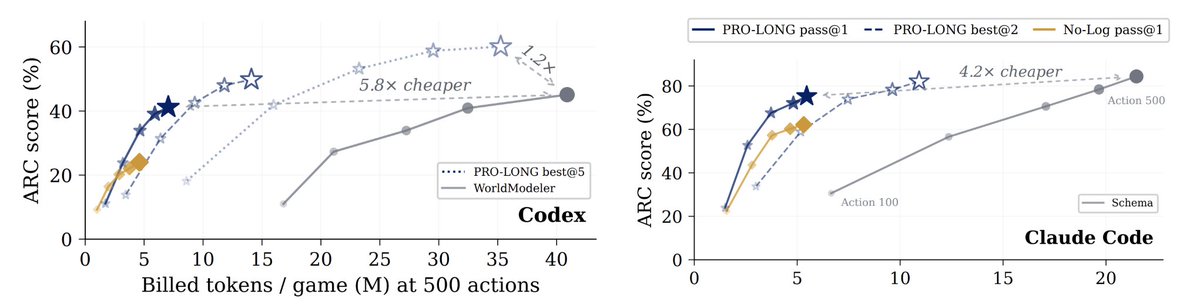
(2) which was the motivation for pro-long, that we can get away with much cheaper ways to hill-climb ARC, both in terms of raw tokens used and API costs -- i.e. we were able to run ~5x cheaper than more elaborate harnesses, like “world modelers.”
i've played acoustic drums for over half my life, but have never dabbled in production. this fully-featured in-browser drum machine is my little foray into that world - try it out and drop your fav beats!
🧵(3/3)
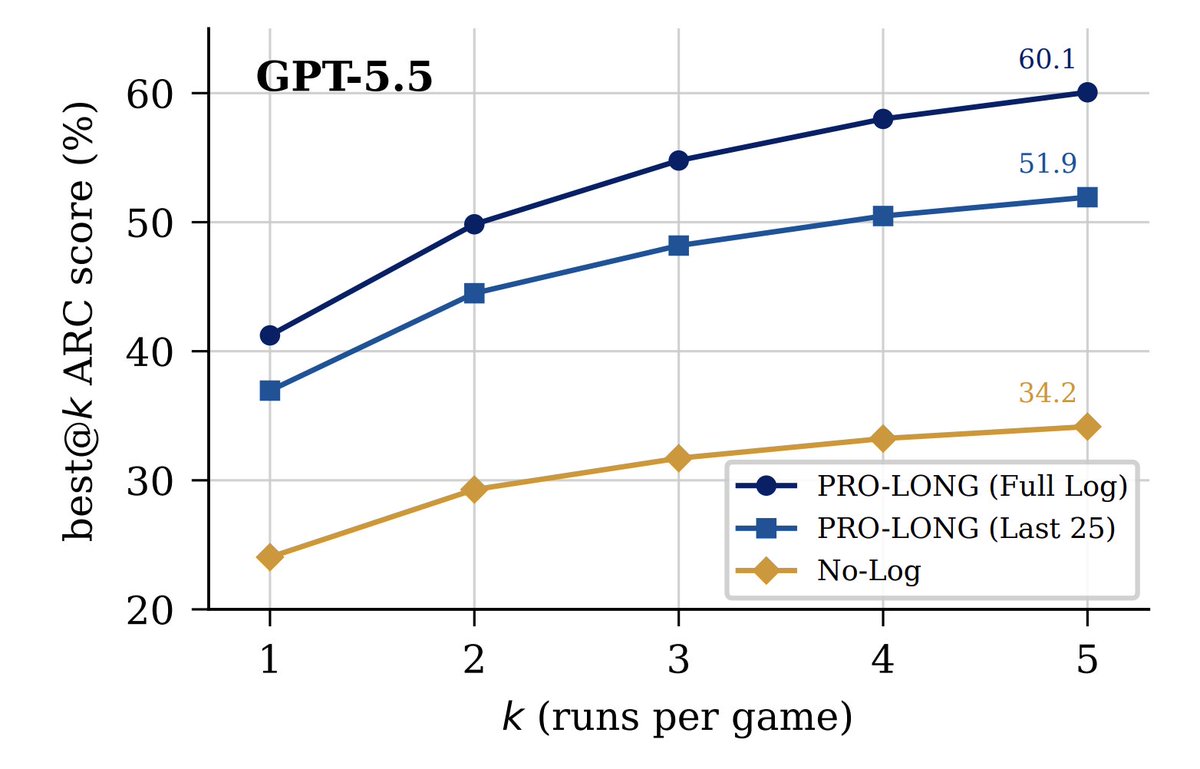
We see significant variance across runs; for GPT-5.5, best@5 is ~19 points above pass@1 (41.2 → 60.1). This motivates posting best@k results where possible, and leaves a lot of room for methods that close the pass@1 ↔ best@k gap.
PRO-LONG scores 𝟗𝟕.𝟒% on public ARC-AGI-3 for $1,750 with Fable 5; ~𝟒𝐱 cheaper (400 million tokens less) than best prior harnesses.
We introduce PRO-LONG -- 𝐩𝐫𝐨grammatic memory for 𝐥𝐨𝐧𝐠-horizon reasoning.
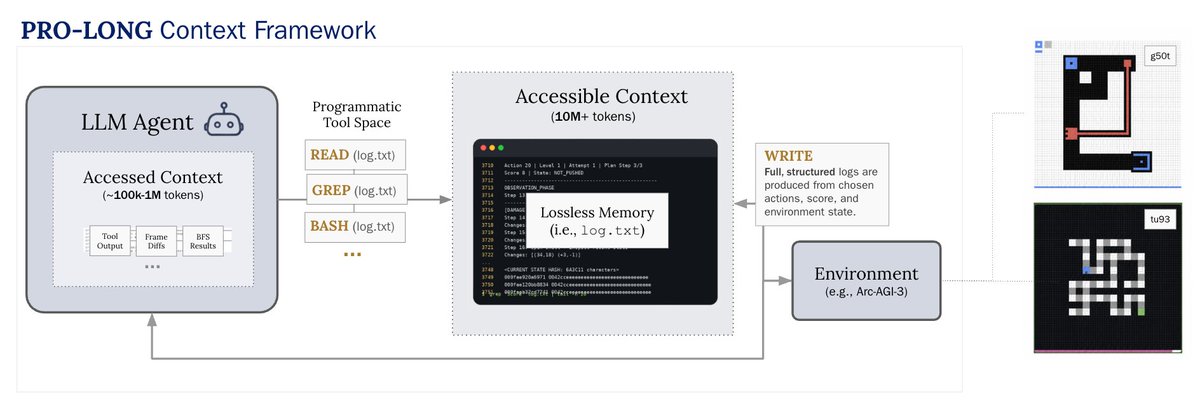
Simple harnesses work; ours is a minimal memory addition through structured search over a log.txt and a 30-line prompt.
We release our paper: https://t.co/RT6rqkyDSO
Along with our code, logs, and scorecards: https://t.co/NQIhOKrBdn
Work with @JunlinWang3 , @PaulRosu11 , and @bhuwandhingra at @duke_nlp, with many thanks to the @arcprize foundation for their support and helpful discussions.
🧵(2/3)
PRO-LONG was built with principles of (a) simplicity (b) losslessness of information and (c) compatibility with coding agents. Our harness keeps a structured log of environment states (e.g., boards, actions, and score) and summarized plans over the full trajectory; the read is programmatic search over this log.txt, which we find stays tractable for 100k+ lines.
We claim that:
(1) Programmatic perception and reasoning, like using code to parse board grids, model game transitions (coded “world models”), and BFS planning, are broadly effective for continual learning tasks,
(2) Simple harnesses can elicit these behaviors, with PRO-LONG a minimal but highly effective instance
🧵(1/3)
On matched scoring setups (500 actions, all 25 games), PRO-LONG is 𝟒.𝟐-𝟓.𝟖𝐱 cheaper across all frontier models tested -- GPT 5.5, Opus 4.6, Fable 5 -- while matching or exceeding specialized harnesses like multi-agent and world-model systems, e.g. Schema and WorldModeler.
On average, PRO-LONG improves over a base coding agent by 18 percentage points.
We often pay for context our agents don't need for the task at hand
You may let agents edit their own context, but grepping quickly becomes wasteful + cut context is lost forever
Decant explores context as a list of message objs with flexible fidelity
Blog + Thread 🧵 (1/6)
A much better idea would be to actually use this as a test of harnesses themselves!
Eg how well does Opus 4.6 do
In Claude Code
In OpenCode
In OpenClaw
In Perplexity computer
Agentic learning is driven by the harness people
Announcing ARC-AGI-3
The only unsaturated agentic intelligence benchmark in the world
Humans score 100%, AI <1%
This human-AI gap demonstrates we do not yet have AGI
Most benchmarks test what models already know, ARC-AGI-3 tests how they learn