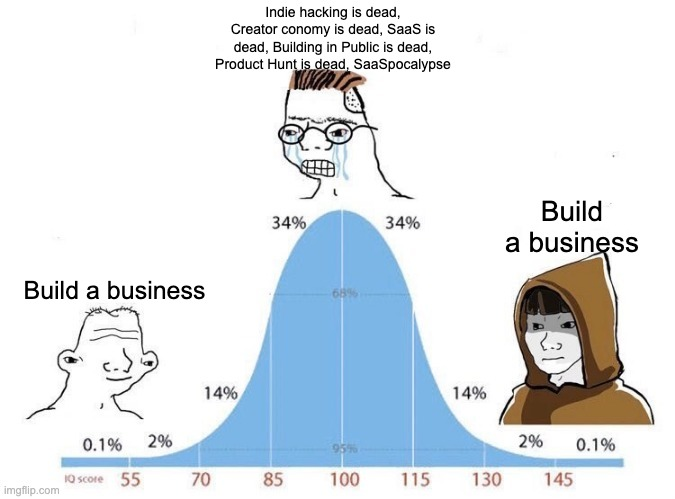
Every year it's the same. Something is dead, the window closed, it's too late
And every year, the people who ignore it and just build put themselves in a position to get "lucky"
Maniacally focus on driving a huge amount of value for customers with real problems and keep going!
I strongly believe that people create problems because they have too much time. The mind needs to be fed with something – it is neutral – it eats what ever you feed it.
Communication experts agree on something unsettling: the media builds a second reality, and people treat it as the real one.
Communication experts came to this conclusion: the mass media has the power to create a new reality. People orient themselves around what they hear and what they see, from any source — and they’re no longer as limited as people who never had access to such means.
The entire content of dramas and sitcoms shown on television is treated as valid, useful, instructive — in a word, good for life.
As though it weren’t fiction at all. When solving family problems, people admit they remember how a similar problem was solved on TV, and often, out of several options, they pick the one closest to what they saw on screen.
You're Not Bad at Getting Things Done — You Just Never Ran the Experiment
"I spend most of my time wondering what's the best way to go about the task."
If that lives in your head — it's textbook perfectionism. Endless waiting is perfectionism, because you're holding out for perfect conditions that never come. The truth is simpler: perfect is when you start with what's already in your hands.
At the root sits one thing: the fear of the "wrong" choice. That fear freezes you and kills momentum. But here's the reframe — every step forward, in any direction, is a step toward discovery. No move is wasted when you're learning about yourself.
So stop trying to think your way to the perfect path. You can't.
The antidote: 1% per day. Instead of hunting forever for the "best" method, run experiments on yourself. How could you know what resonates if you never try? That's exactly why it terrifies the perfectionist — experimentation is their worst nightmare, because the result is uncertain and you might be "wrong."
Start modestly. Don't know what you want? Guess. Roll the dice. Everyone's curious about something — pick it, do it for a week, two weeks, two months. Maybe you love it, maybe not. Both are wins, because now you know.
Brace yourself for the unsexy part: small progress. Nothing happens overnight. Be patient, be consistent, and accept that progress zigzags.
Most of all — see what works for you. Run the experiments:
Night or day?
Alone or in a team?
Coffee or none?
Schedule or freedom?
Can you function on no sleep?
The questions are infinite, and nobody online can answer them for you. You master your productivity by testing, observing, and adjusting.
So treat your life like a lab. Test for a week, keep what works, toss what doesn't — and you'll conquer the indecision and finally thrive as someone who acts instead of wonders.
You were never bad at this. You just never ran the experiment.
Erling Haaland doesn’t sleep like a normal person.
He treats sleep like a performance drug.
Just 6 body signals that tell his nervous system it's safe to sleep:
1. Wear blue-blocking glasses 3 hrs before bedtime.
You are not more intelligent than others if you overthinking every detail (telling yourself you are smart and want to see all the possibilities) and you are not taking action, which is always the only answer.
You’re not bad at discipline , you were just never taught that your perfectionism is the discipline.
It’s discipline wearing a really convincing disguise, like a burglar in a business suit.