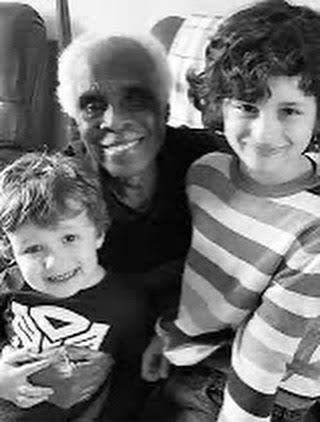
Titus Okere: He holds the record as the first Nigerian to play professional football in England:
His name is Titus Davis Okere. He was born on March 22nd 1929 in Ngor Okpala, Owerri, present Imo State.
He is the first Nigerian to sign professional football abroad in the year 1953.
He started with Zik's Athletic Club Bombers in Port Harcourt in 1938 after he impressed Dr Nnamdi Azikiwe himself.
Later he moved to Lagos to join Lagos Railways FC where he captained the team in 1948 and won trophies.
At just 20 years old, he was selected as one of the 18 pioneers called the UK Tourists, that is the first ever Nigeria national team that toured England in August and September 1949. They played barefoot.
They played nine matches against English amateur sides like Bishop Auckland, Dulwich Hamlet and South Liverpool, won two, drew two and lost five. On October 8th 1949, after that UK tour, he scored Nigeria's first ever official international goal in a 2-0 win against Sierra Leone in Freetown in front of 15,000 fans.
British press loved him. Edgar Kail of Daily Graphic described him as fast and brilliant and said he could play in most European league sides.
Liverpool Echo of September 1st 1949 also praised his speed at outside left.
In February 1953 he made history by signing for Swindon Town FC in England.
That made him the first Nigerian citizen to play professional football in Europe. He also later played for Chippenham United. His stay at Swindon was not very successful because of winter and settling issues, but the history is there.
After that 1953 move, he never returned to Nigeria. He settled quietly in Kent, about 61 kilometres from London. He became known as the last of the firsts, because he was the last surviving member of the 1949 UK Tourists after goalkeeper Sam Ibiam died in 2015.
He died on June 14th 2023 in Kent at age 94.
His burial was at Bluebell Hill Crematorium in Kent. His granddaughter Frances Okere announced it. NFF paid tribute to him as a pioneer football ambassador.
What time will it be right for Nigerian government to make using horn by motorists, particularly articulated vehicle drivers, to harras other drivers an offence?
THE MIDNIGHT CABINET: INSIDE THE OCCULT ECONOMY OF NIGERIAN POWER
By Kio Amachree
Letters from Stockholm
THE QUESTION SOYINKA ASKED
Wole Soyinka once threw down a challenge that no Nigerian has ever been able to answer. Speaking at an education summit in Port Harcourt, the Nobel Laureate asked his audience to name a single Nigerian head of state who had not been consulting marabouts and prophets, sacrificing goats and animals in the dead of night, in pursuit of a third term or continued power. The silence that followed was itself the answer. Behind the official Nigeria of constitutions, ballot boxes and inauguration ceremonies operates a second government, a midnight cabinet of babalawos, marabouts, dibias, prophets and self-styled seers to whom the political class outsources its ambitions, its fears and, too often, its judgment.
This is not folklore. It is the operating system of Nigerian power, and it deserves the scrutiny of an exposé rather than the wink of a rumor.
THE FATHER OF SECRETS
To understand why politicians flock to these men, one must first understand what they are. Babalawo means father of secrets in Yoruba, a title denoting a high priest of the Ifa oracle, the divination system representing the teachings of Orunmila, the orisha of wisdom. Ifa is a living archive of Yoruba cosmology, with 256 Odu each containing hundreds of poetic verses addressing health, justice, love, farming, politics and destiny, recognized by UNESCO as a Masterpiece of the Oral and Intangible Heritage of Humanity. In pre-colonial Yorubaland the babalawo was priest, judge and legal scholar in one; community elders and disputants appealed to his divination to settle matters from theft to land disputes, and the outcomes of Ifa consultations were treated with a seriousness akin to a judicial verdict.
That is the dignified inheritance. What the political class has done with it is another matter entirely. The genuine Ifa priest, the custodian of proverbs and moral philosophy, has been crowded out in the corridors of power by a mercenary caste of spiritual contractors, the marabout with his Senegalese pedigree, the prophet with his camera crew, the shrine priest with his register of frightened clients. The marabouts were Islamic priests who combined Islam with the syncretic practice of local healers, fortune tellers, spiritual guides and diviners, and today virtually all Nigerian politicians seek mysticism, whether from Islamic mullahs, clergy, babalawo or Senegalese marabouts, to guarantee their political happiness and success.
WHY THEY FLOCK
Bishop Matthew Hassan Kukah, one of Nigeria’s most respected clerics, offered the most honest diagnosis on record. In a 2021 interview with Toyin Falola, Kukah accused Nigerian politicians of consulting diviners and performing rituals to win elections, observing that politicians do not believe they can win through hard work. In a system where elections are decided by godfathers, rigging and judicial roulette rather than by voters, the rational politician hedges every bet, terrestrial and celestial. The occult consultation is not primarily religion. It is insurance, intelligence gathering and psychological warfare rolled into one.
There is also the matter of enforcement. In a state where contracts are unenforceable and betrayal is the national sport of politics, the shrine oath became the only binding instrument the political class trusts. Members of the political elite regularly visit shrines to swear oaths, ask for a deity’s blessing, or seek spiritual defense against political enemies, and in 2004 police discovered dozens of corpses at a shrine in Okija in Anambra State where many of the state’s senior politicians had apparently sworn oaths. The Okija revelations remain the single most documented window into this underworld. It was widely reported that godfather Chris Uba had sent Governor Chris Ngige to one of the most feared traditional shrines in Anambra State to swear his loyalty in a blood oath, believers holding that violating such an oath results in catastrophe and possibly death. Prominent politicians travelled to Okija from states as distant as Sokoto and Adamawa to take secret oaths often aimed at sharing the resources of the state and protecting ill-gotten wealth. The late historian Stephen Ellis, in his landmark study of the shrine, traced this clandestine political system back through colonial Indirect Rule, showing that the informal politics of shrines credited with powers of life and death attracts even national politicians.
ABACHA: THE PRISONER OF HIS OWN SOOTHSAYERS
No case illustrates the futility of it all better than General Sani Abacha. Here was a man with absolute power, a decree placing his government above the courts, a personal security force trained abroad, and billions looted into Swiss vaults. Yet he governed as a hostage to his own diviners. During his draconian rule, marabouts were allegedly imported from Senegal and other North African countries to garnish Aso Rock with a pot-pourri of Arabian and traditional African sacrifices, and hundreds of cows were said to have been buried around the Villa and the outposts of Abuja.
The soothsayers did not liberate Abacha. They imprisoned him. Femi Adesina, later spokesman to President Buhari, recorded the absurdity: the marabouts so caged Abacha in Aso Rock that between November 1993 and June 1998 his local and foreign trips could be counted on the fingers of one hand; Oyo State was put on holiday for his commissioning of the Asejire Water Scheme and he never showed up, and Lagos was locked down for his visit to commission Marwa Gardens before he refused to appear at the last minute. A scholarly study of the era noted that personal dictatorship has the penchant, when all else fails, to resort to the world of spirits, the universe of soothsayers, diviners and sorcerers, and in Abacha’s case there was often direct presidential solicitation for prayers for his self-succession disguised as national prayers.
And then, on June 8, 1998, with all the buried cows and imported holy men at his beck and call, Abacha simply died in that same Villa he was too frightened to leave. No marabout foresaw it. No sacrifice prevented it. The most fortified man in Africa was undone in a single night. As one commentator acidly observed, despite these mundane primitive powers at his beck and call, Abacha was humbled by the most ordinary of mortal appetites.
He was not alone. General Ibrahim Babangida, fleeing Lagos after the Gideon Orkar coup, reportedly consolidated his spiritual power by sacrificing and burying live cows in Aso Rock. IBB still lost power in humiliation in 1993. Nasir el-Rufai’s memoir recounted how former Vice President Atiku Abubakar patronised and became a captive of marabouts, the same metaphysical agents that hallmarked the government of Abacha. Atiku has now lost the presidency six times. The pattern is unbroken: the juju always fails, and the believer always pays twice, first in cash, then in destiny.
TINUBU AND THE PERSISTENT WHISPERS
President Bola Tinubu is widely alleged in Lagos political folklore to be deeply immersed in this spiritual economy, and the whispers have followed him for three decades. It must be stated plainly that these are allegations he has never confirmed, and the most striking documented episode came not from him but to him. After the February 25, 2023 presidential poll, a group calling itself The White Witches and Wizards Association of Nigeria met in Calabar and declared its support for Tinubu’s presidency, its spokesman announcing that 300 witches and wizards had been mobilised to ensure that no harm comes near the president-elect. In what other democracy on earth does a self-declared witches association hold a press conference to announce metaphysical security detail for the incoming head of state, and nobody in government finds it necessary to respond?
Whatever the truth of Tinubu’s personal practice, the ecosystem around him thrives. In late 2025, Primate Elijah Ayodele of the INRI Evangelical Spiritual Church was accused of attempting to extort 150 million naira from then Minister of Power Bayo Adelabu for alleged spiritual intercession concerning the 2027 Oyo State governorship election. A serving federal minister, allegedly shopping for spiritual cover for an election two years away. This is the Nigeria of 2026, marching toward 2027 with its diviners on retainer.
THE ELECTION SEASON HARVEST
Election cycles are boom times for the trade. In Yorubaland, roads leading to aspirants’ houses are decorated with corn and millet sacrifices called aworo, meant to draw crowds of electors; fetish sacrifices adorned in palm oil litter the road intersections called oritameta; and seasons of politics are the moments when dibia, babalawo and marabouts make their fortunes from these politicians. The darker end of this market is deadly serious. Most Nigerians find the idea of ritual killings genuinely reprehensible, yet irrespective of their level of education a large number continue to believe that it works, and every election season the newspapers fill with the disappeared.
THE VERDICT
The prosecution rests on a simple observation. If the juju worked, Abacha would be alive and reigning. If the marabouts could deliver, Atiku would be finishing his second term. If buried cows conferred permanence, Babangida would never have stepped aside. Every strongman who mortgaged his judgment to the midnight cabinet was ultimately failed by it, because the diviner’s real client is never the politician. It is the politician’s fear. And fear, unlike Ifa’s genuine philosophical inheritance, produces nothing but invoices.
The tragedy is double. A profound indigenous intellectual tradition, the Ifa corpus that UNESCO honors and scholars study, has been debased into a protection racket for kleptocrats. And a nation of two hundred million people is governed by men who trust an opele chain more than an economic model, a shrine oath more than a constitution, and a Senegalese marabout more than the Nigerian people. Until leaders believe they can win by work rather than by wonder, as Bishop Kukah warned, the republic will keep sacrificing its future at midnight, one buried cow at a time.
Hashtags
NigerianPolitics OccultOfPower Babalawo Marabouts SaniAbacha AsoRock OkijaShrine Tinubu 2027Elections Ifa YorubaTradition Juju NigerianDemocracy Accountability WorldviewInternational LettersFromStockholm KioAmachree AfricanGovernance Soyinka Kukah
@COVENANTSTUDIO@ruffydfire Flooding that takes place in the developed world is always as a result of a natural phenomenon beyond human control and occurs once in many decades. It is never due to human or government negligence/ineptitude
@iOccupyNigeria When the people that run the government and manage the national resources believe it is their opportunity to enrich themselves and their families, they will not care what happens to the other people. An armed robber doesn't care what happens to his victim
@Gidi_Traffic flood has submerged Lekki. During the dry season the Min of physical planning goes full scale for revenue drive without clearing drains and plan for raining season
@Gidi_Traffic any politician that spends billions of naira to bribe the people or influence election results certainly does not mean to serve without fraudulent personal enrichment.
On 13 Jan 2025, @NatIndCourtNig ruled that the Police Service Commission lacked powers to forcibly retire a Deputy Inspector-General merely because his junior had become Inspector-General of @PoliceNG.
The case was filed by Ambakina Moses Jitoboh, the DIG from Bayelsa State who had been passed over 2ice for the post of IGP.
On the day the Court delivered its judgment, Jitoboh was in his 16th day in the mortuary. He had died on 28 December 2025. But because he insisted on Justice, this past week, the #JitobohPrecedent saved the careers of 8 DIGs & 21 AIGs.
Few people in life are able to point to such a legacy of impact at the end of their earthly race.
So, today, I pay tribute to the memory of Ambakina Moses Jitoboh whose stubborn commitment to doing things right reminds us why life is not always a popularity contest.
It is also a tribute to the work of his lawyer, @sjonu, who did the case despite the best efforts of many forces to intimidate him from pursuing it.🙏🙏🙏
https://t.co/prlfrg4gZF
@Gidi_Traffic@coastal road: why should a road that is not ready to be opened for use be commissioned? I tried to use it last week with a friend but got through many blocks that required pleading until one adamant one that forced us out of the road.
@Gidi_Traffic@lagostraffic961 When can Lagos State sanitise bus transportation such that everyone will find them decent enough for use? These bus arrangements have been abandoned to the, "Oshodi Oshodi Orile" operators.