GOOGLE $GOOGL JUST POSTED THIS
“You can now use Gemini in Google Slides to generate complete”
“Designing a compelling slide deck from scratch is one of the most time consuming tasks. Today we are making it dramatically easier with the power of Gemini.”
This is one of the most anti-crypto laws in the U.S.
It taxes the exchange, transfer, or storage of digital assets—you buy BTC, you pay a tax; you hold your BTC on Coinbase, you pay a tax; and so on.
There is effectively no comparable state financial transaction tax on stocks, bonds, or derivatives anywhere in the country. That means crypto is being singled out in violation of several federal laws.
Further, the approach makes little sense—you aren’t taxed if you exchange a stock, bond, or derivative in paper form, but you are taxed if they happen to be recorded on a blockchain? That’s like taxing email.
So, rather than embracing innovation and the cost efficiencies blockchains can deliver for ordinary people in Illinois, the state is poised to punish its entrepreneurs and citizens that want to use crypto.
This is a shame—it was only just recently that Illinois embraced a constructive approach to blockchain technology through the adoption of the effectively-scoped Digital Assets and Consumer Protection Act. This new tax is a complete 180.
When states adopt discriminatory, asset-specific taxes that drive builders and users elsewhere, we all lose.
Today @googlecloud and @PayPal published a blog with a corresponding demo announcing our new joint offering for merchants that want to deliver agentic commerce experiences inside their own surfaces.
Read more here: https://t.co/tVDXtJMR67
@acce
Today we introduced Gemini Enterprise, built with our most advanced Gemini models. It allows you to chat with your company’s documents, data and apps as well as build and deploy AI agents, all grounded in your information and context.
Have a look at how it helps you build an agent for almost anything:
PayPal is teaming up with @Google to bring smarter shopping to billions—think agentic commerce and PayPal checkout everywhere. Global scale, redefined. Excited for this new chapter in our partnership @sundarpichai 🚀
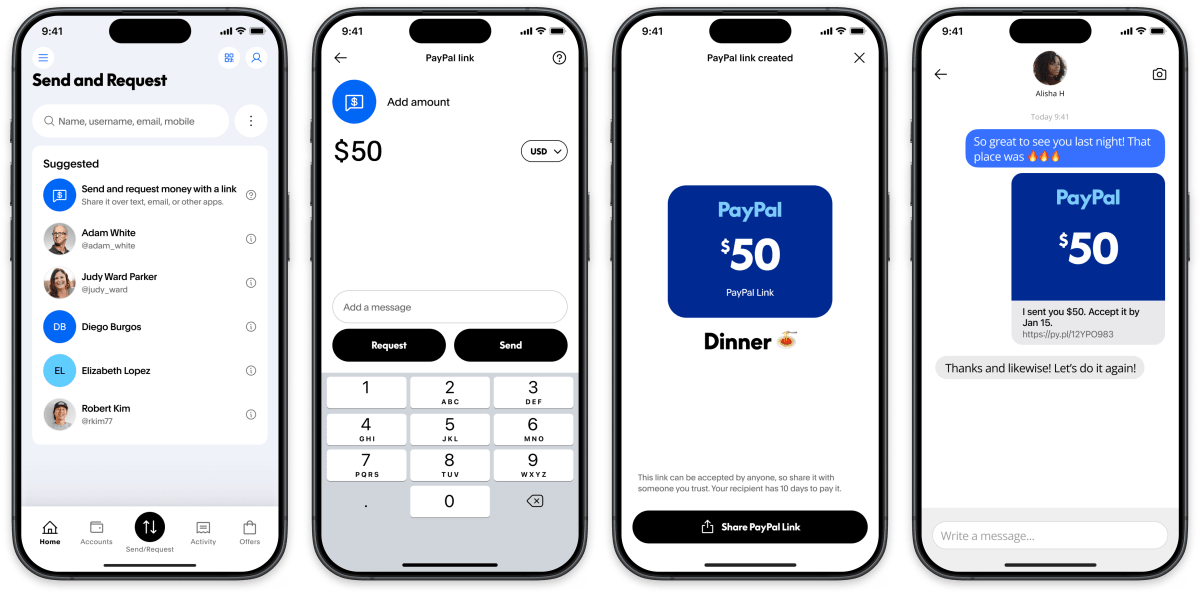
PayPal's Pay links feature is 10 years too late. But that doesn't matter at all.
People are losing their minds over PayPal launching personal links for P2P.
Wise and Cash App had this a decade ago.
But this is a buffer story about PayPal getting it's shit together and looking to dominate cross border.
---
Consider the timeline :
1998: PayPal invents peer-to-peer payments
2011: Wise is founded
2013: They acquire Venmo for $800M
2017: Banks launch Zelle and immediately start winning
2024: Zelle hits $1 trillion in transactions
2025: PayPal finally launches "Links"
---
What took them so long to launch an obvious feature?
PayPal became a sprawling acquisition machine.
Braintree, Venmo, Xoom—all operating as separate fiefdoms with different tech stacks.
Shipping velocity crawled as they tried to be everything to everyone.
Meanwhile their user base stagnated at 429 million while competitors surged.
---
My take?
PayPal is playing for a bit slice of cross border payments.
PayPal Links connects to their PayPal World platform
Launching this fall with Mercado Pago, UPI, and Tencent's Tenpay. Nearly 2 billion users across these networks.
While Zelle owns 54.6% of US P2P volume, they can't touch international transfers.
PayPal is playing to their cross-border strengths.
----
The crypto integration
Bitcoin, Ethereum, PYUSD—isn't a gimmick.
It's infrastructure for frictionless global transfers, building on partnerships with wallets worldwide.
So P2P links?
Yes jt is 10 years too late for US market dominance.
But PayPal is finally becoming coherent—one platform linking global payment ecosystems.
Domestic is table stakes. Global interoperability is the prize.