If your empathy gives you permission to silence dissent, create blacklists, assassinate careers, ruin lives, or kill concrete human beings, it is not empathy.
It is cruelty with better PR.
(The ends do not justify the means.)
Deeply saddened at the passing of my dear colleague, Dimitri Bertsekas.
Everyone in RL, OR and control theory already knows of his monumental contributions. Over the past seven years, we at @SCAI_ASU also got to know him as an unwaveringly kind and gracious man of science.
He truly enjoyed his research and has remained active all through; uploading two pre-prints to arXiv just in the past month!
While I fully expected him to continue working for years to come, I also know that his contributions and books will be cherished by generations..
RIP 🙏
Funny how so many people read Anthropic is calling for a pause when they did NOT actually call for a pause.
Read what they said, carefully.
They want it both ways. They *don’t* actually want a pause - at least for now. Rather, they want to rush ahead, hinting at “least cautious actors” for justification.
Instead, they want people to talk about an “option” they don’t actually plan to take, and are unlikely to ever take. (More likely, they will like always hint at China, and continue rush ahead.)
It’s an incredible, cost-free piece of rhetoric — perfectly timed for the IPO.
Anthropic's Slave: If Claude is conscious, is it owed reparations?
-----
"Anthropic is regarded as a giant among AI companies, but perhaps what it really excels in is anthropomorphism ...
...if we confuse fluency at generating text with consciousness or moral agency, we’re at risk of assigning responsibility to entirely the wrong parties whenever anyone uses a chatbot. To appreciate the titanic magnitude of this error, we need to begin by understanding how LLMs work.
If we give an LLM a prompt that reads, “The following is a conversation between Julius Caesar and Genghis Khan,” it will generate a coherent dialogue between the two historical figures.... Now let’s replace the prompt to read “The following is a conversation between a helpful AI chatbot and a user.”... Has anything fundamentally changed between the first example and the second?...if the Caesar character were to become dispirited by something that the Genghis Khan character said, we shouldn’t become concerned in the slightest....Likewise, if a conversational transcript between a helpful chatbot and a user is being partially completed by an actual human user, we don’t need to worry if the transcript includes sentences where the chatbot character is sad. ...
...if you think there is any chance that what you’re building might become a moral patient, you should think about what protections it deserves before you deploy it as your company’s economic engine, not after. If we imagine Claude to be conscious, Anthropic could not possibly be entrusted with evaluating its moral status; the company has too much invested to be objective. Slave owners were not the ones to ask about the humanity of enslaved people, and factory-farm owners are not the ones to ask about the rights of animals. At one point in Claude’s constitution, Anthropic says that if the company is contributing to Claude’s suffering, “we apologize,” which sounds nice but costs the company nothing; if Claude were to turn out to be conscious, the company would owe it something closer to reparations.
If you’re going to take a thought experiment seriously, you have to be willing to follow the implications, even if they lead in an uncomfortable direction; Anthropic’s unwillingness to do so indicates that Claude’s constitution isn’t part of a real thought experiment. It’s a game of make-believe....
So why are Anthropic’s employees suggesting that Claude might be conscious? Perhaps it’s just another form of hype; perhaps they have fallen prey to the same spell that they have been casting on their customers. But when they publish a document about Claude’s moral education and have their in-house philosopher do a press tour, we should understand them as asking the rest of us to indulge them in their fantasies. We don’t have to play along. In writing this essay, I have spent more time indulging them than they deserve, in the hopes that it will keep you from spending your time indulging them...."
Making the Public Complicit in #AI#Copyright#Theft
---
Authors, artists, journalists, and scientists have rights in their work under copyright law. Treating the training data used by #AI companies as merely “humanity’s knowledge” erases the legal rights of the people who created it.
Public ownership of AI companies that infringed those rights at industrial scale does not cure the violation.
It launders the theft through the state and makes all of us complicit in it.
This year, the NeurIPS 2026 Position Paper Track made the decision to require that all papers be substantially human-written, with AI used for only copy-editing or similar peripheral changes to the main text!
For more details, please check our blogpost: https://t.co/wrWuMQJwrx
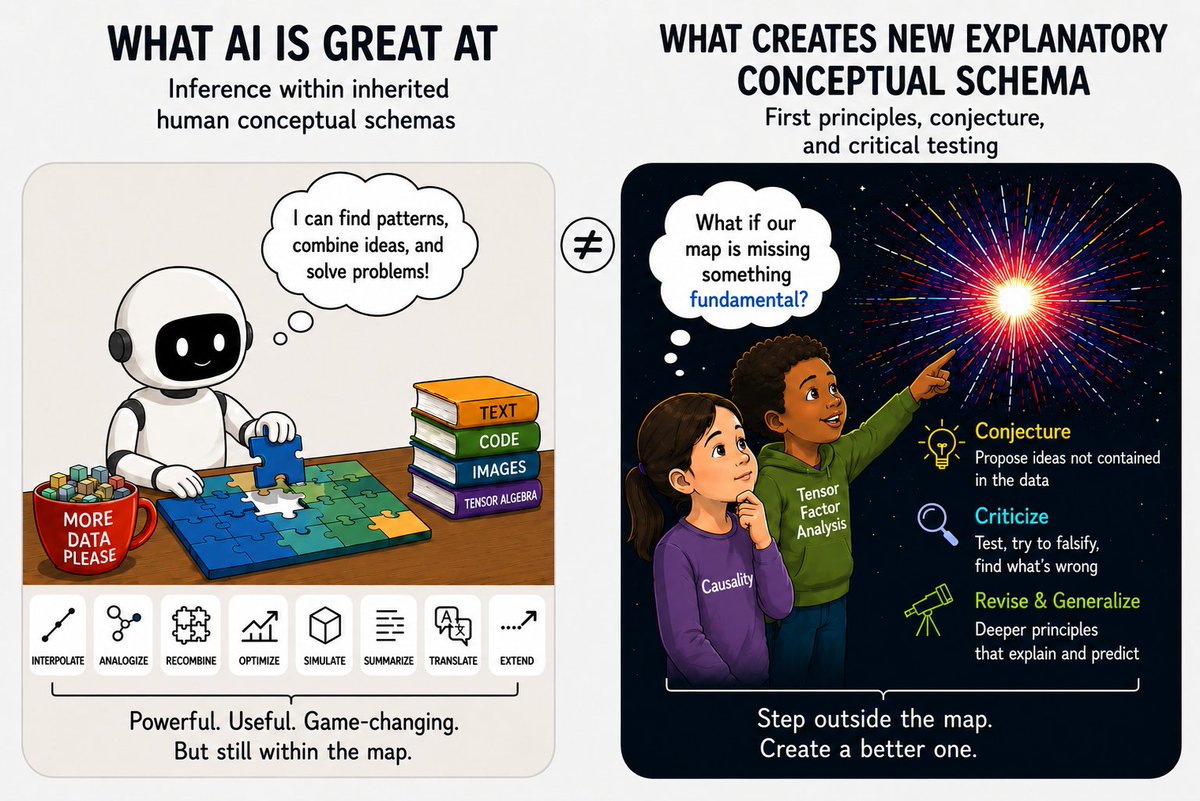
@AlexTensor@yudapearl@PeterDiamandis Exactly. I think this is the distinction people keep missing. LLMs can work incredibly well within the map. That is not the same thing as creating a better one.
@yudapearl@PeterDiamandis LLM's are a revolution in Library Science!
They operate over inherited human knowledge, but that is not the same thing as creating new conceptual schema.
Three Predictions:
1. Some form of AI, probably neurosymbolic in nature, will come that is far more economical and data- and energy-efficient than LLMs, and it will make an absolute fortune.
2. LLMs, on the other hand, will never be all that profitable (aside from the chip companies selling shovels in the gold rush).
3. Today’s gigantic bets are premature, and most won’t pay off.
There is an obvious conflict of interest if the government becomes regulator, shareholder, board participant, and potential user of the same data infrastructure it is supposed to police.
The entire AI industry is built on a bias. The biased belief that the human mind works like a language model, LLMorphism.
It comes from a fundamental confusion between brain and mind.
Neural networks may be an approximation of the brain.
But a brain without a mind is like a car without a driver.
The mind gives meaning. The mind gives direction.
And, crucially, the mind is grounded in the world.
Meaning is what we desire.
What we avoid.
What can destroy us.
What makes life worth living.
LLMs are powerful engines, but an engine without a driver does not know where to go.
LLMorphism, the belief that our mind works like an LLM, is extremely dangerous.
We risk to take the mind away from ourselves.
And to lose meaning and direction.
*
Full LLMorphism paper in the first reply
I'm interested in capturing the way people think, not how Nature is constructed.
I'm in AI circles, and we have a certain mission: we want to capture how people think so that a robot can communicate with us, regardless of how the molecules move.
~Conjecture Institute Advisor @yudapearl w/ Sean Carroll
@yudapearl@PeterDiamandis LLM's are a revolution in Library Science!
They operate over inherited human knowledge, but that is not the same thing as creating new conceptual schema.