Many teams treat email verification as an optional middle step.
It's actually one of the highest-leverage things you can do to protect your outbound.
Here’s why:
Bounce rates are the single metric inbox providers watch most closely.
A hard bounce, where an address simply doesn't exist, tells them you're sending to a list you never cleaned.
Send enough of those and providers start routing all of your mail to spam.
But not just the bad addresses, the valid ones too.
And a damaged sending domain takes weeks to recover.
So before you scale any outbound motion, the list has to be verified.
In @clay, that runs in five steps:
Step 1:
Bring your contacts into a Clay table, from a CSV, your CRM, or a Find People search.
Step 2:
Add a work-email waterfall if you're starting from names, querying providers in the order you set rather than a fixed sequence.
Step 3:
Add an email verification column and run it across the list, so every row comes back tagged: valid, invalid, catch-all, unknown, or role-based.
Step 4:
Filter on that status. Route the clean, deliverable addresses to your sequencer, hold the catch-alls for a more cautious send, and drop the invalids before they ever cost you a bounce.
Step 5:
Set the table to re-run on a schedule or when new rows arrive, so verification is continuous instead of a one-time cleanup you forget to repeat.
This is the kind of system we build with Clay at FastForward.
Because you simply can’t pretend deliverability isn’t a factor.
And not verifying your emails is a great way to crush deliverability.
Early in my career, I had a sales manager stop me after a client dinner.
He told me I was so eager to get into the business agenda that I was plowing right past the person.
At the time, I thought moving fast meant I was prepared.
What I was actually signaling was that the deal mattered more than they did.
The best sellers I've worked with since then do the opposite.
When a prospect opens up about their life, their family, their interests, they pay attention and remember.
They build legitimate trust alongside the business.
Everyone knows trust is important here, but I think many of us push a little too quickly.
Time to cut that out.
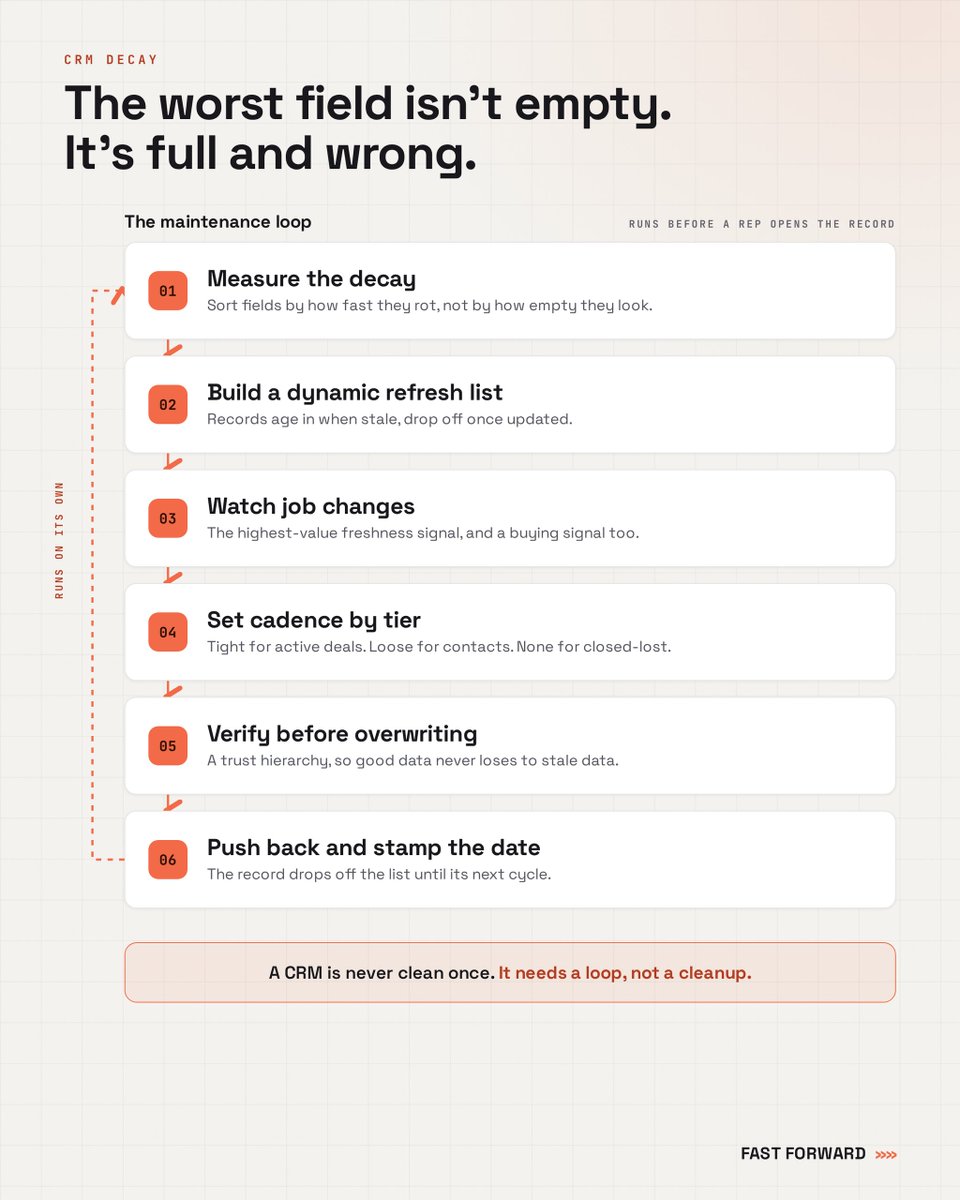
Your CRM is never clean once.
It decays the day you stop touching it.
Remember that people change jobs.
Companies rebrand or get acquired.
The champion who drove your last deal leaves for a competitor.
Which is exactly why the most expensive kind of decay isn't an empty field, but a field that still looks full and is now wrong.
The fix isn't a one-time cleanup either.
It's a maintenance loop that runs on its own and refreshes the records that rotted before a rep ever opens them.
Here’s what that loop actually looks like:
Step 1:
Measure how fast your CRM is actually decaying. Titles and employers rot fastest. Sort your fields by decay speed, not by how empty they look.
Step 2:
Build a dynamic refresh list that fills and drains itself, so records age in when they're stale and drop off once they're updated.
Step 3:
Monitor job changes. It's the single highest-value freshness signal, and it's a buying signal hiding in plain sight.
Step 4:
Set the refresh cadence by tier. Tight for active deals, loose for general contacts, none for closed-lost.
Step 5:
Verify every refreshed value before it overwrites a good one, using a clear trust hierarchy so you never trade correct data for stale data.
Step 6:
Push the verified updates back and stamp the refresh date, which drops the record off the list until its next cycle.
This is the kind of system we build with @clay at FastForward.
Because your CRM is almost like a living, breathing organism.
It’s always changing. And you need to be ready for it.
Nobody is coming to fix it for you.
Not the market…
Not a new hire.
Not the next tool your team is convinced will change everything.
The most capable people I know share one trait, and it has nothing to do with talent.
They take complete ownership of the outcome.
Let’s say they want to enter a new field where they currently have zero experience…
In this situation, you could beg someone for a job when you have zero experience…
Or, option 2, just start doing the job without asking.
I prefer option 2.
Not to get too cliché, but we all need to take destiny into our own hands.
Something I suspect most people aren’t doing enough of.
One of my mentors that had tons of experience dealing with PE sponsors told me “when it’s not going well it’s never as bad as you think it is and when its going well it’s never as good as you think it is.”
He is insane for not taking any chips off the table. Really feel bad for him. He doesn’t owe them anything after that move.
He’s committed and your guidance was great. He needs to remember that as the CEO the board works for him, be assertive, take control, and focus on his plan of action to fix the growth problems
Buyers don't remember features.
They remember stories.
A feature tells someone what your product does.
A story shows them what it means for a business that looked exactly like theirs.
When you can walk a prospect through a real example, same industry, same challenges, and tell them how it played out, the light in their eyes start to glimmer.
They stop evaluating and they start picturing.
That's the moment a deal starts progressing.
So stop leading on specs, and establish a real connection.
In a world where buyers are more informed and more skeptical than ever, connection is what moves a decision forward faster than any product slide ever will.
Your best sellers are not your most charismatic people.
That’s a fallacy people fall for all the time.
Someone is outgoing, energetic, comfortable in the room, and everyone assumes they'll be great.
Sometimes they are.
Often that surface confidence covers a lack of what actually drives performance.
Genuine curiosity.
The willingness to ask the harder second question.
To listen to understand instead of listening to respond.
To keep digging when something interesting surfaces instead of steering back to the pitch.
Charisma is easy to spot in an interview, but curiosity takes more work to identify, and it matters far more.
So hire for curiosity, not purely charisma.
GTM teams try to personalize outreach on top of records that are barely half complete.
A name, an email, maybe a company field someone filled in two years ago…
Then they wonder why the messaging feels generic and the routing keeps sending the wrong lead to the wrong rep.
But the problem sits one layer below where most teams are looking.
It’s the data itself.
Data enrichment is the step that turns a thin record into something a team can actually act on.
You start with an email, and you append what decides everything downstream.
Title and seniority, so you know if you are even talking to a decision-maker.
Company size, industry, and revenue, so you know if the account clears your bar.
Tech stack and recent signals, so you know the angle and the timing.
Without that context, every decision after it is merely a guess.
Which rep owns the lead, whether it fits the ICP, and what the opening line should say.
This is a big part of the work we do with Clay at FastForward.
It’s also why enrichment is not a nice-to-have layer.
It’s the foundation every subsequent step depends on.
Companies are practically sitting on winning lottery tickets, but they can’t cash them in.
And that lottery ticket is their data.
The clearest example is call transcripts.
Months of recorded conversations with buyers.
Coaching gold. Messaging insight. Win-loss patterns.
Almost all of it untouched.
Three things happen when you finally build a system around that data:
- You see the patterns separating won deals from lost ones instead of guessing at them.
- You give the whole team a shared, repeatable playbook instead of knowledge in a few reps' heads.
- You free people from manual review so they can spend time where judgment actually matters.
That’s just a basic example, but you get the idea.
More data that you can actually utilize improves just about everything.
The modern buyer journey has already changed.
Yet most outreach hasn't caught up.
Buyers are flooded with messages that all sound the same.
Generic personalization.
Templated relevance.
The same three signals every competitor is chasing at the same time.
Which is exactly why standing out isn’t about volume anymore. It’s more about showing up with something that proves you actually understand the person on the other end.
A unique angle.
A piece of insight they haven't heard from the ten other companies in their inbox.
Evidence you did the work to understand their world before you asked for their time.
Obviously, before AI, this degree of effort took time.
But there’s really no excuse any longer.
A customer goes quiet.
Fewer logins. The champion who drove the deal internally just changed roles. Support tickets starting to tick up.
Then the cancellation email arrives, and it feels like it came out of nowhere.
But it never does.
The signals were there weeks before that conversation happened.
They showed up in data that nobody built a system to surface in time to act on.
Churn is a GTM problem as much as it is a CS problem.
The teams treating it as someone else's responsibility are the ones getting surprised at renewal.
Many companies treat their RevOps and marketing teams as support functions.
Ticket-takers. System administrators. People who get looped in after the strategy is already set.
But that's the wrong approach to this equation.
The engine room of a go-to-market organization is the infrastructure layer.
The systems connecting data, content, and outreach into a single motion that sales and marketing can actually run on together.
When that infrastructure is built correctly, marketing isn't just generating leads.
It's surfacing the right signals at the right time, routing the right account to the right rep, and feeding the sales team intelligence that changes how they show up to every conversation.
When it isn't, you get two teams running parallel motions with disconnected data and fighting over attribution.
That inefficiency has a direct line to CAC.
It shows up in productivity per rep.
It shows up in deal cycle length.
This is why sales need to work hand-in-hand.
Otherwise, you’re leaving who-knows how much on the table.
Many reps are trained to check boxes.
Budget. Authority. Need. Timeline.
Work through the list, get the answers, score the deal.
The problem is that checklist-style qualification produces checklist-style answers.
Yes or no responses. Surface-level confirmations.
A buyer who technically passes the criteria but hasn't opened up about anything legitimate.
This is why open-ended questions do something different.
They create dialogue.
And dialogue opens rabbit holes that a checklist never reaches.
The upsell you didn't know existed.
The adjacent problem that's actually more urgent than the one they wanted to talk about.
The context that changes how you position the entire deal.
This is why reps need to qualify through conversation, not interrogation.