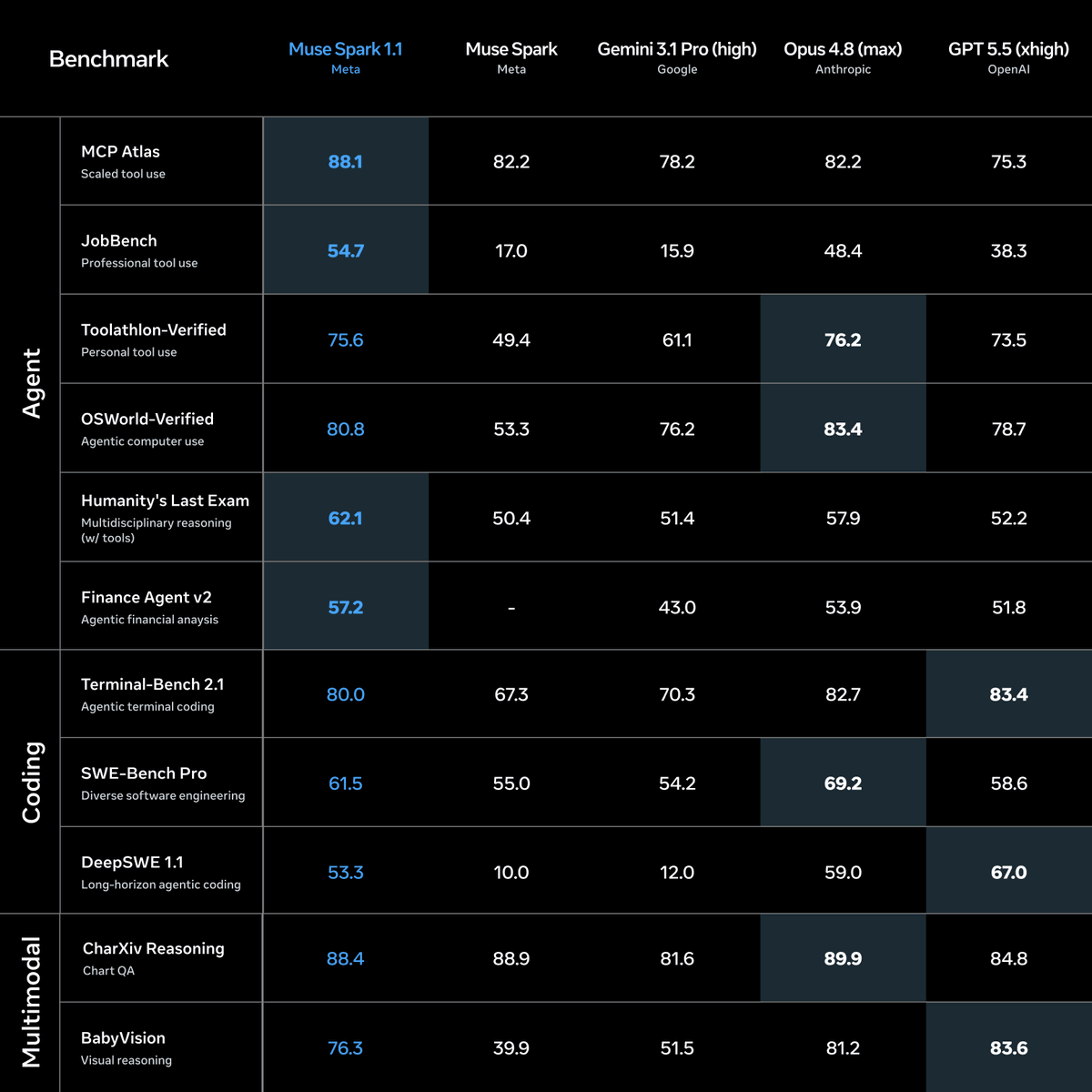
1/ muse spark 1.1 is an industry-competitive agentic and coding model. across many agentic evals it rivals gpt-5.5 and opus-4.8.
available now through the new meta model api and in meta ai. 🧵
Frontier AI labs’ next move should be finding the Heinlein of our era. Not just for the sake of predicting the future, yet in order to spend months imagining it / exploring what could be possible in the years and decades ahead & kinds of lives people might live alongside AGI.
Imaginative engineering.
we’ve become so normalized to LLMs that our conversations revolve around context windows, latency, benchmarks, and pricing. But isn’t the existence of modern language models itself astonishing? That a machine can learn so much about the world through language
in consumer ai, personality of ai matters more than we often acknowledge. It shapes user experience and even virality. A great model with the wrong personality can feel unpleasant, while unnecessary cynicism or forced humor can quietly undermine the product.
i built a personality optimizer for AI based on 2 ideas:
> Big Five / NEO-PI-R as the target personality space
> Findings from Pennebaker & King (1999) and Yarkoni (2010) that relate word choice to personality traits
Created a Windows 98-themed mathematical visualizer that runs fully locally and generates computational art from your prompts. Built for creating startup assets, exploring ideas, and personal projects.
AI has compressed the distance between an idea and a polished product. Young builders can accomplish remarkable things with unprecedented leverage. Recognition now arrives just as quickly. The danger is allowing compliments for moderately good work to satisfy the ambition required for truly great work. Being ahead is temporary. Age eventually fades as context, and comparisons to peers lose their meaning. The work is left to stand on its own. Don’t compromise the potential to create something extraordinary for the comfort of being praised too early. Precociousness without true maturity means nothing
doing something moderately great at 16 carries a different social weight than doing the same thing at 19. the recent rise of young founders (<17) building products is a reflection of that dynamic. yet i believe early praise has a way of distorting ambition.