On Dominating Commoditised Sectors:
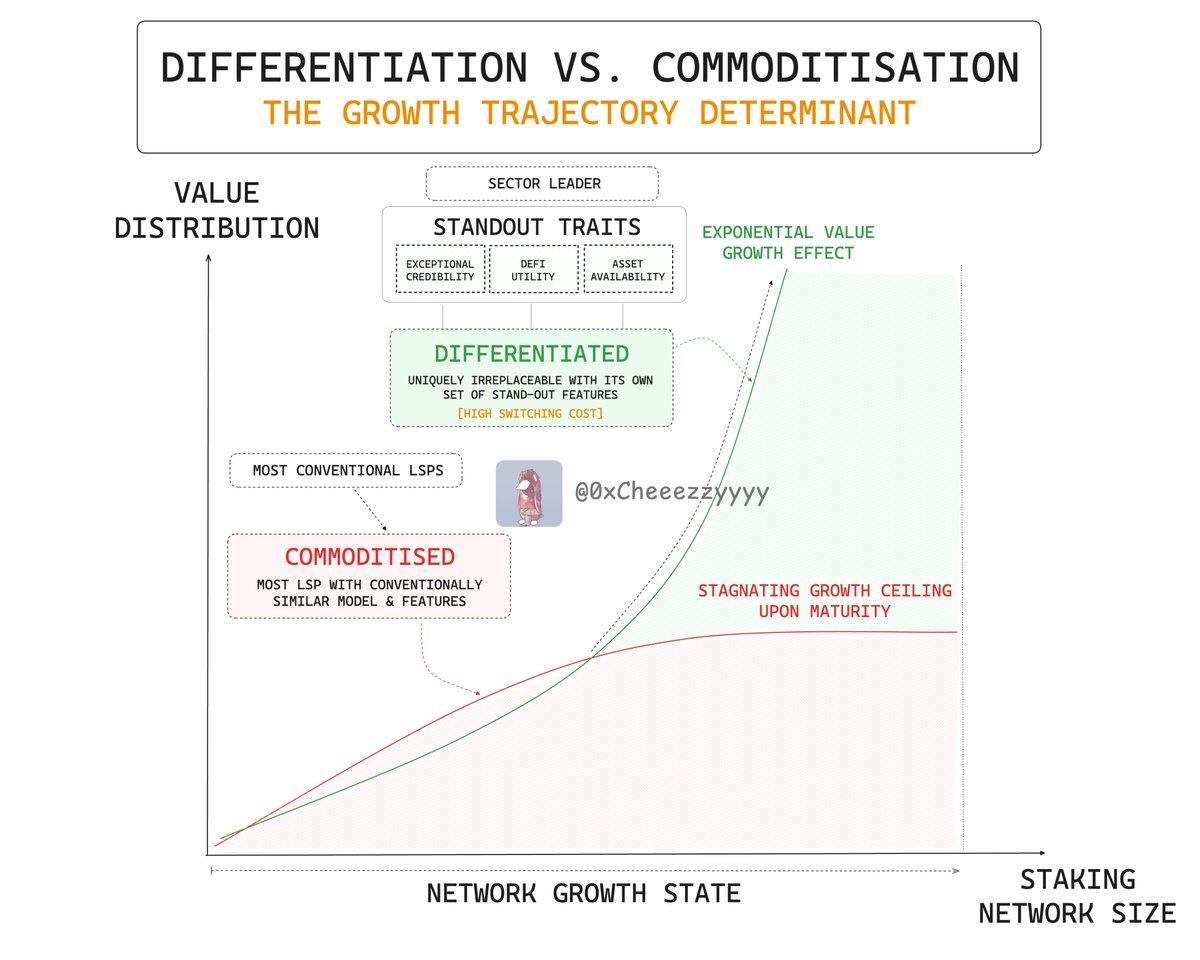
'Commoditisation' refers to how it's easily replaceable.
Sectors like liquid staking, most protocols ultimately serve the same base function via wrapping an underlying asset for yield exposure in a PoS ecosystem.
LST A = LST B = LST C...
While architectural nuances + added features may offer customisation, the core offering often appears interchangeable.
So what drives true differentiation?
It comes down Go-To-Market + how well it aligns with user needs & ecosystem demands.
Within the context of LSTs, these are some key traits that distinguish one from another:
1⃣Security of the underlying mechanism: Users need confidence that their staked assets are protected and credibly managed.
2⃣DeFi Utilisation Opportunities: A liquid staking token is only as valuable as the number of things you can do with it (Broad, deep integrations matter)
3⃣Asset Availability Across Chains: In a multi-chain world, accessibility across major ecosystems becomes critical to liquidity and adoption.
Differentiation is key as it shapes long-term growth trajectories.
As markets mature, the gap widens: the most distinctive players consolidate dominance, compounding market share over time.
@LidoFinance (cur. long-standing 61% sector dominance since pre-shanghai upgrade) @ether_fi ( 35.3% → 74.61%) are textbook examples.
-------
Case in Point:
@Lombard_Finance has carved out a clear lead as the dominant liquid staking protocol within the @babylonlabs_io BTC staking ecosystem largely due to how deliberately + effectively it executed its roadmap.
Here are some highlights behind $LBTC's market lead:
🔸140+ DeFi Integrations → with many S-tier ones like core money markets & restaking platforms @aave@symbioticfi
🔸6 Accredited Vault Initiatives → each tailored to specific use cases + user profiles.
🔸Consortium-Based Security Council → Wide participation of accredited entities ensuring transparent + institution-grade asset management.
This creates a clear, multi-layered answer to 'Why $LBTC?' where an asset that is not just secure, but usable, composable & explicitly visible across DeFi.
The result mirrors the trajectory of dominant assets like @LidoFinance’s $stETH and @ether_fi’s $eETH. Once a liquid staking token gains sufficient integrations, trust & liquidity, network effects kick in:
Asset Utility → Native Adoption from enhanced productivity → Strengthens ecosystem stickiness→ Trust & credibility → More Utility
This flywheel compounds until a protocol becomes the de facto choice. At that point, competing becomes near-impossible unless the dominant protocol suffers a critical failure.
Which is why sectors like this often converge toward a near-monopoly with a clear, defensible winner.
In $LBTC’s case, early execution may be significant.
It’s thoughtful design, targeted integrations & an ecosystem playbook that reinforces itself at every level.
Moving forward, it's ready for the next stage: Bitcoin Capital Markets
And there's so much potential to capitalise from here with its existing distribution + industry-wide recognition.
Towards the trillions and eventually, the Bitcoin Economy 🫡
We’ve rolled out a new support experience on https://t.co/UQ6f3rM2NM
You can now get help within seconds directly from your profile using the support channel in the bottom-right corner
It’s faster, structured, and built to serve users in real time across active community sales
USD1 — The stablecoin of choice
@worldlibertyfi’s USD1 is the exclusive stablecoin powering the @Lombard_Finance Community Sale on Buidlpad
Accepted as ERC-20 & BEP-20, USD1 lets users contribute to $BARD from the chain of their choice using a trusted, dollar-pegged asset
Get ready to contribute!
USD1 — The stablecoin of choice
@worldlibertyfi’s USD1 is the exclusive stablecoin powering the @Lombard_Finance Community Sale on Buidlpad
Accepted as ERC-20 & BEP-20, USD1 lets users contribute to $BARD from the chain of their choice using a trusted, dollar-pegged asset
Get ready to contribute!
We’ve rolled out a new support experience on https://t.co/UQ6f3rM2NM
You can now get help within seconds directly from your profile using the support channel in the bottom-right corner
It’s faster, structured, and built to serve users in real time across active community sales
On Dominating Commoditised Sectors:
'Commoditisation' refers to how it's easily replaceable.
Sectors like liquid staking, most protocols ultimately serve the same base function via wrapping an underlying asset for yield exposure in a PoS ecosystem.
LST A = LST B = LST C...
While architectural nuances + added features may offer customisation, the core offering often appears interchangeable.
So what drives true differentiation?
It comes down Go-To-Market + how well it aligns with user needs & ecosystem demands.
Within the context of LSTs, these are some key traits that distinguish one from another:
1⃣Security of the underlying mechanism: Users need confidence that their staked assets are protected and credibly managed.
2⃣DeFi Utilisation Opportunities: A liquid staking token is only as valuable as the number of things you can do with it (Broad, deep integrations matter)
3⃣Asset Availability Across Chains: In a multi-chain world, accessibility across major ecosystems becomes critical to liquidity and adoption.
Differentiation is key as it shapes long-term growth trajectories.
As markets mature, the gap widens: the most distinctive players consolidate dominance, compounding market share over time.
@LidoFinance (cur. long-standing 61% sector dominance since pre-shanghai upgrade) @ether_fi ( 35.3% → 74.61%) are textbook examples.
-------
Case in Point:
@Lombard_Finance has carved out a clear lead as the dominant liquid staking protocol within the @babylonlabs_io BTC staking ecosystem largely due to how deliberately + effectively it executed its roadmap.
Here are some highlights behind $LBTC's market lead:
🔸140+ DeFi Integrations → with many S-tier ones like core money markets & restaking platforms @aave@symbioticfi
🔸6 Accredited Vault Initiatives → each tailored to specific use cases + user profiles.
🔸Consortium-Based Security Council → Wide participation of accredited entities ensuring transparent + institution-grade asset management.
This creates a clear, multi-layered answer to 'Why $LBTC?' where an asset that is not just secure, but usable, composable & explicitly visible across DeFi.
The result mirrors the trajectory of dominant assets like @LidoFinance’s $stETH and @ether_fi’s $eETH. Once a liquid staking token gains sufficient integrations, trust & liquidity, network effects kick in:
Asset Utility → Native Adoption from enhanced productivity → Strengthens ecosystem stickiness→ Trust & credibility → More Utility
This flywheel compounds until a protocol becomes the de facto choice. At that point, competing becomes near-impossible unless the dominant protocol suffers a critical failure.
Which is why sectors like this often converge toward a near-monopoly with a clear, defensible winner.
In $LBTC’s case, early execution may be significant.
It’s thoughtful design, targeted integrations & an ecosystem playbook that reinforces itself at every level.
Moving forward, it's ready for the next stage: Bitcoin Capital Markets
And there's so much potential to capitalise from here with its existing distribution + industry-wide recognition.
Towards the trillions and eventually, the Bitcoin Economy 🫡
For the first time, $BARD - the native token of the Lombard Protocol - will be distributed through a pre-launch Community Sale on @buidlpad.
This milestone for Lombard, marks an opportunity for the community to participate in the future of Bitcoin onchain.
For the first time, $BARD - the native token of the Lombard Protocol - will be distributed through a pre-launch Community Sale on @buidlpad.
This milestone for Lombard, marks an opportunity for the community to participate in the future of Bitcoin onchain.