Supporting Healthcare Education with My Visit to Ibadan’s Nursing Institution.
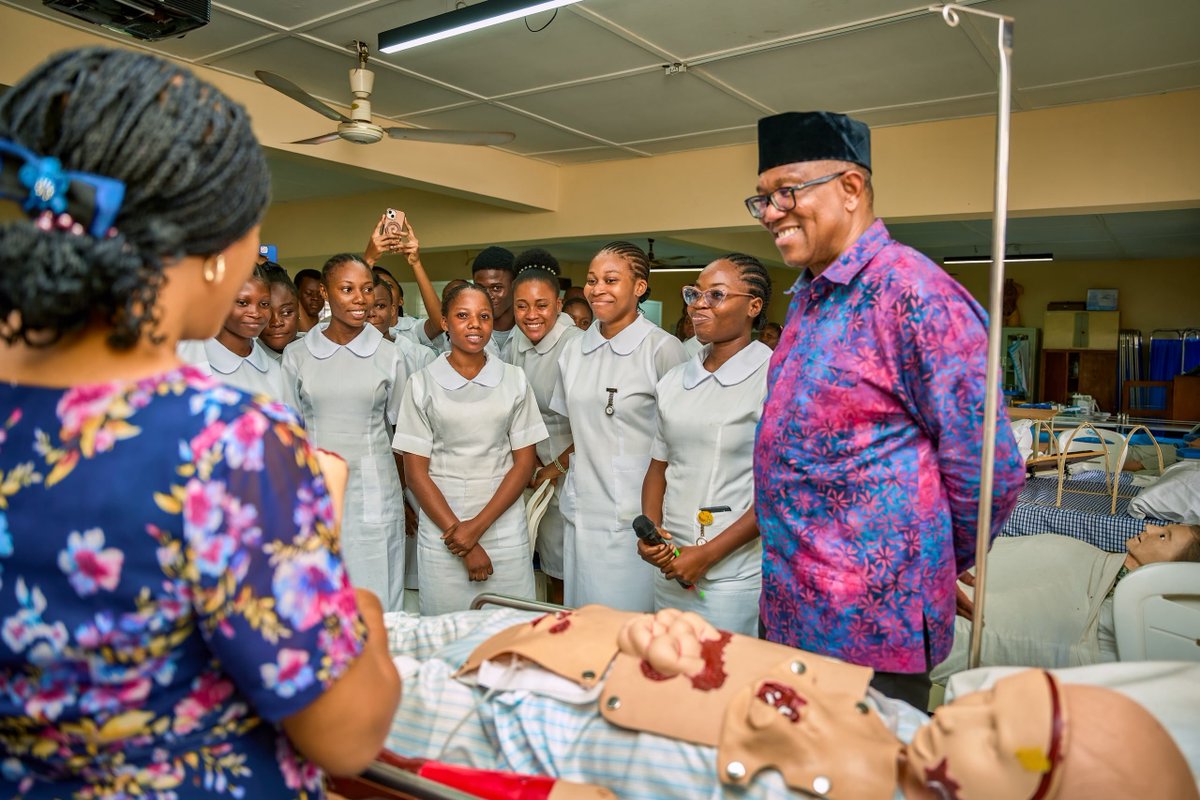
After attending the 50th/15th Biennial Conference of the Methodist Church, I proceeded to the College of Nursing Sciences, Oluyoro, Ibadan, where I interacted with the management and students of the institution.
I reiterated my belief that education remains one of the strongest foundations for building a better nation, especially in critical sectors such as healthcare. The training of competent healthcare professionals is essential to improving the quality of care and strengthening our national development.
In keeping with my earlier commitment to continually support the institution, I donated another ₦10 million to assist the College in its important work of training future nurses and healthcare professionals. This is part of my continued commitment to investing in education and supporting initiatives that contribute to Nigeria’s future.
I also encouraged the students to take their studies seriously, reminding them that nurses occupy a vital place in the healthcare system. Their skills, compassion, and dedication are needed not only in Nigeria but across the world. I urged them to pursue excellence, uphold the highest standards of professionalism, and become worthy ambassadors of our country.
A new Nigeria is POssible. -PO
Catholic churches across Nigeria must now take extra measures to beef up security around their churches.
We're dealing with a bunch of demon-possessed, power drunk, out-of-control maniacs.
These are no ordinary times.
Brace yourselves!
Here is a man who had the best Higher School Certificate result in the old Northern Region in 1962 and who rose through the ranks of the Catholic Church to become a Cardinal, a position that places him among those eligible to be considered for the papacy. Yet he is no ordinary cleric. He is one of Africa’s most respected churchmen, known for decades of service to peace, dialogue, scholarship, and national unity. Resorting to personal attacks against him weakens public discourse and reveals an unhealthy intolerance of criticism in today’s Nigerian political space.
Throughout history, religious leaders have challenged political authorities. Biblical prophets confronted kings, and modern faith communities continue to hold governments accountable. Nigeria has a similar tradition. The Catholic Church criticised military governments and successive civilian administrations, including those of Obasanjo, Yar’Adua, Jonathan, and Buhari. Muslim organisations have done likewise. Governments respectfully disagreed at times, but they generally recognised the right and responsibility of religious bodies to speak. Why, then, does the truth provoke such anger today?
The problem often begins when leaders surround themselves with voices that tell them only what they want to hear. Napoleon Bonaparte was reputed to have preferred hearing bad news because problems were where leadership was required. During my tenure as Governor of Anambra State, I maintained a similar philosophy. I expected cabinet members to bring me problems, not compliments, because only honest feedback could lead to solutions.
Good governance depends on truth. When governments punish truth-tellers and reward sycophants with appointments, honest advisers withdraw, sycophancy thrives, and leaders become disconnected from reality. This is our situation today.
The CBCN did not insult the President and can never do so, given the calibre of the people who make up the Conference, some of the finest among Nigerians. It gave voice to the suffering of Nigerians. The proper response was to thoughtfully address the issues raised, not attack those who raised them. When respected figures like Cardinal Onaiyekan are vilified for speaking the truth, the message sent to citizens is that silence is safer than honesty. No democracy can flourish under such a culture.
Religious leaders should continue to speak because silence in the face of suffering would betray their moral responsibility. The greatest service those around President Tinubu can render him is an honest appraisal of the situation. A leader who hears only praise will never fully understand the pain of his people or find the clarity needed to correct what is wrong.
A New Nigeria is POssible. -PO
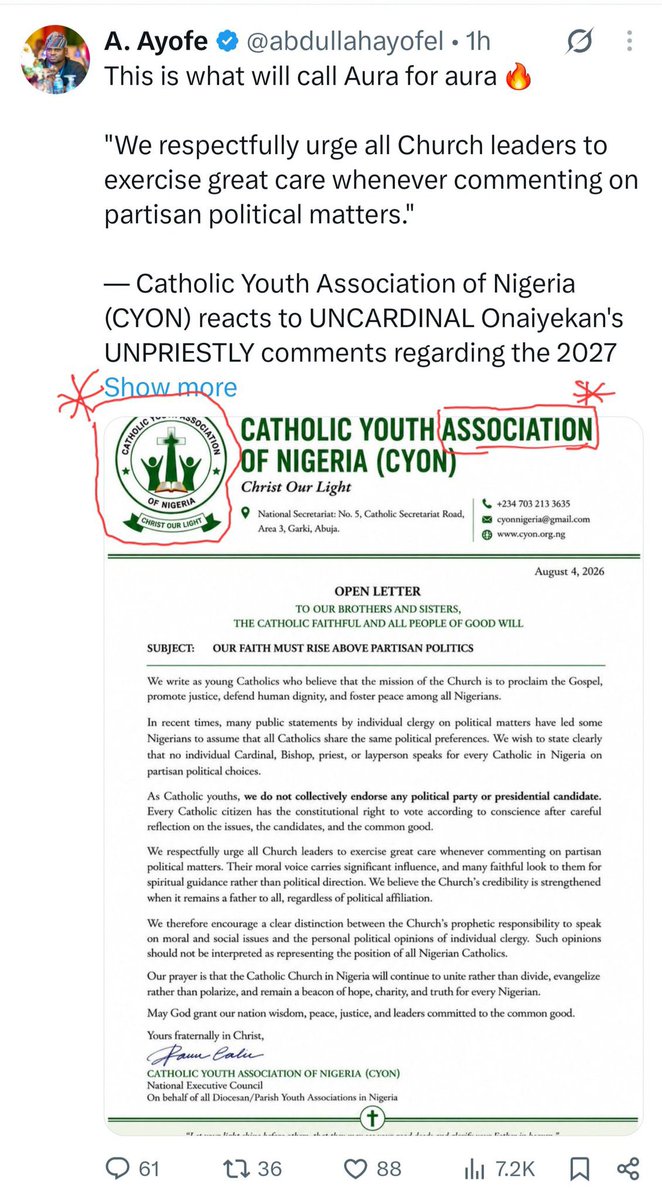
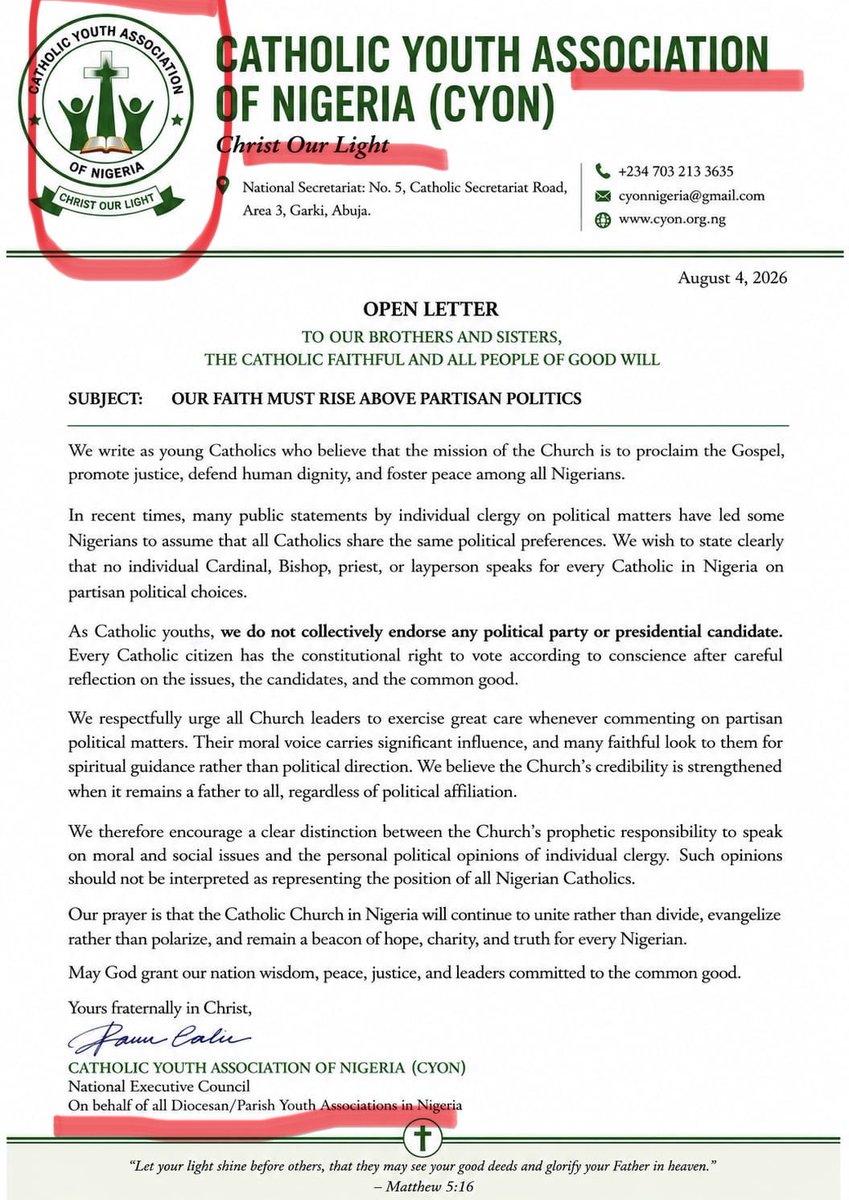
As a former two-term President of the Catholic Youth Organization of Nigeria (CYON) in the Army Chaplaincy, I didn’t need a second look to recognise this as a poorly fabricated forged press release.
The forgers in Aso Rock and their team of failures are now clutching at straws.
For God and For Youth…….
I commend the Catholic Bishops' Conference of Nigeria (CBCN) for demonstrating courage and patriotism by drawing attention to the realities confronting our nation.
Their concerns regarding the rising cost of living, worsening insecurity, declining public confidence, and the hardship faced by millions of Nigerians are neither partisan nor isolated; they reflect the daily experiences of ordinary citizens across every region of our country.
Nigeria is blessed with abundant human and natural resources, yet millions of our people continue to struggle under the weight of economic hardship, unemployment, insecurity, poor access to quality education and healthcare, and diminishing opportunities. These challenges demand urgent, sincere, and people-centred responses from those entrusted with leadership.
I encourage all well-meaning Nigerians to continue constructively engaging the Federal Government and other leaders at all levels whenever the opportunity arises, advocating for good governance, accountability, and policies that prioritise the security, welfare, and prosperity of our people.
It is through such collective commitment and responsible leadership that we can build a more peaceful, united, and prosperous Nigeria.
May Almighty Allah continue to bless the Federal Republic of Nigeria. - RMK
The day Michael carrick introduced himself to the premier league
The quality on this game was unbelievable ❤️
Pep couldn't believe what he was watching 🔥
Nigeria Cannot Afford the Lagos-Calabar Highway; I Don’t Think the Road Will Go Beyond Epe – Duke
There is already a road from Lagos to Calabar; if the road is poor, fix it. There are some expenditures we make that do not reflect the realities of our circumstances. The amount spent on that road could be better spent providing electricity or upgrading the healthcare system.
Donald Duke, Presidential Candidate, People’s Redemption Party
🚨🔴⚪️ GKs exits at Man United today as Bayindir joins Celta Vigo… and Radek Vitek joins Middlesbrough on permanent deal.
Green light for medical; £7m fee plus add-ons up to potential £14m package.
#MUFC also mantain 35% sell-on clause and buy back for the GK.
When a Government Declares War on the Truth
President Donald Trump of America recently described Nigeria as “a now disgraced country.” The painful reality is that Nigeria’s challenges continue to deepen. Each passing day reveals deeper signs of decline, especially when a government becomes increasingly intolerant of truth and hostile to those who speak about the suffering of the people.
The Catholic Church has never functioned as an opposition party in Nigeria. Across military regimes and successive democratic administrations, the Catholic Bishops’ Conference of Nigeria (CBCN) has maintained a principled voice on national issues and the nation’s conscience, commending governments when they deserved commendation and speaking the truth whenever national conscience demanded it. Its interventions are driven by a moral obligation, rooted in Christian social teaching, to defend truth, justice, and the common good.
The same applies to Nigeria’s major religious organisations. Bodies such as Jama’atu Nasril Islam (JNI), the Supreme Council for Shari’ah in Nigeria (SCSN), the Christian Association of Nigeria (CAN), and the Nigerian Supreme Council for Islamic Affairs (NSCIA) have repeatedly raised concerns over economic hardship, inflation, and insecurity. Living among the people, religious leaders often encounter the suffering of citizens firsthand. They speak because they witness families struggling with rising food prices, unemployment, and the fear created by kidnappings and insecurity.
As leaders, we should be gracious enough to listen to people and organisations that speak the truth to us and genuinely criticise us when things are not going in the right direction. As Governor, I had the opportunity of working with a very strong Council of Traditional Rulers, led by the Obi of Onitsha, and religious bodies that consistently criticised me and offered suggestions. This contributed greatly to our success in Anambra State, especially in critical areas like education and health.
Against this background, the attacks on the CBCN, and especially on His Eminence, John Cardinal Onaiyekan, are deeply troubling. Even in 1998, when Pope John Paul II visited Nigeria and told General Abacha some hard truths, including about the incarceration of Chief Moshood Abiola, nobody vilified him.
During the inauguration of Pope Leo XIV in Rome, to demonstrate his purported commitment to and respect for the Catholic Church, President Bola Tinubu arrived in Rome days before the event, ahead of most other visiting dignitaries, including Catholics such as the U.S. Vice President, JD Vance. He participated in the liturgy, queued with other world leaders to greet the Holy Father, and displayed deep respect for the moral authority of the Church. Back in Nigeria, however, that posture has now changed completely.
What is playing out today also reveals how political leaders sometimes exploit religion and ethnicity to divide the people. Even when it was obvious that the CBCN was speaking on issues affecting Nigerians across religious and ethnic boundaries, aides to the President immediately reduced it to a “religious affair.” The question is: are insecurity, poverty, inflation, unemployment, and hardship problems exclusive to a particular faith? Do these challenges recognise religious or tribal boundaries?
The bishops merely expressed what millions of Nigerians experience daily: insecurity has worsened, poverty is deepening, inflation is crippling families, businesses are struggling, and hope is fading. These are realities echoed by religious leaders across the country, to whom successive governments gave thanks and promised to look into their observations.
Rather than address these concerns or explain the measures in place to ameliorate them, President Bola Ahmed Tinubu’s aides and supporters responded with vicious attacks, particularly against Cardinal John Onaiyekan, with little regard for his age, stature, and accomplishments.