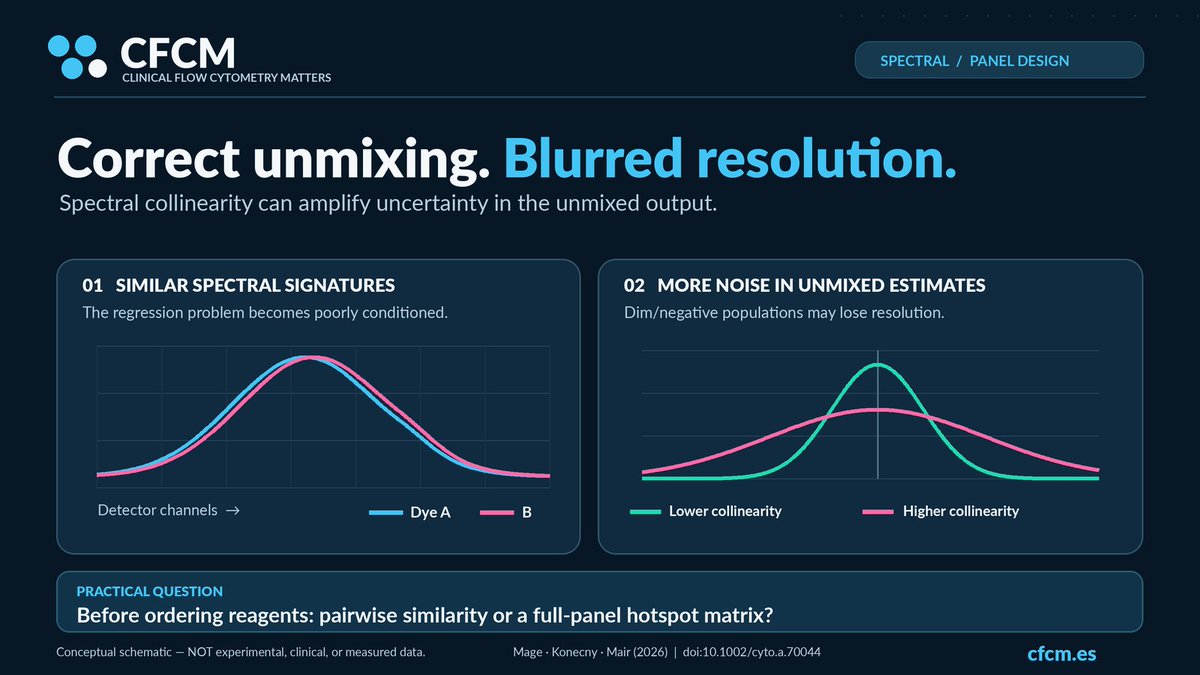
Correct unmixing ≠ clean separation. Spectral collinearity can amplify noise: unmixing-dependent spreading (Mage et al., 2026). In a high-parameter panel, would you check pairwise similarity or a full-panel hotspot matrix first? https://t.co/NmgNst42YB
#FlowCytometry
30 phenotype-consistent MRD events / 1M evaluable cells. Validated LoD: 20; LoQ: 50.
Would you report “detected below LoQ” or a numerical 0.003%?
What else would you verify before sign-out?
https://t.co/mvQjLvJ6yg
#FlowCytometry
Compensation issue or autofluorescence?
An unexpected population appears in your flow plot. What would you check first to identify the cause?
FMO, unstained control, single-stain controls—or something else?
#FlowCytometry#CFCM
A billionaire sat in a room for 42 minutes and listed every psychological trick that makes people lose money. For free. The finance industry has spent thirty years pretending this recording doesn’t exist.
He didn’t sell a course. He didn’t write a newsletter. He sat in a chair at 96 years old and explained why brilliant people do the dumbest things with their money. Then he explained why they’ll keep doing it.
MBA programs charge $200,000 to teach behavioral finance. He covered 25 biases in one sitting. Some of them still aren’t in any curriculum. He gave the entire framework away on camera.
The part nobody talks about: he called crypto antisocial. He said index funds will crush most managers. He said private equity is full of wretched excess. He said all of this in a room full of people who manage money for a living. Nobody argued.
A hedge fund analyst at a top firm told me this is the first thing they send to anyone who joins the desk. Not a book. Not a model. A 42-minute video of a 96-year-old man explaining why you’ll be wrong and how to recognize it before it costs you everything.
40 million people have heard his name. Almost none of them have watched him explain the 25 ways their own brains are working against them.
The lecture is free. He died the following year. It’s in the video.
A QC control that doesn’t behave like the patient sample may give false reassurance.
A new myeloma flow cytometry study tests synthetic cell mimics designed to challenge the real analytical pathway.
Worth watching.
https://t.co/YQsowTRB3x
Hi friends
I have built CFCM — an independent platform for Clinical Flow Cytometry.
Evidence, education, papers, technology, reagents, troubleshooting & market intelligence — curated for people working in the field.
https://t.co/shOjNdbSfa
#FlowCytometry#Cytometry
Personally, I suck at efficiency (doing things quickly). Here’s my coping mechanism and 8-step process for maximizing efficacy (doing the right things):
1) Wake up at least 1 hour before you have to be at a computer screen. E-mail is the mind killer.
2) Make a cup of tea (I like pu-erh) and sit down with a pen/pencil and paper.
3) Write down the 3-5 things — and no more — that are making you most anxious or uncomfortable. They’re often things that have been punted from one day’s to-do list to the next, to the next, to the next, and so on. Most important usually = most uncomfortable, with some chance of rejection or conflict.
4) For each item, ask yourself:
– “If this were the only thing I accomplished today, would I be satisfied with my day?”
– “Will moving this forward make all the other to-do’s unimportant or easier to knock off later?”
5) Look only at the items you’ve answered “yes” to for at least one of these questions.
6) Block out at least 2-3 hours to focus on ONE of them for today. Let the rest of the urgent but less important stuff slide. It will still be there tomorrow.
7) TO BE CLEAR: Block out at least 2-3 HOURS to focus on ONE of them for today. This is ONE BLOCK OF TIME. Cobbling together 10 minutes here and there to add up to 120 minutes does not work.
8) If you get distracted or start procrastinating, don’t freak out and downward spiral; just gently come back to your ONE to-do.
Congratulations! That’s it.
We first saw evidence for this ~ 2019.
We were super surprised & skeptical.
After 5 years of quintuple cross-validation, we feel confident to share with the world.
Visualizing Science! I'm holding a series of free, online workshops, thanks to Johns Hopkins University. All are welcome! I plan to have fun with Danielle VanBrabant, Damond Kyllo, and Amey Zhang to introduce visualization topics and challenges. No art experience is necessary.
1/ One of the most common mistakes in bioinformatics is the one-off error. If you are not careful, you will make mistakes. Even experienced bioinformaticians are not aware of it and the mistake prevails in many bioinformatics tools. A thread 🧵
Recommendations for using artificial intelligence in clinical flow cytometry - Ng - Cytometry Part B: Clinical Cytometry - Wiley Online Library https://t.co/VSQ0N5SpZm
Just published in Cytometry Part B: Clinical Cytometry!
A comprehensive, easy to use guide for validation of flow cytometry assays using real-life examples.
Check it out here!⬇️
https://t.co/aTPomSaq0X
How to master baisc Unix sed commands for computational biologists 15 mins a day for 12 days. 🧵
The text file is the king of bioinformatics. Knowing how to wrangle the text files on the command line is critical.
I created this 12-day short course for you for FREE👇
👀 ¡Deberías mirar tus datos! Y este libro (gratuito) es todo lo que necesitas 😉
📣 Aprende el 'por qué' y el 'cómo' de la visualización de datos de manera divertida y sencilla
🔗 https://t.co/ObtHZcIF70
👤 @kjhealy#DataScience#dataviz#Datavisualization#book#ML#IA#Stats
For me, it's never okay to betray a friend. Not for any amount of money, power, sex, or fame.
Great lifelong friendships is one of the most awesome aspects of our time here on Earth.