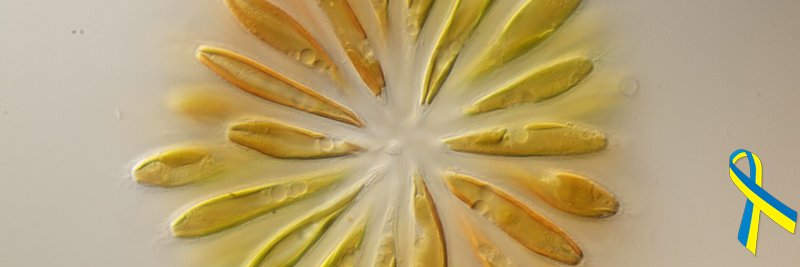
Happy to share our new paper in @JPhycology on Synurales from Florida - adding a fresh piece to the puzzle of silica-ornamented algal diversity and evolution! One of the newly described species even made it to the cover of the issue.😊
https://t.co/O2nTfOZHvq
In this paper, we show that photobiont diversity increases as lichens age. Interestingly, as the thallus grows, autosporine algae become more prevalent at the expense of zoosporine algae, likely because the latter play a key role in lichen establishment. https://t.co/nHwdCAs0bf
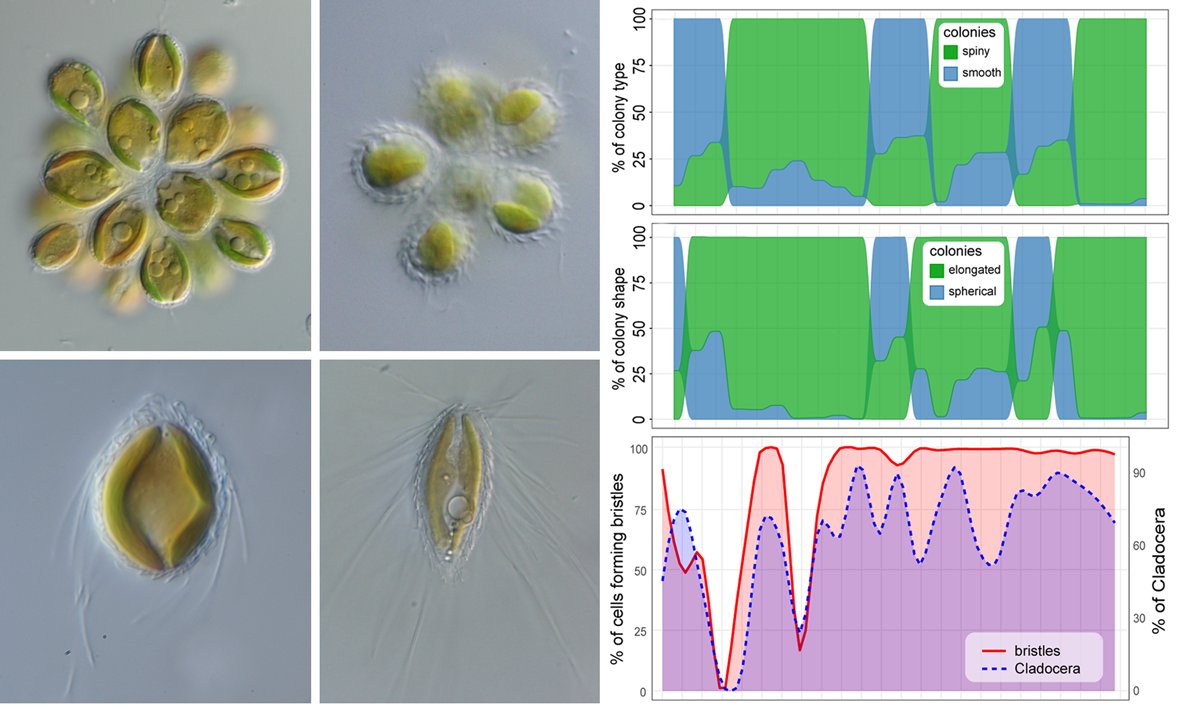
Imagine a forest where every tree vanishes overnight from a gust of wind. Or a meadow where all small birds disappear due to a hawk surge. That’s the scale of change we saw - only it’s underwater, invisible, and microbial. 🙂
Just published! Our new study reveals how phytoplankton communities can shift dramatically within mere days - driven by grazers like Cladocera and environmental factors such as silica concentration and wind speed.
https://t.co/PaL0QcofrV
Huge congratulations to Veronika Kantnerová for winning the Best Student Presentation Award at the #ICOP2025 Congress in Seoul, Korea!❤️🏆I’m incredibly proud of her success. You can check out her award-winning poster here if you're curious: https://t.co/YFxeVZ8Guk
We just described a novel chrysophyte genus Globulochrysis. It produces teardrop-shaped zoospores and big spherical cell packets🙃.
https://t.co/1UQhswKJJu
We are happy to share our review paper summarizing the diversity of green algal lichen symbionts and their free-living occurrences: https://t.co/1VE4KXbGcf
#Paper_Alert! Did you ever wonder why there is such a large morphological diversity in #shell-bearing #amoebae and what is the #function of shells anyway? It was long assumed shells are for #defense, well let me try to convince you that their purpose is #attack! A thread🧵👇
In summary, we show that diversification of protist species can be very rapid. Accordingly, the vast biodiversity of protists and other microorganisms can be explained by rapid ecological speciation despite their widespread dispersal.
Finally, in the third paper we resolved the phylogenetic position of the silica scale-forming genus Spiniferomonas, showing that it represents a sister lineage to the genus Chrysosphaerella. https://t.co/JOtFl78UWL
We are happy to announce the release of the Fottea special issue devoted to Chrysophytes research! https://t.co/MAZjLsrCtU
Three papers that we contributed are briefly described below.
By analyzing the extent of scale deformation, we found that while in Synura the ribs play a key role in the stability of the scale, in Mallomonas they have a negligible effect on stability and apparently play a different function. https://t.co/OfpIt58hdJ