A Dutch computer scientist gave one lecture in 1988 arguing that programming is unlike anything humans have ever tried to do before, and the reason most software on earth is broken is that we are still teaching it as if it were a hobby.
His name was Edsger Dijkstra. He won the Turing Award in 1972. He invented the shortest path algorithm that every GPS on earth still runs on.
He wrote the paper that killed the goto statement in modern programming languages.
He spent 50 years quietly being one of the most consequential thinkers in the entire history of computer science, and he was in a very bad mood by the time he stood up at the ACM Computer Science Conference in 1988 to deliver the lecture that almost nobody at the conference wanted to hear.
The lecture was called On the Cruelty of Really Teaching Computer Science.
It is now one of the most cited papers in the entire history of computing education. It was filed in his archive as EWD1036, handwritten in his careful fountain-pen calligraphy because he refused to use a typewriter and famously refused to use email for the rest of his life.
The argument was simple and uncomfortable.
Programming, Dijkstra said, is a radical novelty. Not a new tool. Not a new skill. Not a faster version of something humans already knew how to do. A genuinely new category of intellectual activity that has no real precedent in the entire history of the human species, and our brains have not been built to handle it.
Here is what he meant by that.
When a programmer writes a line of high-level code and presses run, that single line might trigger a billion operations at the level of the silicon.
The ratio between the abstraction you are working in and the physical events you are actually causing is roughly one billion to one. No engineer in history before computing ever had to reason about a system spanning that kind of ratio inside their own head.
A bridge builder reasons about steel beams and the physics of weight. A surgeon reasons about organs and the physics of tissue. A chemist reasons about molecules and the physics of bonds.
All of them are working inside ratios of physical scale where the largest and smallest things they need to think about are within a few orders of magnitude of each other.
A programmer routinely writes one line that orchestrates a billion physical events on a chip, and is expected to predict the behavior of all of them in advance.
Dijkstra argued that the human brain was simply not built for this. Every intuition we have evolved over hundreds of thousands of years comes from a world of medium-sized objects behaving in continuous ways. Computing is the opposite. It is discrete, not continuous.
A program that runs perfectly a billion times can crash on the billion-and-first iteration because of a single bit. A single character missing from a line of code can take down a power grid. There is no margin. There is no graceful degradation. The system either works or does not, and the only way to know is to actually run it.
This was the part of the lecture where Dijkstra made everyone in the room uncomfortable.
He said the way computer science was being taught in universities was a quiet disaster. Professors were teaching programming the way carpenters teach woodworking. With examples. With metaphors. With analogies to things students already understood. Files are like folders. Memory is like a desk. A function is like a recipe.
Dijkstra said this was actively making it harder for students to think clearly. The whole point of a radical novelty is that there is nothing in your past experience to compare it to.
The moment you start reaching for metaphors, you are smuggling in old intuitions that do not apply, and those intuitions will betray you the first time you try to reason about a system the metaphor was not built to describe.
His exact line was this: the usual way in which we plan today for tomorrow is in yesterday's vocabulary. And yesterday's vocabulary, he argued, was killing the field.
The reason most software is broken is downstream of this single misunderstanding. Programmers are taught to think of code as a craft. Something you get a feel for.
Something you pick up through practice. Something where intuition gets sharper with experience.
Dijkstra said this is exactly backwards. Programming is not a craft. It is closer to mathematics than to carpentry, and the moment you treat it as a craft, you guarantee that the software you produce will be full of the kind of bugs that craftsmanship cannot catch.
The fix, in his view, was to teach programming the way mathematics is taught. You should be able to prove your program correct before you run it.
You should reason about your code formally, the way a mathematician reasons about a theorem, not the way a carpenter feels their way through a joint. The students who learned this way, he said, would walk out of their classes with a kind of confidence that no amount of typing practice could produce.
The lecture was published in Communications of the ACM in 1989. The field did not listen. Universities kept teaching programming the same way.
Software kept getting bigger. Bugs kept compounding. By 2026, almost every piece of software on earth has known security vulnerabilities, undefined behaviors, and edge cases that nobody has ever proven safe. The doom that Dijkstra warned about in 1988 is now the default condition of the digital world we have built.
The deeper lesson is the one most readers miss the first time through.
Dijkstra was not just talking about software. He was making a much bigger point about how humans learn anything that is genuinely new. The instinct to translate the unfamiliar into the familiar is the most natural thing in the world.
It is also the single biggest obstacle to actually understanding something that has no precedent. If you keep reaching for analogies, you will never see the new thing clearly. You will only see your old framework projected onto it.
This is happening right now with AI. The same instinct that made people learn programming through metaphors of files and folders is making people understand large language models through metaphors of brains and people.
Almost every framework being used to describe AI in 2026 is borrowed from a previous domain. None of them quite fit. The few people who are actually building useful intuitions about how these systems work are the ones who have done what Dijkstra recommended forty years ago.
They have set down the old vocabulary. They have looked at the new thing on its own terms. They have accepted that the radical novelty is radical for a reason.
You are not slow. You were taught a discipline as if it were a hobby. The cruelty is real.
The fix is still available.
WEMBY JUST DROPPED A BAR:
"The lack of experience is a strength of us...because we could do impossible stuff because we don't know it's impossible" 🥶
(h/t @ohnohedidnt24)
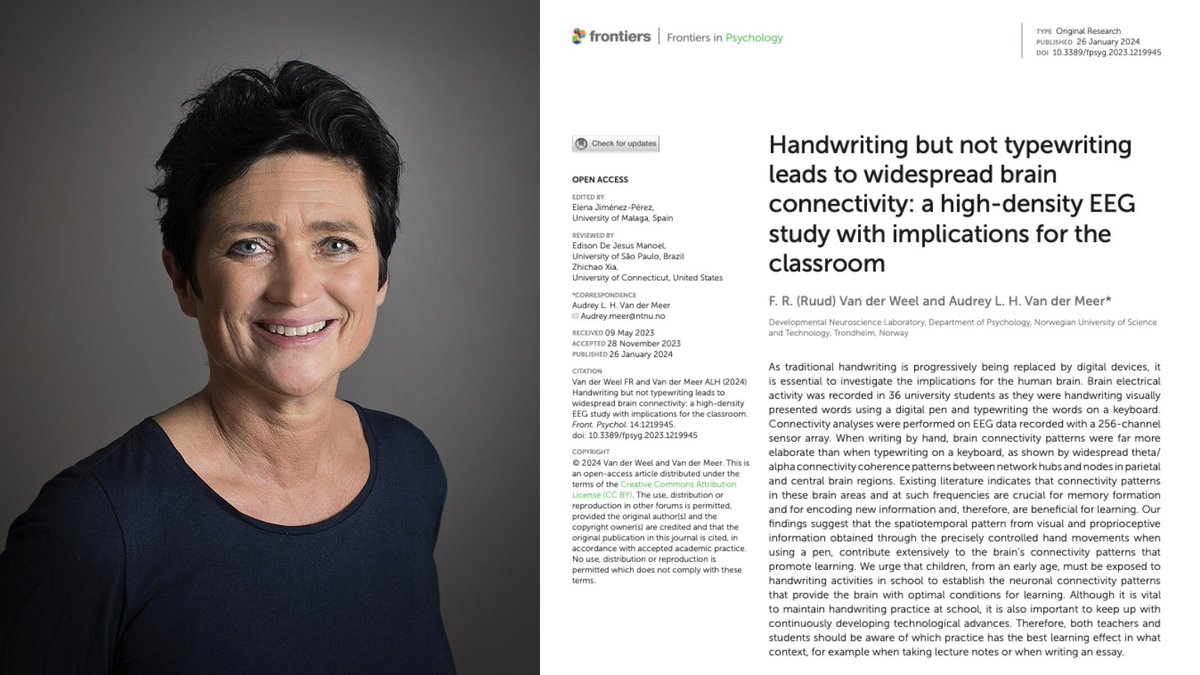
A Norwegian neuroscientist spent 20 years proving that the act of writing by hand changes the human brain in ways typing physically cannot, and almost nobody outside her field has read the paper.
Her name is Audrey van der Meer.
She runs a brain research lab in Trondheim, and the paper that closed the argument was published in 2024 in a journal called Frontiers in Psychology. The finding is brutal enough that it should have changed every classroom on Earth.
The experiment was simple. She recruited 36 university students and put each one in a cap with 256 sensors pressed against their scalp to record brain activity. Words flashed on a screen one at a time.
Sometimes the students wrote the word by hand on a touchscreen using a digital pen, and sometimes they typed the same word on a keyboard. Every neural response was recorded for the full five seconds the word stayed on screen.
Then her team looked at the part of the data most researchers had ignored for years, which is how different parts of the brain were communicating with each other during the task.
When the students wrote by hand, the brain lit up everywhere at once.
The regions responsible for memory, sensory integration, and the encoding of new information were all firing together in a coordinated pattern that spread across the entire cortex. The whole network was awake and connected.
When the same students typed the same word, that pattern collapsed almost completely.
Most of the brain went quiet, and the connections between regions that had been alive seconds earlier were nowhere to be found on the EEG.
Same word, same brain, same person, and two completely different neurological events.
The reason turned out to be something nobody had really paid attention to before her work. Writing by hand is not one motion but a sequence of thousands of tiny micro-movements coordinated with your eyes in real time, where each letter is a different shape that requires the brain to solve a slightly different spatial problem.
Your fingers, wrist, vision, and the parts of your brain that track position in space are all working together to produce one letter, then the next, then the next.
Typing throws all of that away. Every key on a keyboard requires the exact same finger motion regardless of which letter you are pressing, which means the brain has almost nothing to integrate and almost no problem to solve.
Van der Meer said it plainly in her interviews.
Pressing the same key with the same finger over and over does not stimulate the brain in any meaningful way, and she pointed out something that should scare every parent who handed their kid an iPad.
Children who learn to read and write on tablets often cannot tell letters like b and d apart, because they have never physically felt with their bodies what it takes to actually produce those letters on a page.
A decade before her, two researchers at Princeton ran the same fight using a completely different method and ended up at the same answer. Pam Mueller and Daniel Oppenheimer tested 327 students across three experiments, where half took notes on laptops with the internet disabled and half took notes by hand, before testing everyone on what they actually understood from the lectures they had watched.
The handwriting group won by a wide margin on every question that required real understanding rather than surface recall.
The reason was hiding in the transcripts of what the two groups had actually written down.
The laptop students typed almost word for word, capturing more total content but processing almost none of it as they went, while the handwriting students physically could not write fast enough to transcribe a lecture in real time, which forced them to listen carefully, decide what actually mattered, and put it in their own words on the page.
That single act of choosing what to keep was the learning itself, and the keyboard had quietly skipped the choosing and skipped the learning along with it.
Two studies. Two countries. Same answer.
Handwriting makes the brain work. Typing lets it coast.
Every note you have ever typed instead of written went into your brain through a thinner pipe. Every meeting, every book highlight, every idea you captured on your phone instead of on paper was processed at half depth.
You did not forget those things because your memory is bad. You forgot them because typing never woke the part of the brain that would have made them stick.
The fix is the thing your grandmother already knew.
Pick up a pen. Write the thing down. The slower road is the faster one.