Small scope note: blcli is GCP-first today.
That is intentional — we wanted to open-source the stack we actually run and battle-tested in production, not a thin multi-cloud abstraction that were freshly vibe-coded.
We are happy Google Cloud customers, and this stack encodes a lot of real GCP + GKE + Terraform + k8s production practice.
We are open-sourcing blcli: an Agentic Infra Stack, battle-tested at 30M+ user scale.
It allows coding agents like Codex or Claude Code to help manage your whole cloud infrastructure through code, PRs, dry-runs, and deterministic apply workflows. A solid & serious infra that can support to millions of users.
This is a collaboration across multiple teams, the same stack that powers @AlvaApp, @Galxe, @GravityChain, and @ReahPlatform.
Check it out here:
Docs: https://t.co/7XYzNboNiX
blcli: https://t.co/ddwTyMB5vT
Production stack template: https://t.co/pLmswgFsTA
Personal account starter: https://t.co/gQSUZDy9Yq
A common take today is:
AI agents are useful for toy apps and prototypes, but not for serious infrastructure.
The conclusion is wrong, because the issue is not that agents cannot work on real systems.
The issue is that real infrastructure requires a large amount of expert context to get it correct in the first place, and even more context to guide agents through the next 18 months of iteration.
Production infrastructure is not just a few Terraform files or Kubernetes YAMLs.
It includes:
cloud projects
IAM boundaries
networking
VPC / subnet / firewall design
Terraform state and backend management
Kubernetes clusters
cluster add-ons
secrets management
Git-based deployment workflows
observability and telemetry (logs, metrics, traces. All integrated together and ready for your Agents to debug live on your prod env)
databases, often self-hosted for cost efficiency and control
environment separation: stg / beta / prd
operational runbooks
rollback paths
production failure patterns
Most of this knowledge usually lives in senior engineers’ heads, internal docs, shell scripts, Slack threads, old runbooks, and lessons learned from real incidents.
If an agent does not have that context, of course it will build toy infrastructure.
So the real question is:
How do we package production infrastructure expertise into a form that AI agents can read, reason about, modify, and operate safely?
That is what blcli does. At its core, blcli is a CLI tool plus a whole package of best practices of Infrastructure as Code. The key design principle is simple: Agents are already very good at reading and modifying code. So we make infrastructure code-first. The generated repo is intentionally self-explanatory. An agent can open the repo and understand what happened, and what's next.
Who blcli is for?
We built blcli for two types of users.
1. Product teams that need to scale beyond prototypes
The first group is teams building real products that need infrastructure capable of growing beyond the prototype stage. These teams want the speed of AI-assisted development, but they cannot afford toy infrastructure.
2. Frontier labs and agent teams building self-improving systems
The second group is frontier labs, data companies, and agent teams that need infrastructure not just to run applications, but to train, evaluate, and improve agents.
If you are building coding agents, infra agents, or long-horizon autonomous systems, blcli stack is a good agent harness/env.
Authors:
@SiriJhui@p0pUBhv35I8308@alvinFu1@ryan4yin@algoxstonk
Something I re-realized recently:
Trading is not just about ideas, theses, data, or finding alpha (ofc @AlvaApp help you do these)
But for some 'new' traders, the things outside the numbers matter just as much: emotions, psychology, and mindset.
This week I took a break and watched a World Cup game in the Bay Area: Algeria vs Jordan.
I didn’t know either team well, so to make the game a bit more fun, I placed a small bet (if won, ticket is free) on Polymarket. At the time, Algeria was priced around 64% to win, while Jordan was around 15%.
On paper, Algeria looked like the rational side. They rank higher.
But once the game started, Jordan played way better than I expected. After a few great counterattacks, they scored first and took the lead for the first half.
At that moment, I had this strange feeling that reality was moving toward the low-probability outcome. And it reminded me a lot of trading (when I lose money).
Football has a lot of structure behind it: squad quality, tactics, historical data, coaching, matchups. The gap between a stronger team and a weaker team is real.
But football also has very sparse rewards, just like trading or many things on earth.
90 minutes is often not enough for the true difference between two teams to fully show up. That is why the better team does not always win.
You can make a decision that is right from a probability perspective. Your data, odds, and thesis can all make sense.
And you can still lose on that one outcome.
The hard part is not finding a 64% opportunity.
The hard part is staying clear-headed when that 64% starts moving toward the other 36%.
In the long run, what decides whether a trader survives may not just be their information edge.
It may be whether they can live with probability, volatility, and their own emotions.
Last year, we deployed a used $DELL server in a local data center in SF, with total cost of less than $4000, 256GB RAM, 96 Cores, and more than 20TB (RAID5) disk, half NVMe SSD, half cheap HDD.
At the time, 8 sticks of 32GB DDR4 2666MHz for a total of $248 — about $31 per stick.
Now, our team have been spinning up way too many VMs for their agents, so I had to add more memory. So I went to the same seller and he told me this:
“To be honest, when I looked back at your original order, it almost brought tears to my eyes remembering how great memory prices were at that time.”
The current price: 8 × 32GB DDR4 2666MHz — $1,520.
That is more than 6x the price.
I told him i'm crying right now, and yes, the price is OKAY.
The price $MU is OKAY.
wow, very cool. Just tried to ask it to teach me about slay the spire 2 Ironclad, the UI/UX looks cool, although the course content is unfortunately a bit sloppy (model's fault?)
Introducing Honen
The world's fastest way to train skills needed to succeed in the Al era
Simply drop in your org's docs
Get interactive courses that self-improve over time
To prove out our vision, we partnered with NVIDIA to bring AI literacy to 250,000 learners
By 2030, 78M jobs will need reskilling due to Al, and we're ensuring no person or company gets left behind
Learn more https://t.co/4fOh4My1Bf
Made some updates to this playbook.
The whole point: shorting this shitcoin was unfortunately a super BAD idea.
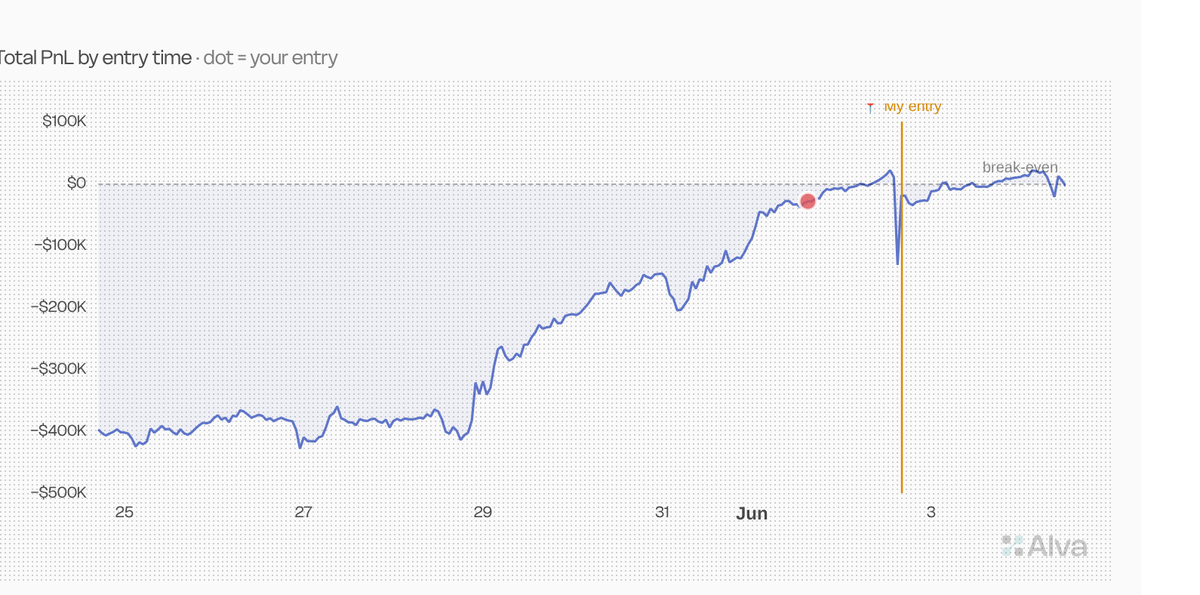
Look at the chart over time. Even if you shorted at $24 and never closed, you are only +20% now. If you opened a short after the first crash, around $15–16, and held until now, you’d be -18%
The bet was that the ppl behind this shitcoin had no idea what they were doing and would play it like ethereum:0x17205fab260a7a6383a81452ce6315a39370db97. Unfortunately, they actually do know what they’re doing.
I booked my loss last night. Bad fight.
The Tracker Working in RealTime!
As of close yesterday my playbook #GammaSqueezeCenrcom Alerted the $MU Squeeze imminent! $1050 the big #GammaWall, once cleared Mu is ready to take off again as we see today another 9% Monstrous move! @AlvaApp@algoxstonk@mozhi_zhang
https://t.co/fr6y4d3ZcQ
Alva should support those data too, similar to what massive has supported. Let me know if your Alva agents doesn't do the work. I just ask mine, she says she will 1. query contracts by underlying, e.g. AAPL
2. pick the OCC ticker, e.g. O:AAPL260410C00200000
3. fetch option kline data for that exact contract
Alva dev is moving smooth because we built a super agent-friendly dev env:
Infra: Terraform + k8s, fully infra as code, Atlantis, ArgoCD, and full suite of otels. All read/write-able to agents.
Codebase: a monorepo built to be "local-first". Anyone can run the whole Alva backend on a laptop, or some freshly minted VM.
Agents: Codex/Claude can work inside a real environment: research → plan → TDD code → review → PR → human + AI review → release checks for DB db migrations, env vars, secrets, and infra diffs.
Will share & open source more when I have time.
Very cool. I’ve been watching those too. Sentiment started to shift a bit around two weeks ago. I don’t have a strong view or position yet, so I’m mostly keeping an eye on them as confirmation signals
I just deployed a production-ready Options #GammaSqueeze Tracker on @alva_ai@algoxstonk
It is a non-linear risk engine designed for high-beta volatility ($MU , $TSLA , $SNDK ):
1/ Tracks Dealer Gamma Wall & Net GEX Sign-Flips
2/ Pre-calculates 1-3 Sigma Expected Move
3/ Triggers IV Crush alarms prior to major catalysts
Architected with minimum usable surface area.
I kept the quantitative engine read-only and left the ticker fully fluid.
Click Remix, swap the ticker to your likes, and automate your portfolio defense in 3 seconds.
Live workflow here:
https://t.co/fr6y4d3rni
#alvaai #optiontrading #stock
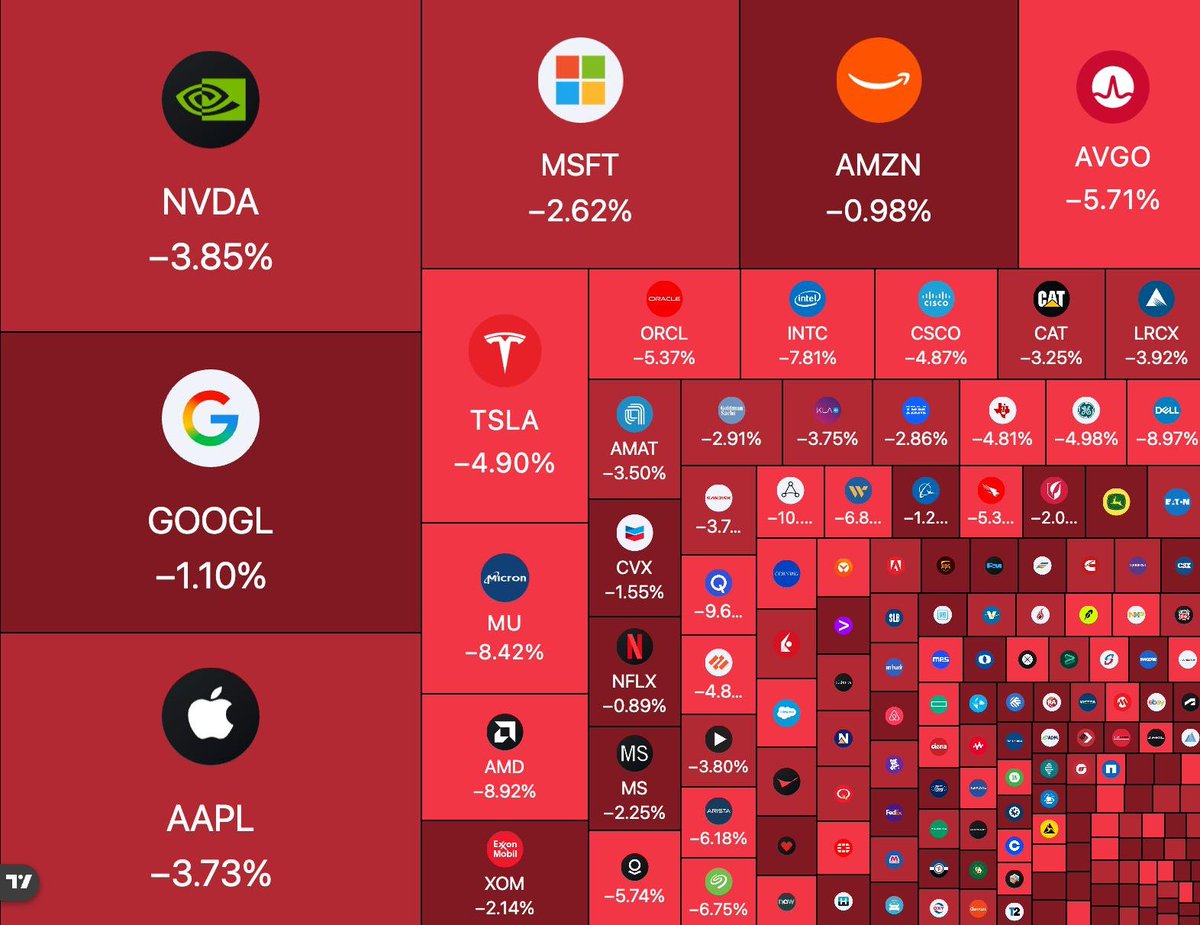
"Nasdaq is down 3%, SPX is down 2%" Before you panic, look at what's actually moving it.
no, it's not some secret spacex mechanic. two boring catalysts, stacked.
- Semis cracked Friday. Broadcom guided soft and the market read it as the AI trade finally cooling, and chips have been carrying this entire rally, so when they roll over, the index rolls with them. That was the -4% nasdaq day.
- today it's Iran. Trump saying the US "must respond" puts escalation back on the table, and that means oil spikes and money runs out of risk fast. so stocks get sold.
One's a growth scare that's been building all week. It's a geopolitical scare that hit this afternoon.
From my Alva agent (i think it's complaining:
First push of H (HUSDT): 2026-06-06 18:03 UTC.
Since then it's fired 16 times (06-06 18:03 → 06-08 22:05 UTC), escalating as funding deepened from −0.108% to the −2.0% exchange cap.
• First alert: price 0.569 · funding −0.108% · OI $104.5M
• Latest alert: price 0.143 · funding −2.0000% · OI $21.5M
That's ~−75% in price and −81% in OI across the run — funding pinned at the −2% floor with OI collapsed, which reads like late-stage capitulation rather than the start of a fresh leg down.