▪️ Sheikh Salih Al-Fawzan said in [*Wujub At-Tathabbut fi al-Akhbar*]: "Mutual abandonment only occurs due to the devils of jinn and mankind who instigate it among Muslims to scatter their congregation and divide their unity."
▪️▪️▪️▪️
▪️ Al-Hafidh Ibn Hajar said in [*Fath al-Bari*]: "The apparent meaning of the narration is the permissibility of that during the three days, and this is out of leniency/gentleness, because the nature of a human being includes anger, ill-temper, and the like, and predominantly this subsides or lessens within three days."
▪️ Imam Malik said in [*Al-Muwatta*]: "I do not deem *tadabur* (turning backs on one another) to be anything other than turning away from your Muslim brother by turning your face away from him."
▪️▪️▪️▪️
💢 For other benefits in this lesson, you may listen to them:
📎 Audio link:
[https://t.co/bEbca6EG7X](https://t.co/ruAsZj37Jr)
▪️ Part (12) to follow.
📎 The Ahl al-Athar Group Join Link: https://t.co/9ZSlU0khso
💢 As for the stances of the Prophet ﷺ with the Muslims:
▪️ A Muslim ought to draw close to his brothers,
▪️ Foster affection and harmony with them,
▪️ Love them,
▪️ Endear himself to them, treat them with kindness, and maintain ties with them,
▪️ Not harm any of them nor hurt their feelings,
▪️ Not address them with words they dislike,
▪️ Not slander nor mock them,
▪️ Not ridicule them nor make others laugh at their expense,
▪️ Not backbite them, nor permit anyone to backbite them in his presence,
▪️ Not disclose any of their secrets that they would hate to be revealed,
▪️ Not seek out their faults/private matters,
▪️ Not call them by offensive nicknames,
▪️ And not ruin their state/affairs,
▪️ Such as ruining their unity and mutual harmony.
▪️▪️▪️▪️
🔘 On the authority of Anas, may Allah be pleased with him, that the Prophet ﷺ said: "Do not harbor hatred toward one another, do not envy one another, do not turn your backs on one another, and be servants of Allah as brothers; and it is not lawful for a Muslim to abandon (boycott) his brother for more than three days."
📎 Reported by Al-Bukhari in his *Sahih*
▪️▪️▪️▪️
🔘 And on the authority of Abu Hurairah, may Allah be pleased with him, that the Prophet ﷺ said: "Beware of suspicion, for suspicion is the most false of speech; and do not spy on one another, do not eavesdrop, do not compete maliciously with one another, do not envy one another, do not harbor hatred toward one another, and be servants of Allah as brothers."
📎 Reported by Al-Bukhari and Muslim
▪️▪️▪️▪️
🔘 And on the authority of Abu Ayyub, may Allah be pleased with him, that the Prophet ﷺ said: "It is not lawful for a Muslim to abandon (boycott) his brother for more than three days."
📎 Reported by Al-Bukhari and Muslim
🔘 And in a narration by Abu Dawud: "There is no abandoning beyond three days; so whoever abandons his brother beyond three days and dies will enter the Fire."
🔸 Its chain of narration is authentic (sahih).
▪️▪️▪️▪️
💢 Thus, abandoning (al-hajr) is of two types: legislated and prohibited.
▪️ The prohibited type: is that which is for selfish personal motives (haz al-nafs) and not for the sake of religion; whoever abandons beyond three days for this reason incurs sin, and if he dies, he enters the Fire.
🔘 And on the authority of Ibn Umar, may Allah be pleased with them both, that the Prophet ﷺ said: "It is not lawful for a Muslim to abandon his brother for more than three days."
📎 Reported by Muslim in his *Sahih*
▪️▪️▪️▪️
🔘 And on the authority of Abu Hurairah, may Allah be pleased with him, that the Prophet ﷺ said: "There is no abandoning after three days."
📎 Reported by Muslim in his *Sahih*
▪️▪️▪️▪️
▪️ Ibn Hibban said in [*Rawdat al-'Uqala*]: "It is not lawful for a Muslim to abandon his fellow Muslim brother for more than three days; whoever does that has committed a transgression against the prohibition of the Prophet ﷺ, and the better of the two is the one who initiates the greeting of peace."
▪️ Al-Hafidh Ibn Hajar said in [*Fath al-Bari*]: "This abandonment stems from selfish personal motives; therefore, it is prohibited."
🔴 Meaning it is not for the sake of Allah nor His Messenger ﷺ.
▪️▪️▪️▪️
▪️ Ibn Muflih said in [*Al-Adab Ash-Shar'iyyah*]: "And this indicates the prohibition of abandoning one's relatives for personal grievance."
▪️ An-Nawawi said in [*Sharh Muslim*]: "The scholars said concerning this hadith that it indicates the prohibition of abandonment between Muslims for more than three days, and its permissibility during the first three days by the explicit text of the hadith, and the latter by its implication."
▪️ Muhammad ibn al-Hasan said in [*Al-Muwatta*]: "And by this we take the view that abandonment should not occur among Muslims."
📘 *Tuhfat al-Akhyar fi Ta'lif Qulub al-Abrar*
▪️ Part (11)
💢 *Continuation of the Prophet's ﷺ Stances with the Hypocrites, and the Beginning of His ﷺ Stances with the Muslims*
📎 By His Eminence, the Sheikh, the Muhaddith, the Jurist Fawzi Al-Athari, may Allah preserve and protect him.
[https://t.co/aLiHzqqlj3)
💢 We continue the discussion on the Prophet's ﷺ stances with the hypocrites:
🔘 On the authority of Aisha, may Allah be pleased with her, who said: "A man asked permission to enter upon the Messenger of Allah ﷺ, so he said: 'Admit him; what an evil brother of the clan he is.' But when he entered, he spoke softly and gently to him. I said: 'O Messenger of Allah, you said what you said, then you spoke softly to him.' He said: 'O Aisha, indeed the worst of people is the one whom people abandon out of fear of his foulness/evil.'"
📎 Reported by Al-Bukhari in his *Sahih*
▪️▪️▪️▪️
▪️ Al-Hafidh An-Nawawi said in [*Sharh Sahih Muslim*]: "The Prophet ﷺ intended to clarify his condition so that people would know him and anyone who does not know his condition would not be deceived by him. Describing him as 'an evil brother of the clan' is among the signs of prophethood because he turned out just as he was described in terms of defaming the religion. He only spoke gently to him to conciliate him and those like him toward Islam. From this hadith comes the principle of *mudarah* (courteous diplomacy/affability) toward the one whose foulness is feared, and the permissibility of backbiting the openly wicked sinner (fasiq) and the one whom people need to be warned against."
▪️ Thus, this hypocrite defamed the religion, yet he displayed Islam outwardly, and he was foul; despite this, the Prophet ﷺ permitted him to enter and spoke gently to him to win over his heart and those like him toward Islam. Likewise, the Prophet ﷺ averted the foulness of this man, lest he go to the people and cause confusion against the Prophet ﷺ and Islam, and so that this man would find nothing with which to defame the Prophet ﷺ and Islam.
▪️ This is an act of *mudarah* (courteous diplomacy) for the sake of Da'wah and spreading Islam—not out of fear of him, nor fear of his followers, but solely for the sake of Islam, without compromising anything from the religion, while remaining upon the sound methodology and holding fast to the Book and the Sunnah.
▪️ As for *mudahanah* (flattery/compromising the truth), this is not permissible; it means to go along with people in their falsehoods and innovations.
▪️ This is the difference between *mudarah* and *mudahanah*.
▪️ Therefore, partisans (hizbiyyun) watch for opportunities against the Salafis whenever they boycott them or do not greet them on certain occasions, creating confusion around them to defame the Salafis.
▪️▪️▪️▪️
💢 In the hadith, there is consideration for people and taking their circumstances into account.
▪️ Especially those who wish to defame the Salafi Da'wah, as they enter from various angles to slander it; thus, caution must be exercised regarding such individuals, and we must treat people with *mudarah* as the Prophet ﷺ did.
▪️ Ibn Abi Ad-Dunya authored a book entitled: *Mudarat an-Nas* (Affability Toward People), wherein he mentioned the marfu' hadiths, mawquf and maqtu' narrations regarding the Prophet's ﷺ *mudarah* toward people, and the *mudarah* of the Companions, the Successors, and the scholars toward people; therefore, we must follow their example so that the Da'wah is established upon knowledge and insight.
▪️ Thus, we conclude the Prophet's ﷺ stances with the hypocrites.
▪️ Likewise, the mention of the Prophet's ﷺ stances with the polytheists has preceded.
▪️▪️▪️▪️
🟢 Fatwa of the Eminent Scholar, the Muhaddith Ibn Baz, may Allah have mercy on him, former Grand Mufti of the Kingdom of Saudi Arabia: The best time for the night prayer (Qiyam al-Layl) is the last part of the night, and this is the Sunnah upon which the Prophet, peace and blessings be upon him, settled at the end of his life. It is the time in which Allah the Exalted descends to the lowest heaven and answers the one who supplicates to Him, and the prayer at this time is witnessed; therefore, it is the time that ought to be given careful attention for Qiyam al-Layl.
https://t.co/X7wT4RCu9I
🟢 *فتوى العلّامة المحدّث ابن باز رحمه الله، مفتي المملكة العربية السعودية سابقا: أن أفضل وقت لقيام الليل هو آخر الليل، وهذا هو السنة الذي استقر عليه النبي عليه الصلاة والسلام في آخر حياته، وهو الوقت الذي ينزل الله تعالى فيه إلى السماء الدنيا ويجيب فيه من يدعوه، وهذا الوقت الصلاة فيه مشهودة، فهو الوقت الذي يجب أن يعتنى به لقيام الليل*
https://t.co/X7wT4RCu9I
🔵 *Raising the index finger and pointing with it during the sitting between the two prostrations in prayer: It is not established in the Sunnah, as the hadith regarding it is anomalous (shadh) and not authentic. Rather, pointing with the index finger in prayer is only during the first Tashahhud and the last Tashahhud; this is what is correct and established in the Sunnah.*
📎 *By our Sheikh, the Muhaddith, the Eminent Scholar, the Jurist Abu Abdur-Rahman Fawzi Al-Athari, may Allah preserve him*
[https://t.co/ziRk2lItvm)
🟡 *Adhere to the jurisprudence (Fiqh) of the Companions, for they reached consensus on the rulings of the religion and did not differ; and do not pay attention to the controversies of later generations that are transmitted by ignorant pretenders to knowledge (al-muta'allimun) and blind followers, who abandon the jurisprudence of the Companions due to their ignorance and for their sectarian and partisan agendas. Therefore, these preachers and ignorant pretenders to knowledge must be suppressed night and day in order to spread the Sunnah and suppress ignorance and innovations.*
📎 *By our Sheikh, the Muhaddith, the Eminent Scholar, the Jurist Abu Abdur-Rahman Fawzi Al-Athari, may Allah preserve him*
[https://t.co/F82GB4RjQj)
🔴 *The Fatwa of the Eminent Scholar, the Muhaddith Al-Albani, may Allah have mercy upon him: That among modern innovations is what is termed "ad-Da'iyah" (the preacher/caller) and "ad-Du'at" (the callers/preachers), while they are ignorant individuals who come to the forefront of Da'wah! They believe it is incumbent upon them to call people through ignorance and pretending to possess knowledge (ta'alum). Among them, for example, is Jama'at al-Tabligh: they send out groups of people for Da'wah while they do not know the simplest basics of knowledge (do not know five from a blot)! Rather, you find their leaders falling into Shirk along with the polytheists, such as circumambulating graves, and immense matters they fall into because of stepping to the forefront of Da'wah while they are ignorant. And what is obligatory is that no one should come to the forefront of Da'wah except the scholars who are firmly grounded in the knowledge of the Book and the Sunnah, and who have studied at the hands of the scholars of the Sunnah.*
[https://t.co/9vEOMjrS7C)
💢 *This is how people flocked to the lessons of the People of Hadith*
▪️ *Imam Ibn Abi Hatim, may Allah have mercy upon him, said:*
((Sa'id ibn al-Mughirah al-Sayyad al-Massisi, Abu Uthman; he narrated from: Abu Ishaq al-Fazari, Ibn al-Mubarak, and others. My father narrated from him.
• And I heard my father say: "It suffices you as a virtue of his that he began reading the book 'Al-Siyar', and I saw the people of al-Massisah had closed the doors of their shops and attended his gathering."
• And my father said: "Sa'id ibn al-Mughirah al-Sayyad narrated to us, and he was trustworthy.")). End quote.
• The book [Al-Siyar]: It is by Imam Abu Ishaq al-Fazari.
📘 *[Al-Jarh wa al-Ta'dil] (Vol. 4, p. 67)*
📎 The Ahl al-Athar Group Join Link: https://t.co/9ZSlU0khso
2️⃣ The Hadith of Abd Khayr, who said: (Ali, may Allah be pleased with him, came to us after having prayed, and called for purifying water. We said: "What will he do with the purifying water when he has already prayed? He only wants to teach us." A vessel containing water and a basin were brought to him. He poured from the vessel onto his right hand and washed his hands three times, then rinsed his mouth and sniffed water into his nostrils and blew it out three times... then he said: "Whoever is pleased to know the ablution of the Messenger of Allah ﷺ, it is this.")
🔸 An authentic Hadith (Sahih).
📎 Narrated by Abu Dawood, An-Nasa'i, Ahmad, and others.
▪️ Authenticated by Shaykh Al-Albani in "Sahih Sunan Abi Dawood".
▪️▪️▪️▪️
▪️ Our Shaykh Al-Uthaymeen (may Allah have mercy upon him) said in [Fath Dhi Al-Jalal]: (It is prescribed to wash the palms three times before ablution.) End quote.
▪️ Our Shaykh Al-Uthaymeen (may Allah have mercy upon him) said in [Ash-Sharh Al-Mumti']: (When the Prophet ﷺ performed ablution, he would begin by washing the palms three times because they are the instrument of washing; through them water is conveyed and the limbs are rubbed, so it was most fitting that their purification should come first.) End quote.
▪️▪️▪️▪️
💢 There is no harm upon the servant if he wishes to wash the hands "once" on the condition that they are cleaned; and if he wishes, he washes them "twice"; and if he wishes, he washes them "three times"; and the best is to wash them "three times" in following the Sunnah.
▪️ Ibn Al-Mundhir (may Allah have mercy upon him) said in [Al-Ijma']: (All the scholars from whom we have preserved knowledge agreed by consensus that washing the hands at the beginning of ablution is a Sunnah that is recommended to practice. He has the choice: if he wishes, he washes them once; if he wishes, he washes them twice; and if he wishes, three times. Whichever of that he wishes, he may do, and washing them three times is more beloved to me.) End quote.
▪️▪️▪️▪️
💢 An issue: If a Muslim performs ablution and then experiences an invalidator during his ablution, he does not repeat washing his hands if he restarts the ablution.
▪️ It is not obligatory for him to wash his palms three times, because what was required has been done; therefore, he should proceed directly to the required limbs, as Al-Baji explained in [his explanation of Al-Muwatta'].
▪️ The wisdom behind washing them is that they are the instrument of action, so it is proper to purify them before the action.
▪️▪️▪️▪️
💢 For more benefit, please listen to the entire lesson.
▪️ Audio material link:
[https://t.co/p9eA1rw9UC](https://t.co/tJvRcQ9S3I)
🔗 To be followed by Part (8)
📎 The Ahl al-Athar Group Join Link: https://t.co/9ZSlU0kPhW
📘 *The Description of the Prophet's Ablution (Peace and Blessings be upon Him)*
▪️ Part (7)
💢 *The Evidence for the Recommendation of: Washing the Hands (Palms) Three Times at the Beginning of Ablution*
📎 By the Eminent Scholar, the Muhaddith, the Jurist Fawzi Al-Athari, may Allah preserve and protect him.
[https://t.co/kDe9fiuowh)
💢 Mentioning the evidence for the recommendation of washing the palms three times at the beginning of ablution:
▪️ The palm (Kaff): It is the palm of the hand along with the fingers; it was named "Kaff" because it wards off (Takuffu) harm from the body.
▪️ When "the right hand" is mentioned in an absolute sense, it refers to the palm and the rest of the arm/hand.
▪️▪️▪️▪️
1️⃣ On the authority of Humran, the freed slave of Uthman, that Uthman ibn Affan (may Allah be pleased with him): (called for water for ablution and performed ablution: he washed his palms three times, then rinsed his mouth and sniffed water into his nostrils and blew it out, then washed his face three times, then washed his right hand up to the elbow three times, then washed his left hand likewise, then wiped his head, then washed his right foot up to the ankles three times, then washed his left foot likewise. Then he said: "I saw the Messenger of Allah ﷺ perform ablution in the manner of this ablution of mine.")
📎 Narrated by Al-Bukhari in his "Sahih" and Muslim in his "Sahih".
▪️▪️▪️▪️
💢 Among the descriptions of the ablution of the Prophet ﷺ: He used to wash his palms three times.
▪️ This is to prepare the palm for washing the limbs, removing whatever dust, dirt, or otherwise may have clung to the servant's palms, as water eliminates that.
▪️ An-Nawawi (may Allah have mercy upon him) said in "Al-Minhaj": (His saying: "and he washed his palms three times," this is evidence that washing them at the beginning of ablution is a Sunnah, and it is so by the consensus of the scholars.) End quote.
▪️ The Hadith of Uthman is both Mawquf and Marfu': it is Mawquf regarding the action of Uthman, and then he raised it (Marfu') to the Prophet ﷺ.
▪️ As for the Hadith of Al-Qaysi with the wording: ("and he washed them once"), it is an anomalous addition (Ziyadah Shadhdhah).
▪️ Likewise, the Hadith of Abdullah ibn Zayd with the wording: ("and he washed his hands twice") is also an anomalous addition.
▪️ See: "Al-Ilal" by Ibn Abi Hatim (Vol. 1, p. 118), and "Al-Awsat" by Ibn Al-Mundhir (Vol. 1, p. 374).
▪️▪️▪️▪️
▪️ Our Shaykh Al-Uthaymeen (may Allah have mercy upon him) said in [Fath Dhi Al-Jalal]: (His saying: "and he washed his palms three times," this washing is undoubtedly an act of worship, because the Prophet ﷺ worshipped Allah through it, so it is an act of worship. However, it is not among the limbs that must be washed except after washing the face. Thus, washing the palms is prioritized here because they are the instrument for scooping water, so it is proper for them to be clean before starting to wash the rest of the limbs.) End quote.
▪️▪️▪️▪️
💢 Therefore, the servant must apply the washing of the palms according to the description of the washing of the Prophet ﷺ and take care to implement the Sunnah.
▪️ An eloquent admonition regarding the implementation of the Sunnah and not abandoning it, for in it lies blessing, and the descent of safety upon the servants and the lands.
🔴 These are two Sunnahs among the Sunnahs of ablution: Washing the palms at the beginning of ablution is a Sunnah, and washing them three times is another Sunnah.
▪️ Ibn Al-Mundhir (may Allah have mercy upon him) said in [Al-Awsat]: (All the scholars from whom we have preserved knowledge agreed by consensus that washing the hands at the beginning of ablution is a Sunnah.) End quote.
▪️▪️▪️▪️
🟢 *No hadith regarding female circumcision is authentic; circumcising them is neither obligatory nor recommended, but rather it is an innovation (Bid'ah). That has not been established in the authentic Sunnah, nor did the Companions command it for women, and a woman does not need that. Therefore, it is not part of the Sunnah, but rather it is among the innovations and extremism.*
📎 By our Shaykh, the Muhaddith, the Erudite Scholar, the Jurist Abu Abd al-Rahman Fawzi al-Athari, may Allah preserve him.
[https://t.co/Rh7W5RPYGk)
🟡 *Beneficial knowledge is not to be found except with the People of Hadith (Ahl al-Hadith), and none shall benefit from it except the responding nation (the Muslims). It is the knowledge grounded upon the Quran, the authentic Sunnah, and the traditions of the predecessors (Salaf) of the nation, from the Companions' interpretations (Tafsir) and their jurisprudence (Fiqh). As for the rabble and the riffraff, they fall under the blind imitators who feign knowledge, studying unbeneficial knowledge, thus plunging them into greater confusion, loss, and disarray.*
📎 By our Shaykh, the Muhaddith, the Erudite Scholar, the Jurist Abu Abd al-Rahman Fawzi al-Athari, may Allah preserve him.
[https://t.co/V9EOQvSlqR)
🔵 *Fatwa of the Erudite Scholar and Mufti Saleh Al-Fawzan, may Allah preserve him, Mufti of the Kingdom of Saudi Arabia: Suppressing pseudo-intellectuals who merely regurgitate ideas, and those who call themselves thinkers while they are ignorant and people of misguidance, who disparage the knowledge of the righteous predecessors (Salaf) and their status, whereas we have been commanded to emulate them and follow them.*
[https://t.co/RQX5yFWWpl)
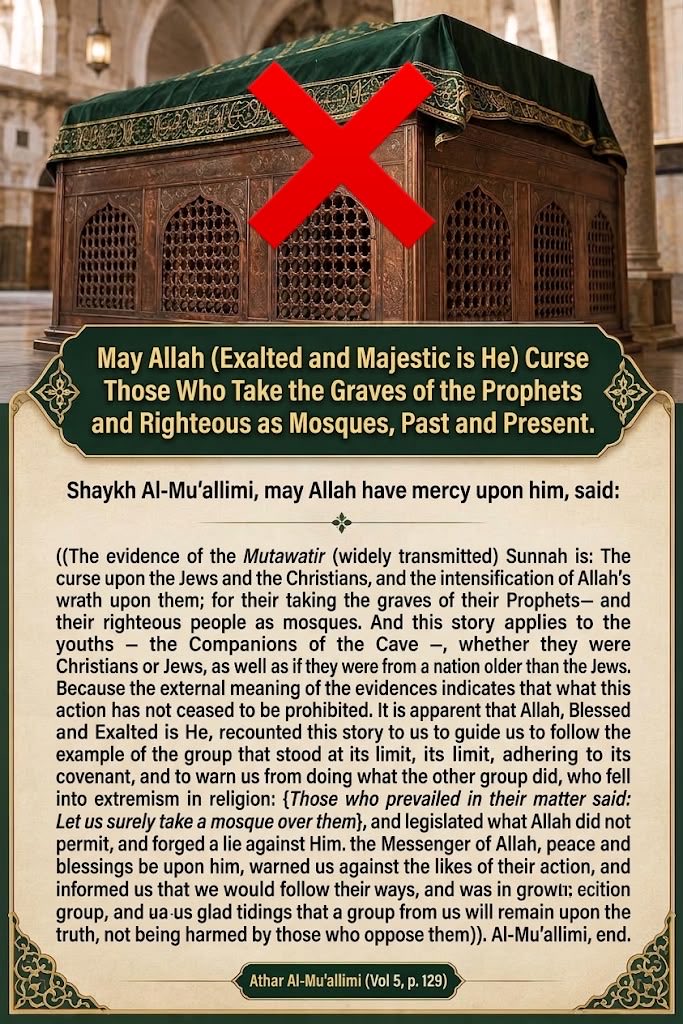
🔴 *Fatwa of the Erudite Scholar, the Muhaddith Al-Albani, may Allah have mercy upon him: It is forbidden to pray in a mosque containing a grave, such as the Umayyad Mosque in Damascus, and many mosques in Syria, Egypt, Pakistan, India, and other countries. Grave-worshipers frequent these graves seeking rescue, aid, and the fulfillment of needs from them, and seeking blessings through them; all of this is part of associating partners with Allah (Shirk), Exalted and Majestic is He. Therefore, it is not permissible to pray in these mosques, for the prayer is invalid.*
[https://t.co/SxE2THCPku)
📗 *Description of the Prayer of the Messenger, Peace and Blessings Be Upon Him*
▪️ Part (10)
💢 Mention of the Evidence for Joining Shoulder to Shoulder and Foot to Foot in Prayer
🔘 On the authority of Anas ibn Malik (may Allah be pleased with him), who said: The Messenger of Allah ﷺ said: ((Straighten your rows, for I see you from behind my back. And each of us used to join his shoulder to the shoulder of his companion, and his foot to his foot)).
📎 Reported by Al-Bukhari in his "Sahih", and Muslim in his "Sahih".
▪️ Straighten (Aqīmū): meaning level and make them straight.
📎 See: [Fath al-Bari] by Ibn Hajar (2/208).
▪️▪️▪️▪️
▪️ To be followed by Part (11)
📗 *Summarized from the book: [Siraj al-Muttaqin fi Sifat Salat Sayyid al-Mursalin ﷺ]*
📎 By our Shaykh, the Muhaddith, the Erudite Scholar, the Jurist Abu Abd al-Rahman Fawzi al-Athari, may Allah preserve him.
📎 The Ahl al-Athar Group Join Link: https://t.co/9ZSlU0khso
💢What we have come upon is the testimony of Ibn Abbas (may Allah be pleased with them both) for Mu'awiyah ibn Abi Sufyan (may Allah be pleased with him) regarding jurisprudence and knowledge; may the curse of Allah be upon whoever slanders Mu'awiyah ibn Abi Sufyan (may Allah be pleased with him) from near or far: {May Allah destroy them; how are they deluded?} [At-Tawbah: 30].
Al-Bukhari reported in his "Sahih" (3765); from Ibn Abi Mulaykah; it was said to Ibn Abbas: "Do you have any remark regarding the Commander of the Faithful, Mu'awiyah, for he did not pray the Witr except with a single Rak'ah?" Ibn Abbas (may Allah be pleased with them both) said: "(He was correct; indeed, he is a jurist)".
So, O you "blind followers" who display factional prejudice, submit to the narrations (Athar) of the Companions (may Allah be pleased with them) in the jurisprudence of fundamental principles (Usul) and subsidiary issues (Furoo'), and abandon "blind following" (Taqleed) in its entirety and in detail; O Allah, grant forgiveness.
Shaykh al-Islam Ibn Taymiyyah (may Allah have mercy on him) said in "Minhaj al-Sunnah" (Vol. 4, p. 435), after mentioning those among the Companions (may Allah be pleased with them) who praised Mu'awiyah ibn Abi Sufyan (may Allah be pleased with them both): "(So this is the testimony of the Companions [may Allah be pleased with them]: 'to his jurisprudence and his religiosity'; and the witness 'to jurisprudence' is Ibn Abbas [may Allah be pleased with them both], and to the excellence of prayer is Abu al-Darda [may Allah be pleased with him], and who could match the two of them!)" End quote.
(1) And nothing brought them to ruin except the ill omen of blameworthy blind following in the purified Shari'ah.
📎 The Ahl al-Athar Group Join Link: https://t.co/9ZSlU0khso