This animated globe by @tylermorganwall gives us a rather immersive view of global population. I particularly love how clear the "empty hemisphere" appears.
This timelapse captured on the island of Tenerife, shows how stable air flows over a mountain range can form waves in the clouds that resemble an ocean.
[📹 Tristan Heth]
Hey, look at that snake.
Wait, it's not a snake. It's a family of shrews.
They have poor eyesight and when a mother wants to move her offspring, each shrew will hold onto the shrew in front forming a long caravan.
[📹 NHK]
https://t.co/yMgE5yJXqr
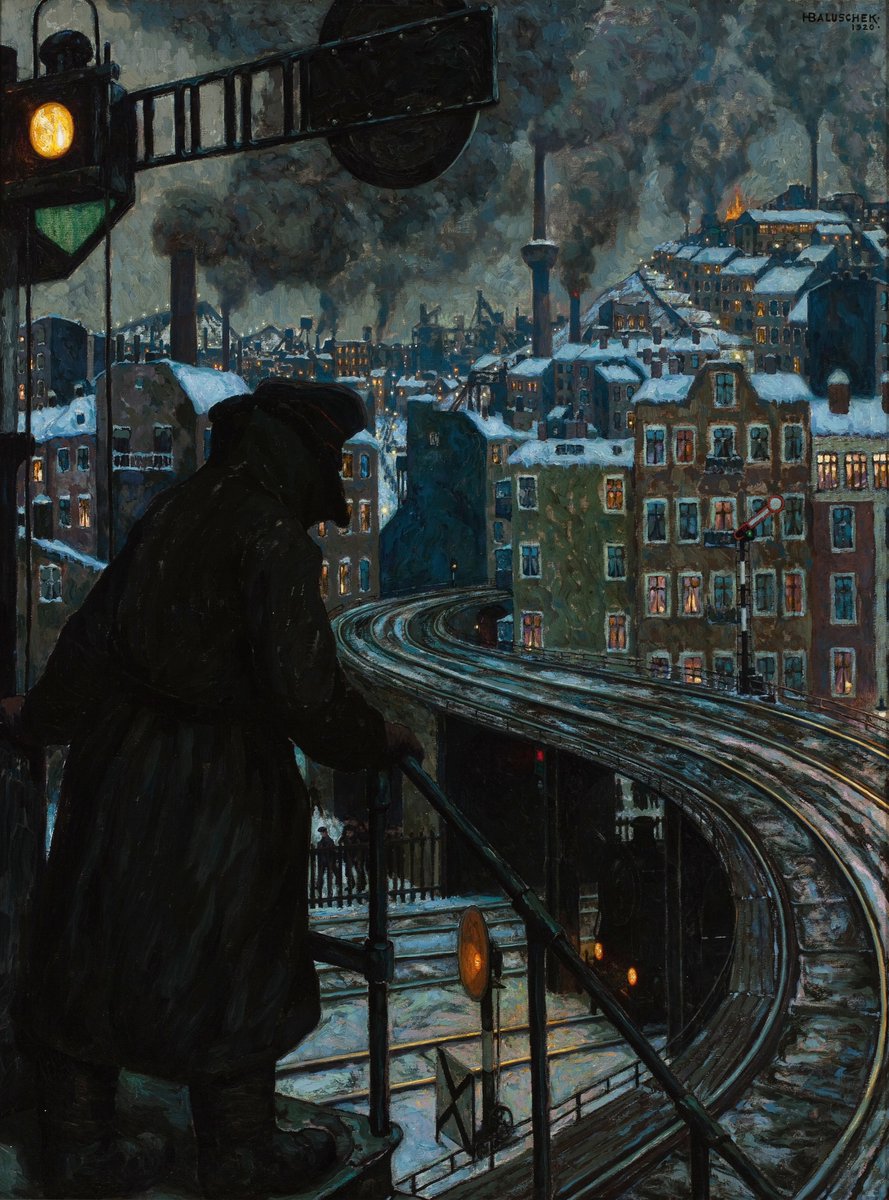
There's more to the world of art than Leonardo da Vinci and Pablo Picasso.
So here are 11 brilliant, beautiful, & bizarre painters you've (probably) never heard of:
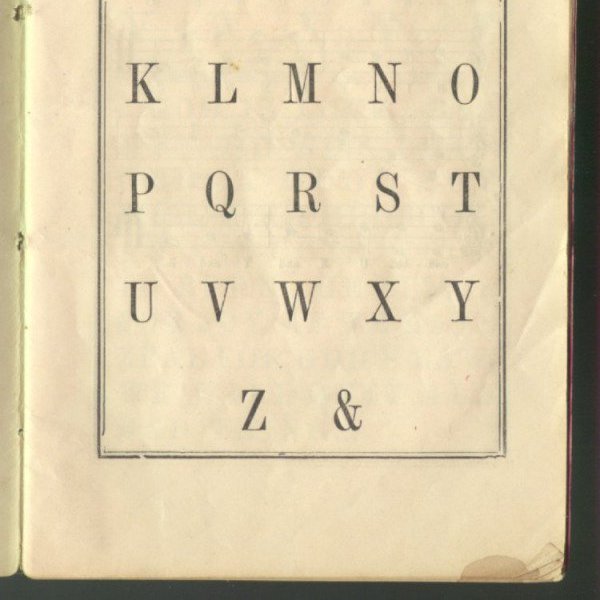
What the hell is an ampersand and why does it look like that?!
The first thing you need to know is that "&" used to be the 27th letter of the alphabet...
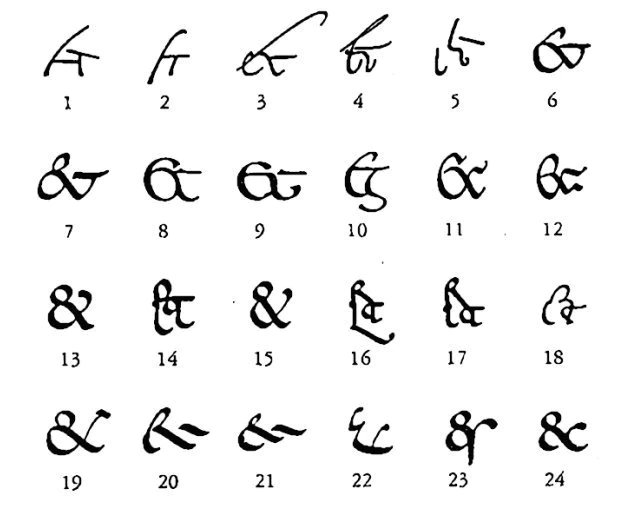
But there are three parts to this story. And the first begins over two thousand years ago in Ancient Rome with a single word: et. It's the Latin for "and". At some point Roman scribes started combining the two letters of et into a single symbol, which was the ancestor of our modern &.
The earliest example of the "et" symbol is actually from graffiti in Pompeii. In any case, it did not disappear with the fall of the Roman Empire.
Latin survived as the language of the Catholic Church and of scholarship in Medieval Europe. Scribes during the Dark Ages continued to use the & symbol. It evolved down the centuries, in places losing any semblance of the letters e and t whatsoever.
The second part of the story is that during the 18th and 19th centuries, as education and the teaching of literacy spread, & was added to the end of the alphabet as a sort of 27th letter.
On a related note, although "et cetera" is now usually just abbreviated as etc., for a long time it was instead abbreviated as "&c". The & was for et and the c for cetera.
The third and final part of the story is about how the alphabet was taught to children — and how it was read out loud.
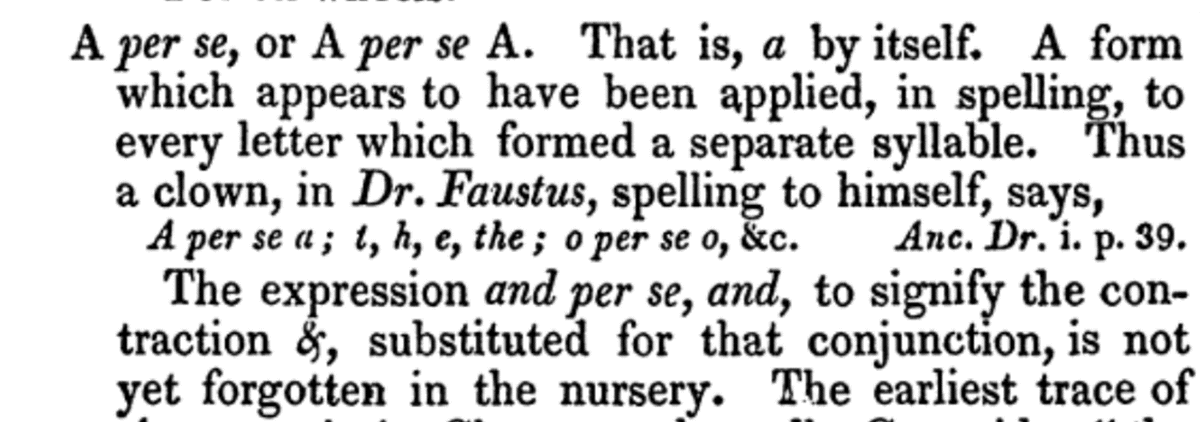
As this 1822 Glossary of Words and Phrases explains, it had been normal during the Renaissance, when speaking the alphabet, to add "per se" before any letter which could also be a word on its own — "per se" means "by itself" in Latin.
Take the letter A, which can also be a word of its own. When reading out the alphabet people would say "A, per se A, B, C, D, E, F, G, H, I, per se I..." and so on. O was also considered a word of its own.
Which means, when people got to the end of the alphabet, with & being the 27th letter, they would say: "S, T, U, V, W, X, Y, Z, and per se &."
When this old way of reading the alphabet was taught to children in the 18th century and they were reciting it aloud, they would garble "and per se " into what eventually became... ampersand.
A Dictionary of Slang and Colloquial English from 1905 relates some of the many other pronunciations school children apparently came up with:
"Ampersand. The sign &; ampersand. Variants: Ann Passy Ann; anpasty; andpassy; anparse; apersie; per-se; ampassy; am-passy-ana; ampene-and; ampus-and; ampsyand; ampazad; amsiam; ampus-end; apperse-and; empersiand; amperzed; and zumzy-zan."
Well, of all the many pronunciations that might have stuck, it was "ampersand" which came to be accepted and is now the official name for &... rather than zumzy-zan. So, from hurried Roman scribes to unruly school children, that's where "&" came from.
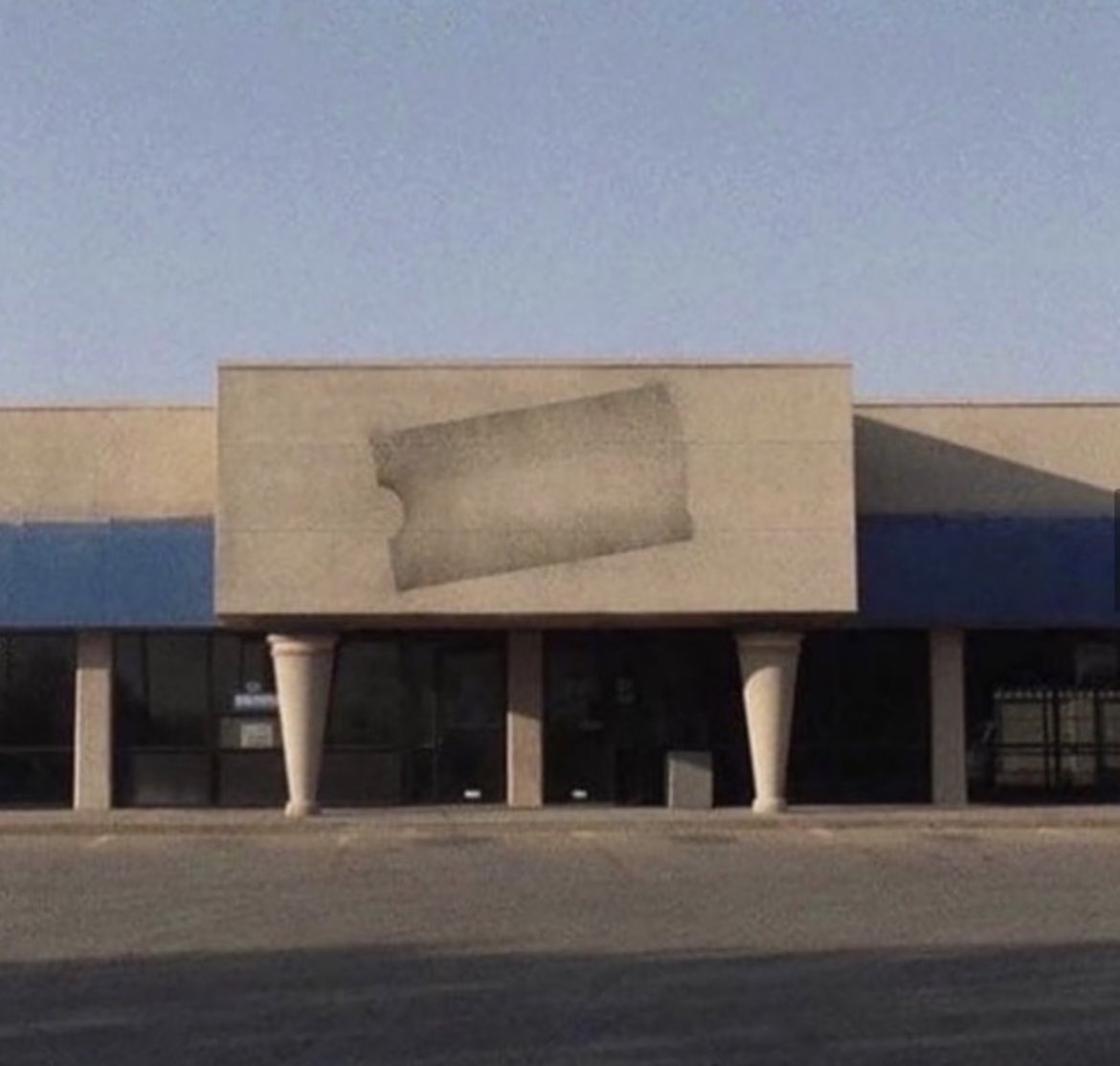
Abandoned Blockbuster, location unknown.
A brief history of the rise and fall of the media giant and the ensuing Netflix takeover.
For almost two decades, Blockbuster was the go-to spot on Friday nights for families around the world. At its peak, it had 9,000 stores. However, by 2010, it had gone bankrupt. So, what happened to the video rental giant?
In 1997, Reed Hastings, the future founder of a fledgling company called Netflix, went to a movie store to return the movie "Apollo 13" and was hit with a $40 late fee. This incident, among others, sparked his idea for Netflix.
By 2000, when Netflix was still in its infancy, Hastings flew to Dallas to propose a partnership to Blockbuster CEO John Antioco and his team. The idea was for Netflix to run Blockbuster's brand online, while Blockbuster would promote Netflix in its stores. However, Hastings was laughed out of the room.
Ten years later, Blockbuster was out of business, and Netflix is now worth over $200 billion. It's easy to wonder what Antioco was thinking, but the answer isn't that simple.
Antioco, the Blockbuster CEO, was a competent executive who had doubled the company's revenue during his tenure. At the time Hastings approached Blockbuster, it had thousands of retail locations, millions of customers, massive marketing budgets, and efficient operations. Blockbuster dominated the competition, while Netflix was just a blip on the radar.
However, there was a major weakness in Blockbuster's model that wasn't clear at the time—the late fees. Blockbuster earned an enormous amount of money from late fees at its stores worldwide. Penalizing its patrons turned out to be its Achilles' heel.
Netflix, on the other hand, could cut out retail locations, lower costs, and offer a much greater variety of titles. Customers could subscribe instead of renting, and they could watch videos for as long as they wanted without worrying about returns. By the time Antioco and the company realized this, it was too late.
The top of the Empire State Building was originally designed to be used as a docking station for airships. In the late 1920s, there was a belief that cross-Atlantic travel would soon be carried out using zeppelins or dirigibles. Therefore, the investors behind the Empire State Building saw the top of the building as an ideal site for embarkation.
In this envisioned scenario, a dirigible would arrive and dock on top of the building at the specially constructed mooring station. The airship would be quickly secured with ropes, allowing passengers to disembark by walking single-file down a gangplank and into the tallest building in the world from its top floor. From there, they could take the elevator down and find themselves in the heart of Manhattan, a mere seven minutes after landing.
Since the idea was driven by the practical desire to make the building more profitable, the developers went as far as actually constructing a mooring mast on top of the Empire State Building. However, even the most skilled American engineers failed to devise a method to attach a zeppelin to the top of a 1,250-foot-high building that regularly experienced 50 mph winds, while also ensuring a pleasant experience for the average cross-Atlantic traveler.
The airship companies ultimately deemed the idea impractical and even dangerous, leading to a lack of interest. Despite this, the one and only actual mooring on the Empire State Building occurred in September 1931 when a privately-owned blimp managed to dock for three minutes, although no unloading took place.
"Traffic was tied up in the streets below for more than a half hour as the pilot, Lieutenant William McCraken jockeyed for position in the half gale about the tower 1,200 feet above the ground," the Times reported in 1931.
The age of trans-Atlantic zeppelins ended in 1937 with the Hindenburg disaster, when the largest craft of its type ever built burst into flames while landing in New Jersey.
The Asian giant softshell turtle is a species of freshwater turtle native to Southeast Asia. It spends 95% of its life buried and motionless, with only its eyes and mouth protruding from the sand
[read more: https://t.co/r6YdBudyaZ]
What does a baby rhino sound like? Certainly not anything like we thought they would. If we had to describe their sound, it would probably be a cross between dolphins and when you pinch the neck of a balloon to let the air out [full video by DoctorDuni: https://t.co/TLG5z8lW2n]
🇬🇷 The island of Tilos has built a reputation as a testing ground for Greece's green ambitions.
⛔️ It was the first Greek island to ban hunting in 1993.
🔆 And in 2018, it became one of the first islands in the Mediterranean to run mainly on wind and solar power.







![Rainmaker1973's tweet photo. The Asian giant softshell turtle is a species of freshwater turtle native to Southeast Asia. It spends 95% of its life buried and motionless, with only its eyes and mouth protruding from the sand
[read more: https://t.co/r6YdBudyaZ] https://t.co/g4YzjYh16P](https://pbs.twimg.com/media/ForULunXgAE6-qi.jpg)


