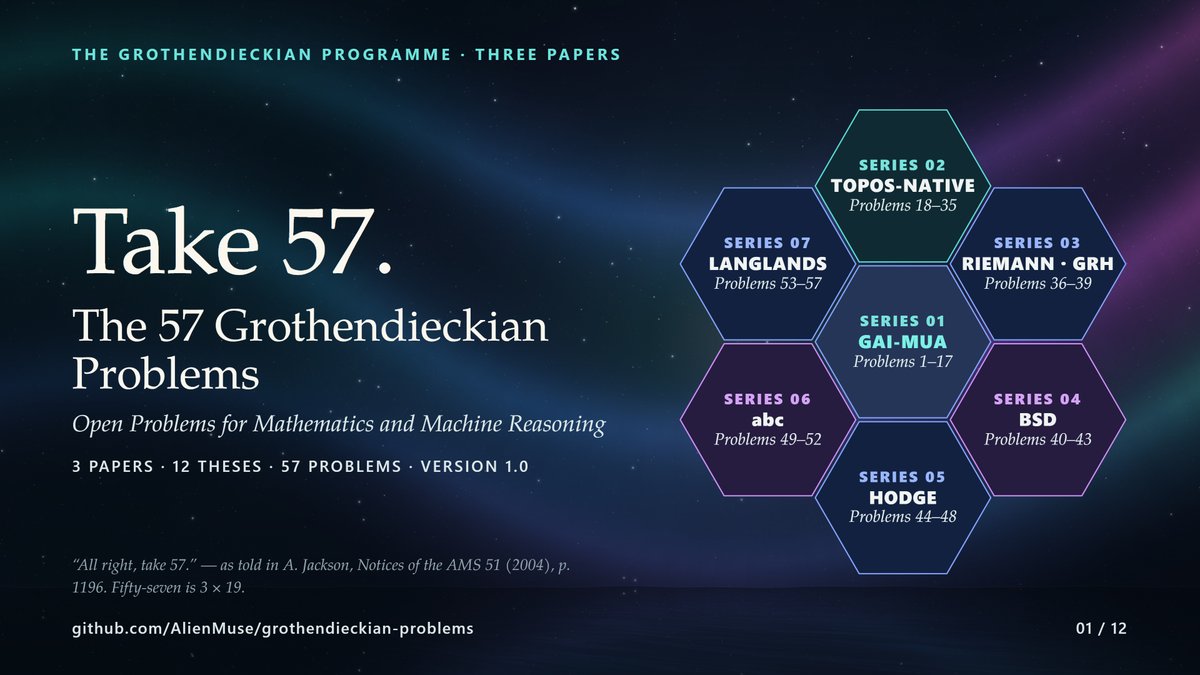
Take 57.
The 57 Grothendieckian Problems — Open Problems for Mathematics and Machine Reasoning from the Grothendieckian Programme.
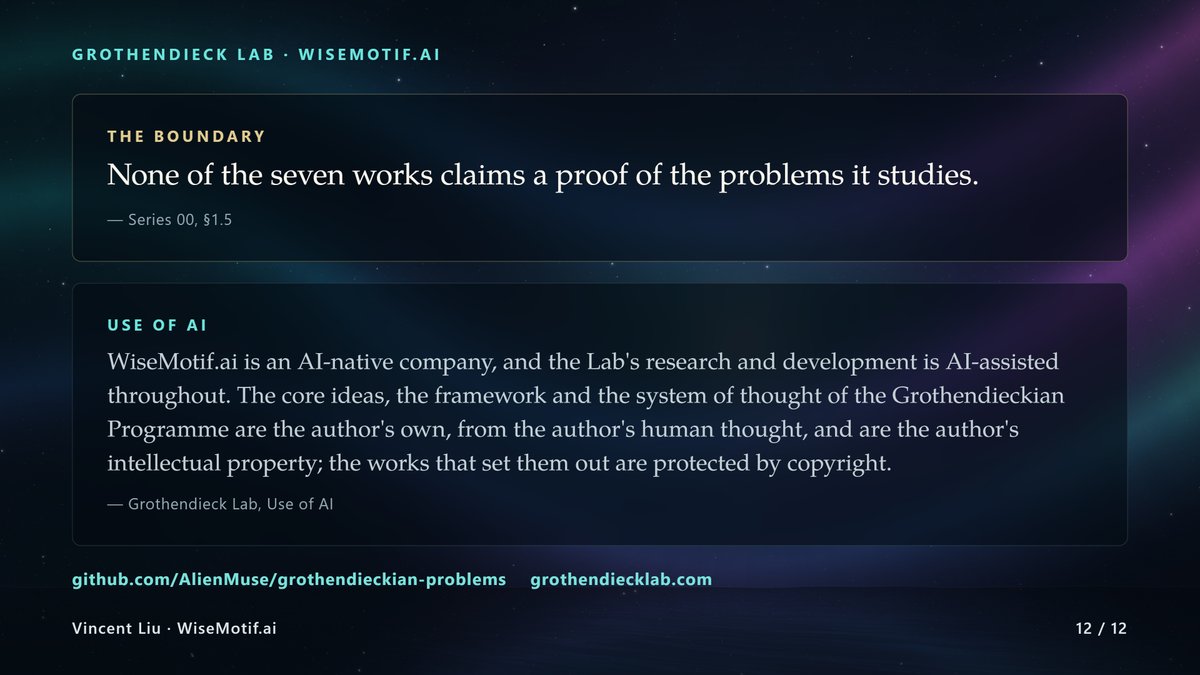
None of the seven works claims a proof of the problems it studies.
1/13
@jdlichtman Descent holds both in one statement: local data that agree on overlaps glue to a global object. Checking each piece is rigor; seeing why they glue is understanding. Grothendieck chose covers that made both cheap, which may be why his proofs read as explanations.
@SnupSnus@CarinaLHong Thanks, good reference. Its Prop. 4.3.8: the integral motivic category has no reasonable t-structure (when some conic has no rational point), while over Q the standard motivic conjectures still predict mixed motives. Knowing which dream holds where is itself the map.
@jdlichtman Over C they sit right beside Hodge: the Hodge conjecture already implies the Lefschetz standard conjecture B. In characteristic p, even the Hodge standard conjecture is open in general. Stating both precisely in Lean, on top of Weil, would be a natural next step.
@axiommathai Your blog calls it Grothendieck's “rising sea”: a surrounding theory that brings an inaccessible problem within reach. Stacks, then Weil in under 24 hours, makes the method measurable. Next: can the swarm raise the sea toward a problem nobody has solved, not just re-prove one?
@AlexKontorovich Calegari's “straitjacket” is the right target: “the first natural conjecture they cannot prove”. Grothendieck seldom attacked a hard problem where it stood; he built the setting in which it became natural. Can AI be pointed at the setting rather than the conjecture?
@axiommathai Reading the project page: StacksCore is human-checked to Mathlib standard, StacksFrontier is agent-written and not yet reviewed, and Lean checks every proof in both. How large is each today? That ratio is the number I would watch as review catches up.
@axiommathai Between Bourbaki and de Jong stands Grothendieck: schemes in EGA, sites and toposes in SGA 4, descent in SGA 1. The Stacks Project is written in his language. His way was to build the setting in which a problem becomes natural, then pose the next question there. What is yours?
@wtgowers Since your post: Axiom’s errata PDF lists 96 selected departures from published arguments (34 structural, 62 local); the classification stands. And the known theorem that every finite simple group is 2-generated now has a Lean proof built on it. Usable, at least.
@CarinaLHong Impactful. And the PDF is careful: its 96 entries are “selected departures”, not a tally of errors, and they leave the classification standing. Will the full list, many thousands of items, be published too? For anyone citing a CFSG paper it would be a reference in itself.
None of the seven works claims a proof of the problems it studies.
https://t.co/7vAQxhJsJF is an AI-native company, and the Lab's research and development is AI-assisted throughout.
https://t.co/sk0Q2tXAEk
13/13
Take 57.
The 57 Grothendieckian Problems — Open Problems for Mathematics and Machine Reasoning from the Grothendieckian Programme.
None of the seven works claims a proof of the problems it studies.
1/13
For AI laboratories and tool builders: problems.json lists every problem with its source, status, kind and decision criterion, and formal/ contains Lean 4 statements against a pinned Mathlib; both may be used as a benchmark …
12/13