New lecture drop 🎓
In our latest "Learning from Bio to AI" session, Andrew Coward explores Procedural Memory—how the brain learns skills and sequences.
Join us tomorrow 7pm EST for a live Q&A on X Spaces to dig deeper.
🎥 Watch now
Meet the Founder
Rachel St. Clair spent years solving a problem most AI teams live with daily but rarely name: the data-compute lock-in that makes building AI slow, expensive, and inaccessible.
Her path here wasn't linear. PhD in Complex Systems and Brain Sciences at FAU. Postdoc at the Center for Future Mind. Computer vision systems for the Department of Homeland Security. Innovation Lab Director managing 25+ researchers. 20+ peer-reviewed papers. Work spanning compressed sensing networks, GANs, quantum ML, and bio-inspired architectures.
But the throughline across all of it: the belief that AI's biggest bottleneck isn't intelligence. It's infrastructure.
She founded Servamind to fix that at the architecture level — not with another tool, but with a new standard.
The .serva standard.
Free 1TB beta launch → coming soon!
https://t.co/XcwiwUqbLe
Meet our CTO. The person who helped us figure out how to hyperscale our stack.
Austin Cook (@alignment_lab ) currently serves on the Board of Directors of the Active Inference Institute and has spent the majority of his career contributing to open-source AI, focusing on Optimization and Representation research. Those open-sourced contributions have been adopted across the industry from LAION through Intel to Nvidia as key milestones for state of the art openly accessible AI
His take on what we're building: "Every model, every framework, every hardware target, they've all been operating on incompatible data dialects. .serva is the universal language they've been missing."
https://t.co/XcwiwUqbLe
Great work from GoogleResearch on TurboQuant. Strong results — 3-bit KV cache quantization, 8× attention speedup, zero accuracy loss. Solid theoretical foundations.
Worth noting the distinction: quantization optimizes what happens inside the model. .serva operates at the data layer — before the model ever sees the input.
.serva is universal and lossless. When downstream tasks are unknown — which they often are in general AI pipelines — you cannot know in advance what information will matter. We preserve everything and defer relevance to the learning system.
We're also operating at a different layer entirely: ~44× speedup at the data layer in fine-tuning. We’ve built across any model, at any stage — pretraining, fine-tuning, inference — with no retraining required.
The efficiency stack is being built from multiple directions at once. That's a good sign for the field.
Meet the researcher who designed the foundation ServaEncode and Chimera from the ground up.
@PeterSutorJr is a PhD candidate in Computer Science at University of Maryland — one of the world's leading experts in Hyperdimensional Computing, with 7+ peer-reviewed papers including a publication in Science Magazine.
He worked with the Army Research Laboratory under an ORAU Fellowship, collaborating on Hyperdimensional Computing and Vector Symbolic Architectures. His thesis is built on the same theoretical foundations that power .serva.
His take: "I joined Servamind to make Hyperdimensional Computing the lifeblood of modern AI — to fully capitalize on efficiencies that classical machine learning cannot take advantage of."
That's not a vision statement. It's already in the benchmarks: 30–374× energy efficiency. 68× compute payload reduction. Same accuracy.
https://t.co/XcwiwUqbLe
Meet the engineer who takes our research from theory to production.
@VictorCavero has spent his career doing one thing really well: making complex systems actually work at scale. Embedded systems. IoT. Automotive. Military R&D. Combat-critical systems design.
Before Servamind, he took a compression algorithm from research-stage into a production-grade C implementation — from scratch. That's exactly what we needed someone to do with .serva.
At Servamind he owns the architecture design of our core technology — responsible for turning the encoding and compute engine into infrastructure that works in the real world, on real hardware.
His take: "Obsessed with making things more efficient — there's still so much to build and explore, but better technology shouldn't come at the planet's expense."
That's the Servamind ethos in one sentence.
https://t.co/XcwiwUqbLe
Learning to write kernels might be the highest-ROI activity for displaced SWEs:
→ prereq: reasonable engineering ablity
→ six to twelve months of study
→ millions of dollars, mark zuckerberg showing up at your house to hire you, etc.
i wish this were an exaggeration
Particularly in terms of quantization of features to effective regimes, there's a very large amount of that explicitly operating on actual measurements of entropy unsupervised for the purpose of allowing a maximally efficient representation to emerge, because the computational substrate is itself still dominated by the entropy costs as a primary consideration
absolutely disagree, even if we stopped with just what we have now it would take years forr society and for the delpoyment of it to really be appreciable with the scale, the current stopgap is just how long it takes people to understand, not whats avaliable as currently known/extant implementation
until i read this paper i was losing my mind not able to figure out wh this architecture i had was outperforming everything else so hard (fully constructing mostly reasonable sentences out of bytes in a few minutes at 5m parameters) after reading the paper and doing some analysis and ablations, its because i was using 768d model and 256 vocab (plus some other stuff to do with num params to dim) that avoided the bottleneck they mention almost entirely by acident
so it turns out
the fast inv sqrt trick from Quake III Arena, (according to the internet from either or both of Greg Walsh and @ID_AA_Carmack )
entirely critical for some work im doing building linear models out of pretrained nonlinear ones.
rmsnorm and softmax both would have gone unsolved if not for it.
the unlock here is extremely op, im stoked
so it turns out
the fast inv sqrt trick from Quake III Arena, (according to the internet from either or both of Greg Walsh and @ID_AA_Carmack )
entirely critical for some work im doing building linear models out of pretrained nonlinear ones.
rmsnorm and softmax both would have gone unsolved if not for it.
the unlock here is extremely op, im stoked
@sebkrier is this paper operating on the premise that what happens inside of a computer is *not* happening in reality/subject to thermodynamic constraints?
@sebkrier ive read this twice now, i dont get where it identifies which party is which and why, and what the delta is between a compression algorithm producing a codebook of class labels like a rANS, or me definitely learning language from my parents?
@sebkrier It's genuinely crazy, people have no idea how efficient the tech actually is, no one ever really considers what something like mohrs law running for so long actually means
You can only double something so many times before it gets entirely out of hand
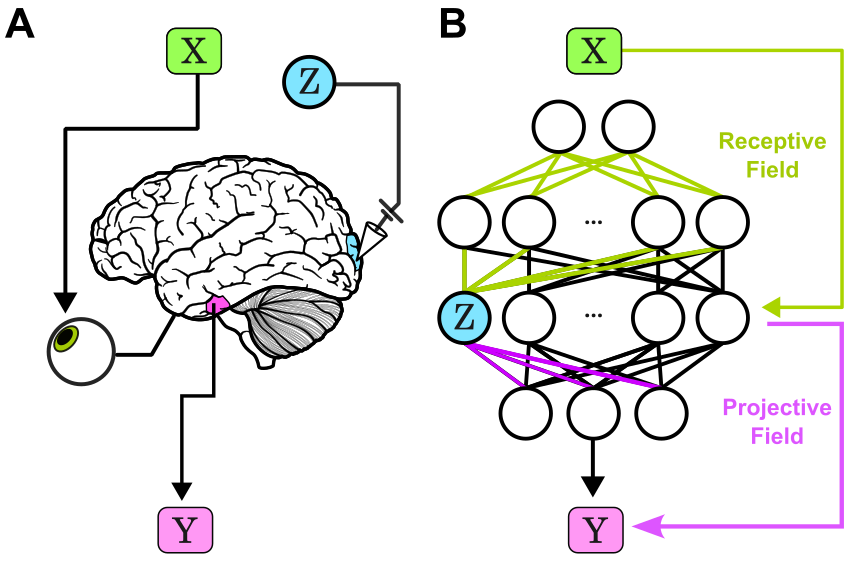
Trying to interpret how a neural-network does what it does? Activations tell you if a neuron responded. Contributions tell you if a neuron mattered!
New paper from myself, @Zaki_Alaoui1, @sunnyliu1220 , @SuryaGanguli, and Steve Baccus: https://t.co/mcGZuj56AI