Settlement. Value. Trust. Tooling. Developer surface. Governance.
The pieces of an internet-scale blockchain, built to work as one.
Here is the whole MultiversX stack, layer by layer 🧵
We’ve just added the @MultiversX Dust Converter to xPortal 🧹
Now, you can see exactly how much "dust" is scattered across your different coins and swap them all into $EGLD with just one tap.
Make sure you update to the latest app version to see the new section 🤙
Last week, we shipped three major protocol integrations:
@Google's Universal Commerce Protocol
@OpenAI & @Stripe's Agent Commerce Protocol
@Google's Agent Payments Protocol
Here's what each does and how they work together to enable agent commerce on MultiversX. 🧵
What happened to your XP from last season? 👇
⚡ XP reset to 0 means a fresh start for everyone
📸 Snapshot taken on June 30 (surprise coming 👀)
👕 365 T-shirt SFT holders: you’ll soon redeem for real merch or token value
New season. Let’s go 🔥
Today’s tip: time to plan that summer getaway and don’t forget to swipe your xPortal Card for everything from flights to gelato 🍦💳 https://t.co/6bHNQCLf3N
Andromeda just landed on @MultiversX – the first major step to one-shot, sub-second finality. And that’s YUGE.
To celebrate? We’re dropping one last mission in Claim XP Season 2 🧵
🚨 Season 4 of E.V Daily Claim kicks off tomorrow, Friday the 23rd!
@PulsarMvX send 0.2 EGLD to 150 reactions
🎁Bonus : RT & Tag 2 frens for a chance to win an E.V Cyborgs NFT! 🔥
🎯Claim daily to receive instant bonus rewards and keep your streak alive to compete for EGLD, NFTs & ESDT prizes! 🎁
Now.... You asked, we listened! This new edition brings exciting upgrades:
🗓️ Streak duration reduced from 45 to just 30 days!
💰 Streak repair now costs only 100 $UTX, down from 300!
✅ The first 187 daily claims will receive an instant bonus, up from 167!
Where?
https://t.co/eQHyrSpL6n or directly from @xPortalApp
When?
Starting from tomorrow, Friday 23rd, 16.00 UTC
No more excuses… it’s time to jump in. Let’s go!🔥
Did you know that on xPortal you can access dApps from 7 different chains?
Download xPortal and access dApps from Solana, Base, Berachain, MultiversX, Polygon, Ethereum and BSC, all in one place.
https://t.co/KDy99BKLDg
TL;DR: Andromeda Upgrade Governance Vote!🗳️
✅ Removes confirmation blocks
✅ Ends equivocation risks
✅ 2× faster cross-shard transactions
✅ Simplifies verification
✅ Democratizes consensus
All without compromising security.
https://t.co/FEkiFY1P0G
To have this implemented in the #mainnet, the #MvX team needs your vote 🫵 Cast it here:
https://t.co/ThAWT5TIFq
📚🧵
Let’s review the changes introduced by Andromeda and why this matters so much:
https://t.co/ZkyMPDZuBp
Andromeda is the first step in a two-phase roadmap to boost speed, efficiency, and security.
The goal?
🔹 Shrink block times from 6s → 600ms
🔹 Unlock parallel execution
To achieve this, Andromeda rewires key components of the #MultiversX engine:
✅ Consensus mechanisms
✅ Block finality
✅ Cross-shard execution
✅ Cross-chain proofs
Faster, without sacrificing security or decentralization.
Finality is now instant. ⏳🚀
Before: Extra confirmation blocks were needed.
Now: Once consensus is reached, the block is final.
No delays. No rollbacks. Stronger certainty.
No more single block leader.
Before: The leader finalized blocks—if they failed, issues could arise.
Now: Any node can finalize.
🔹 More security
🔹 No more equivocation risks
Execution shards are now stronger.
Before: Only 63 out of 400 validators participated per round.
Now: All 400 validators take part.
🔹 More security
🔹 Fairer rewards
🔹 One-shot consensus
Cross-shard execution is now twice as fast.
Before: 6 steps
Now: Only 3 steps
🔹 Faster transactions
🔹 Consistency maintained
Cross-chain proofs are lighter & faster.
Before: Validators had to reconstruct selection per block.
Now: Fixed order, less metadata, quicker verification.
🔹 Faster cross-chain transactions
🔹 Less computational overhead
The Bottom Line: Andromeda isn’t just faster.
✅ Eliminates ambiguity
✅ Strengthens decentralization
✅ Lays the foundation for Supernova
Supernova: The Next Evolution.
Building on Andromeda, it brings:
⚡ 600ms block times
⚡ Parallel execution
⚡ Unmatched performance & throughput
What used to take 6 seconds will now take 600ms.
🚀 20× faster finality
🚀 Transactions confirmed instantly
Fairness & efficiency upgrades.
✅ All validators participate & get rewarded
✅ Lower overhead, better efficiency
✅ Simpler, cleaner proofs
With this upgrade, @MultiversX is now one of the fastest & most scalable L1s.
🔹 Ready for DeFi, gaming, digital identity & more.
🔹 A blockchain built for the future.
The best time to #BUIDL is now, on #MultiversX 🔥🛠️
#EGLD #MultiversXBuilders #BlockchainInfra #Interoperability
As USH and its mechanisms have now been active for nearly one month, we’d like to summarize the progress made, the challenges encountered, and areas that still require improvement.
Before diving into USH’s specific mechanisms, it's helpful to compare it with other decentralized stablecoins like DAI and GHO, which don't include a built-in redemption mechanism. Those stablecoins rely entirely on traders, arbitrageurs, market makers, and minters stepping in when their value dips below $1, believing it will naturally return to its intended value.
While effective on highly liquid blockchains with active markets, this model wouldn’t work well in the current MultiversX environment, where professional and sophisticated participants as well as fundamental component for their activities are still to be built. Without enough arbitrage activity and proactive minters, this soft-peg system alone can't maintain stability. USH addresses this issue by incorporating a redemption mechanism that acts as an extra safeguard, helping to keep its value stable when market dynamics alone are insufficient.
Understanding USH’s Design
Let's now examine why USH was designed this way, the advantages it offers, and its current limitations:
Unlike the stability fee model used by DAI (which adjusts borrowing costs to balance stablecoin supply and demand), USH uses a redemption mechanism. This guarantees that each USH token always maintains a value close to $1, because the protocol guarantees you can always exchange it back for exactly $1 worth of collateral.
The redemption mechanism serves as an automatic safety net or a self-correcting feature if the ecosystem can't balance itself naturally. When there's too much USH circulating and its value falls below $1 (known as a "depeg"), redemptions encourage reducing the supply, helping restore balance. It's important to note that just issuing stablecoins doesn't automatically create liquidity, and real equilibrium only occurs when the amount issued matches market demand.
Unlike centralized stablecoins, which are directly backed one-for-one with dollars (FIAT), decentralized stablecoins like USH are backed by volatile crypto assets, meaning minting these tokens implies the creation of debt. This introduces a responsibility to maintain sufficient collateral, with liquidation mechanisms in place to prevent any risk of accumulating bad debt or under-collateralization.
This means that positions need to be individualized, as each one has different collateralization parameters and therefore risk.
When debt is created, redemptions could work in two ways:
• Each user sees an equal share of his debt repaid and loses an equivalent part of his collateral. Meaning that redemption is socialized to all participants.
• Specific users are individually targeted.
If redemption were evenly spread among all users, for example, if 0.1% of the total supply was redeemed, and everyone lost exactly 0.1% of their collateral, no user would have the chance to avoid redemption. This would remove the motivation for users to voluntarily rebalance supply and demand, as everyone would be affected equally regardless of their actions.
In this scenario, redemptions would become a shared burden, meaning no single user would feel individually responsible for restoring the stablecoin’s balance, since everyone would bear the cost equally.
This is why USH uses individual redemptions. Specifically targeting users closest to their borrowing limits motivates them to either increase their collateral or repay part of their debt to protect their assets. When users actively manage their positions this way, the whole system stabilizes naturally and relies less on frequent redemptions.
Over time, this approach naturally brings borrowing limits down to a balanced level where stablecoin supply matches demand. As confidence grows in the stablecoin’s stability, redemptions become less frequent, and borrowing limits can safely rise again.
Today, various stablecoin models exist, each emphasizing different priorities:
• Redeeming from users with the highest borrow limits encourages higher overall collateral in the system, limiting recourse to liquidation (used by Liquity V1).
• Redeeming from users with the lowest borrowing rates boosts the protocol’s earnings, allowing it to incentivize future liquidity and demand, especially as total debt grows larger than available supply (used by Liquity V2).
With USH, we've combined elements of both models. Since the collateral used generates staking rewards, this allows us to provide extra incentives for liquidity. Essentially, the better collateralized the entire protocol is, the more rewards can be distributed to users relative to the total circulating supply of USH.
Therefore, we've chosen a 0% borrowing rate with no initial minting fee, and redemptions that target users based on how close they are to their borrowing limits.
Current Challenges
Now that we've covered the theory, let's look at the challenges we've encountered and the solutions currently being considered.
Initially, redemptions weren't very effective due to limited participation, insufficient liquidity, and a general lack of awareness about arbitrage opportunities between sEGLD and EGLD pool on Ashswap. Additionally, high fees related to complex trades made redemptions less profitable.
We had initially designed the redemptions to force a buyback of USH, to ensure that their efficiency had a direct positive impact on the peg. However, while this approach has benefits, it only creates buying pressure during brief moments when redemptions are immediately profitable, rather than providing consistent buying support over longer periods.
Additionally, the original method made users feel that redemptions didn’t directly protect the dollar value of their positions because they couldn't redeem USH directly and instead, they had to swap it for EGLD to regain their original exposure.
The first solution was creating a simple, user-friendly redemption interface that anyone could use without technical expertise. Unlike automated redemption bots, regular users often just want to acquire collateral (sEGLD) at a lower price rather than complete complex arbitrage strategies. Because of this, regular users have a lower threshold for profitability, making redemptions attractive even under less favorable conditions.
Similarly, users who want to liquid-stake their EGLD tokens are now automatically directed to AshSwap if that allows them to get more sEGLD.
These improvements have significantly boosted redemption reliability and efficiency in maintaining USH’s peg. Additionally, they allow everyday users and not just automated bots to benefit from these opportunities.
However, a key challenge remains: redemption currently occurs too frequently. While the peg is strong, the rapid supply turnover means users must actively monitor and manage their positions if they wish to maintain consistent exposure to EGLD. This high frequency is partly due to limited efficient market-making activities, which means EGLD's price fluctuations have a strong impact, both positive and negative on USH’s peg.
When the price of EGLD rises, it usually happens first on centralized exchanges (CEXs), as they have higher trading volumes and more liquidity. This initially creates a price difference, making EGLD temporarily cheaper on MultiversX. Traders notice this and move USDC onto MultiversX, buy EGLD at a lower price, and sell it on centralized exchanges for a profit. This arbitrage activity quickly brings prices back into alignment .
A similar process occurs with USH. When EGLD’s price goes up externally, the EGLD<>USH liquidity pool on MultiversX needs more USH tokens to match this new price. As a result, more USDC ends up accumulating in the USH<>USDC pool, strengthening and stabilizing USH’s peg.
Conversely, when EGLD’s price drops significantly, the EGLD price in the EGLD<>USH liquidity pool can differ substantially from the real EGLD price (the oracle price in USD). If this price difference becomes large enough to cross a predefined redemption threshold, users have a financial incentive to buy USH and redeem it for collateral. This redemption activity helps push USH’s price back up towards $1, effectively acting as a "market maker of last resort" as a backup mechanism that kicks in whenever normal market activities aren’t enough to manage EGLD’s volatility and protect USH’s peg.
One of the core ideas behind this system was to position USH not only as a pathway to USDC liquidity but as a driving force within the ecosystem itself, one that doesn't depend solely on centralized stablecoins for growth. Redemptions are extremely important, as they help keep USH’s circulating supply balanced, aligned with what the ecosystem can sustainably support while leaving room for natural, organic growth based on the overall strength of the ecosystem.
The Path Moving Forward
To address these issues, we're currently exploring several potential improvements:
1. Direct USH Redemption with Small Fee
First, we're considering allowing direct redemption of USH tokens, charging only a small redemption fee. This would encourage users to buy USH anytime its value falls below $1 and not just when immediate profit opportunities appear through the current redemption process. Users would have the assurance that they'll always get back at least 99.5% of their dollar value (assuming a small 0.5% fee). This approach would also help recently redeemed users regain their collateral directly, avoiding the extra step of swapping tokens. Additionally, this could address extreme situations where there isn't enough liquidity available to buy back collateral efficiently, preventing larger losses.
This new redemption option would complement the current model. The existing redemption strategy would remain active but with a lower trigger threshold, such as around $0.98. In this way, the current model becomes purely a safety net rather than the primary method for controlling the peg.
2. Dynamic Minting Fees During Depeg
Next, we're looking into adding a dynamic upfront minting fee whenever USH's price falls below $1 (a depeg). Currently, there's no direct discouragement for minting USH during a depeg, potentially adding unnecessary selling pressure exactly when USH supply needs to decrease. Right now, someone minting USH at $0.99 doesn't immediately experience a loss unless USH rises again above this price. Introducing a fee tied to the level of the depeg would create a stronger incentive to avoid minting when USH is below its target, thus stabilizing the supply more quickly and efficiently.
3. Separate Redemption Prioritization for Liquidity Providers
Finally, we're evaluating a new way to prioritize redemptions. Right now, many users mint USH to participate in liquidity pools to earn incentives, but frequent redemptions make this strategy unpredictable. One idea is creating a separate "Isolated Pool" specifically for liquidity providers. This would allow redemption priority to differ based on user behaviour.
This setup would result in two separate redemption lists. Regular borrowers (those creating leveraged or long positions, for example) often affect USH’s stability significantly, while liquidity providers help support the overall stability of the system. Redemptions would continue to occur in order of borrowing limits (highest to lowest), but liquidity providers would only face redemption after all regular borrowers have been redeemed first.
We still need to carefully study the implications of this change. It's important to note that for users uncomfortable with the redemption mechanism, simply buying USH directly from secondary markets to build liquidity positions might be a healthier alternative. Doing so adds helpful buying pressure when USH is below $1 and offers extra profit opportunities as USH returns to its intended value.
Our immediate next step is determining the benefits that this new ranking mechanism could bring, when clarifying the incentive not necessarily to mint USH to participate in the Liquidity Provision might be sufficient and avoid adding further complexity.
Partners who participated in providing the initial liquidity for USH will be able to migrate their positions into a second Isolated Protocol starting next week. This will allow them to maintain their positions without being subject to redemptions while we finalize the development of the upcoming feature. As key contributors to USH's stability, their participation is essential, and this measure will ensure they can continue supporting the ecosystem without disruption.
In addition to these first 3 pillars, we are also considering research into facilitating market making by our own means by having working capital in EGLD, USDC, and USH, capable of responding to a certain volatility while remaining at least dollar-value neutral. In any case, if you have the necessary knowledge and would like to participate on your own in this kind of activity, don't hesitate to contact us on the Hatom Dev Telegram, we'll be delighted to help you :
https://t.co/MhiEoKrztw
Meet the new Rewards section under Explore (ex-Analytics), where you can find:
🔹 rewards dashboard
🔹 7d DEX yield
🔹 granular distribution details
🔹 and more!
Anything you’d want to see added to the Explore section? Let us know in the comments 👇
https://t.co/IdNH84sxTs
Got a side wallet for every one of your moonbags? Time to level them all up!
You can onramp & top up your card directly from your secondary wallets.
One wallet is never enough, and we make 0 (zero) compromises on ease of use 😉
We are thrilled to announce that USH is now live on Mainnet, marking a monumental event for the #MultiversX ecosystem.
$USH is the first decentralized stablecoin designed to maintain a stable value, pegged to the U.S. Dollar, and native to the #MultiversX blockchain. Unlike centralized stablecoins like $USDC or $USDT, which are bridged from other chains, $USH is minted and managed within #MultiversX, reducing dependency on external chains and mitigating potential security risks related to wrapped assets.
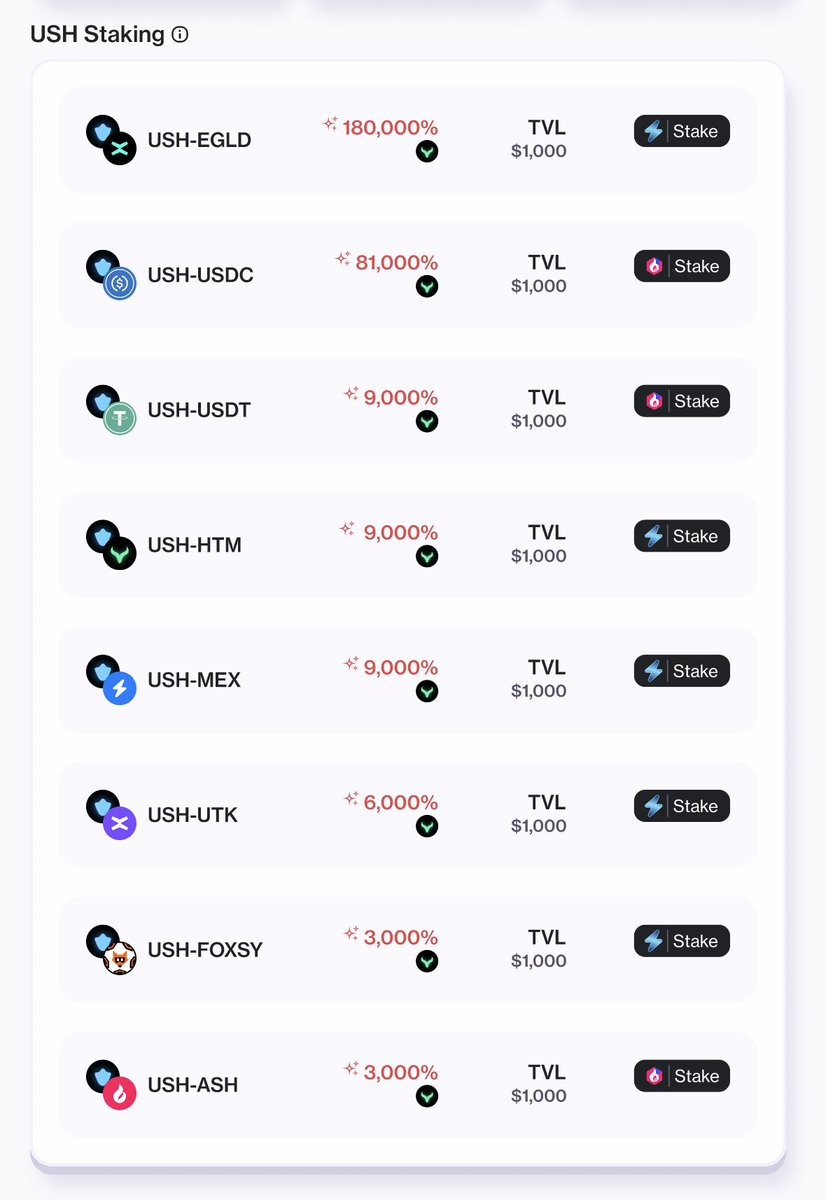
We invite everyone to actively participate in the launch and take advantage of the incredible APYs available for USH LP stakers through the USH Staking Module.
While these high yields will be available at launch, they will naturally adjust as more participants join and deposit liquidity. In the first few hours, early participants will have the opportunity to capture some of the highest APYs ever distributed.
Based on our calculations, even with $50 million in liquidity deposited in the USH Staking Module, we expect to maintain over 60% APY, assuming all positions are equally boosted. Since not all participants will maximize their boost, even triple-digit APYs are expected in the first hours of launch, providing a significant advantage for early stakers.
We are bringing back the high-yield days of DeFi, built in a sustainable way to ensure long-term stability and growth for the $MultiversX ecosystem.
To start participating, you can mint $USH through two main Facilitators, each with their unique dynamics and fees:
Lending Protocol
Through this Facilitator, users can mint $USH by collateralizing their assets in Hatom’s Lending Protocol at a fixed minting fee per asset as follows:
• $USDC & $USDT: 10%
• $WBTC, $WETH, $UTK, $HTM, $MEX: 15%
Isolated Pools
Through the Isolated Pools, users can deposit $EGLD , $wTAO, and their Liquid Staking Tokens ( $sEGLD and $swTAO) to mint $USH without any minting fees. However, depositing Liquid Staking Tokens shifts the user’s exposure to the underlying asset ( $EGLD or $wTAO), and the collateral will no longer earn staking rewards.
Please use the following links to engage with USH:
• Mint USH through the Lending Protocol: https://t.co/VqnF1LtocO (make sure to switch to the USH Pool)
• Mint USH through the Isolated Pools: https://t.co/Lu9eZDzQSU
• Provide liquidity for USH on @xExchangeApp: https://t.co/q5jw0y6O9Q
• Provide liquidity for USH on @ash_swap: https://t.co/YtEooKOIWy
• Once you create LP or Farm Tokens, stake them in the USH Staking Module to take advantage of the $USH staking yield: https://t.co/Lu9eZDzQSU
The first few hours after $USH launches might be more volatile, and $USH will need some time to fully stabilize. Therefore, we encourage everyone to focus on pairing $USH with $EGLD or another asset for liquidity provision rather than minting $USH and selling half of it to buy the other asset for liquidity. However, if this isn’t feasible, we recommend carefully checking slippage, price impact and adjusting accordingly to ensure the best trading experience.
As a reminder, during the Private Mainnet period, Hatom generated almost $300,000 in revenue, which was used to buy back $HTM from the open market. These funds will be distributed as incentives within the USH Staking Module.
Here is a breakdown of the total incentives allocated across different pairs:
• USH/EGLD → 52%
• USH/USDC → 35%
• USH/USDT → 3%
• USH/HTM → 3%
• USH/MEX → 3%
• USH/UTK → 2%
• USH/FOXSY → 1%
• USH/ASH --> 1%
Booster V2
We are also thrilled to announce the launch of Booster V2 on the Mainnet, working in perfect harmony with USH to create a synergistic ecosystem designed to accelerate the growth of our products, with our $HTM token at its core.
The new Booster V2 eliminates all previous restrictions, enabling users to stake an unlimited amount of $HTM in the Booster. This introduces a "battle of the yield" concept, where the more you stake, the greater the incentives you can earn, proportional to the liquidity you provide. But that’s not all, as users can now also stake LP Tokens, Farm Tokens, or even Dual Farm Tokens for the HTM-EGLD pair, as well as Staked HTM from @xExchangeApp, reaping the benefits of trading fees, farm rewards, dual farm rewards, and Boosted Rewards!
A key feature to highlight is that there’s no need to unstake your $HTM from the Booster to create LPs or Farm Tokens and have a 7-day cooldown period. All liquidity provisioning can now be managed directly through the xExchange Dashboard within Booster V2, allowing users to utilize their staked $HTM in order to create the LP tokens.
With an integration directly into @xExchangeApp via Booster V2, users can now:
• Provide liquidity directly from the Booster Dashboard without leaving the Hatom website
• Upgrade or downgrade their positions
• Lock $MEX to boost their Energy and enhance rewards for providing liquidity
• Manage their Energy positions, including charging, discharging, removing, merging, or transferring Energy
• Claim all rewards generated from LPs deposited in the Booster
In Booster V1, users could only deposit single $HTM tokens, earning no yield beyond the incentives distributed by Hatom through the Booster. With Booster V2, this limitation is gone as users can now generate up to an additional 22.92% APR by creating a Dual Farm position on @xExchangeApp for HTM-EGLD (fully boosted with Energy), all while earning Hatom’s Boosted Rewards in different modules such as Lending or USH Staking.
This upgrade significantly boosts capital efficiency for users and strengthens $HTM liquidity pools, enhancing the trading experience across the ecosystem, maximizing returns and flexibility, and offering a superior solution for all participants.
USH Airdrop
We’re happy to announce that the snapshots for the USH Airdrops have now concluded, and we want to express our gratitude to everyone who participated in this event, designed as a meaningful way to reward our token holders. Moving forward, we will provide an update regarding the distribution of the prizes by the end of this week, highlighting each step in the process.
USH Market Page
We’re excited to unveil the new USH Markets page, designed for full transparency. Now, anyone can explore key metrics for USH Facilitators, including collateralization ratios, total USH minted, and the collateral backing all the minted assets, plus much more, all in one place. Our Dune Dashboards will also be updated to reflect all the most important USH metrics.
Please access the Market Page here:
https://t.co/Rd6xHlyaeV
We’ve come a long way in our journey, and it’s amazing to see $USH, one of the products with the greatest potential in the #MultiversX ecosystem, finally live! With the entire #MultiversX ecosystem poised for a period of tremendous growth, we are thrilled to be at the forefront of this transformation.
We thank you for your support on this journey and look forward to $USH driving real value and activity in the #MultiversX ecosystem, reaching new milestones together. Your backing has been crucial; this is yet another big step for Hatom and #MultiversX. Let’s keep pushing forward together!
Big moment for MultiversX.
Native stablecoin. Fully overcollateralized and transparent. Built on-chain for DeFi
@HatomProtocol goes live with $USH on March 3. Here’s why it matters 🧵👇