Can RL with outcome rewards alone just efficiently explore outside the support of the base model and learn completely new capabilities?
We study it in a theoretically tractable setup, and prove that outcome rewards are not enough, but process rewards can get you there! [1/3]
Standard PG analysis requires "all-iterate coverage" ie bounded π*/π_t ∀𝐭. What if we only assume it at 𝐭=𝟎 (eg base model has nontrivial success rate on all prompts)?
Ans: 𝐞𝐱𝐩𝐨𝐧𝐞𝐧𝐭𝐢𝐚𝐥 complexity due to "coverage collapse". https://t.co/K3oQqoznV1
What should I do if some ICLR submissions are so much of a slop that I can't even write a summary about them? Sometimes there is not a single sentence in the submission that I think would make sense to a human. Quite funny artifact of the RLVR pressure on LLMs.
What should I do if some ICLR submissions are so much of a slop that I can't even write a summary about them? Sometimes there is not a single sentence in the submission that I think would make sense to a human. Quite funny artifact of the RLVR pressure on LLMs.
We have now crossed the threshold where developing theory has become orders of magnitude faster. It is now possible to rapidly develop theory that can drive AI research, not just explain it post-hoc. https://t.co/9OsBzGAWFZ
For those who like deep learning "theory", our job for now seems to be finding the setting with the right amount of generality/complexity where models can produce meaningful (to humans) mathematical insights. How long till the model itself develops the taste to find it?
I’m at ICML 🇰🇷 presenting a 🔦 spotlight 🔦 poster today. Check it out if you want to know how process rewards help RLVR go beyond the base model support when outcome rewards alone can’t.
📆 Thu. 5-6:45 pm. Hall A. Poster # 1307.
🚀 🚀 🚀 Excited to share our new paper:
Remember to be Curious: Episodic Context and Persistent Worlds for 3D Exploration
What does it take for an agent to stay curious in a 3D world?
The answer is memory.
🌐 Project: https://t.co/G4SjLoFJht
📄 Paper: https://t.co/iUFwp5NvRu
💻 Code: https://t.co/KZRaQLyzyh
Can RL with outcome rewards alone just efficiently explore outside the support of the base model and learn completely new capabilities?
We study it in a theoretically tractable setup, and prove that outcome rewards are not enough, but process rewards can get you there! [1/3]
(1/8)
🚀 Introducing Super Apriel: One Checkpoint, Many Speeds
Train once → serve at any speed-quality tradeoff
We release:
✓ 15B supernets with 4 mixers/layer
✓ Training code (Fast-LLM)
✓ vLLM serving extension
🧵 How it works ↓
Attention and MLP matrices can store as much knowledge as # params, but in practice, finite samples/compute and long context noise can further limit this capacity. We characterize these trade-offs in a needle-in-a-haystack model.
#ICLR2026 poster Thurs, led by @nurimertvural45
Excited to share @YaldaForoutan and @pekzta4's work on robust 3D reconstruction from 360 captures!
Casual 360 video capture gives you the coverage you need for calibration and reconstruction; FullCircle makes it hassle-free!
No more wrestling with stitching artifacts or floaters from the camera operator. Data and code are released, enjoy!
This is no longer an issue if you use process rewards. Number of reward queries will depend on a “token-level likelihood quantile” that is never exponentially small in sequence length. [3/3]
📄 arXiv: https://t.co/PwdlP3oRfP
Can RL with outcome rewards alone just efficiently explore outside the support of the base model and learn completely new capabilities?
We study it in a theoretically tractable setup, and prove that outcome rewards are not enough, but process rewards can get you there! [1/3]
We prove the number of reward queries in RLVR depends on the “likelihood quantile” function of the base model.
Unfortunately, LQ becomes exponentially small if we want to go significantly below the base model error, then RL needs exponentially many reward queries. [2/3]
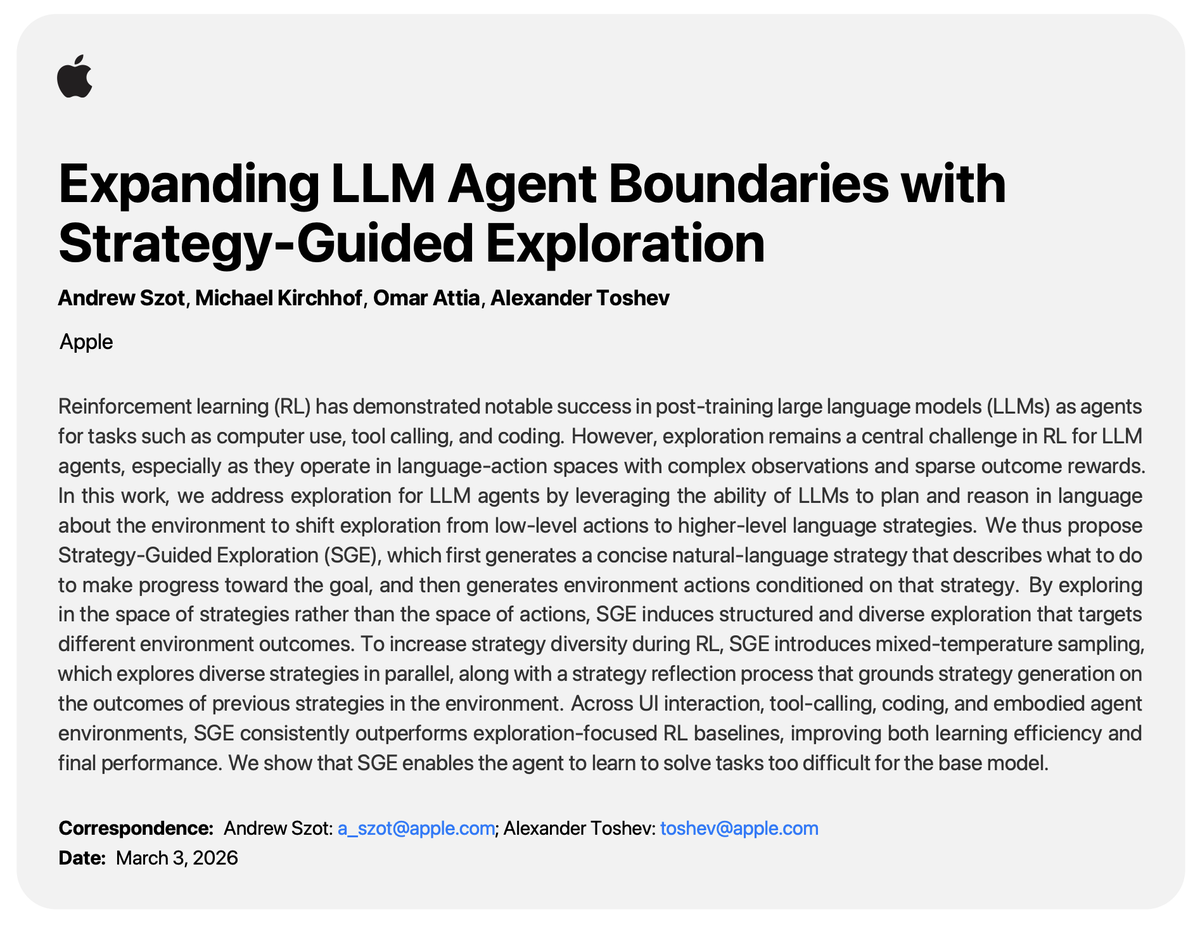
New paper 🥳 RL relies a lot on an agent’s capability to explore. Our strategy-guided exploration makes the agent find new solutions more efficiently. It learns faster, and in some environments its Pass@1 surpasses the base model’s Pass@128. 🧵1/6
📄 https://t.co/IZEyeMQG9g
Masked Diffusion LMs (MDLMs) are the most exciting paradigm shift in AR generation because they can decode in parallel, infill, and self-correct.
But they are bottlenecked by the transformer's quadratic attention, making throughput fall apart for long contexts.
We offer a simple solution. Introducing DiffuMamba: first diffusion LM with a bidirectional Mamba backbone. Better quality. Up to 8.2x faster.
🧵1/N