@wals_eth Just started with Kaito, but looking at the leaderboard and analyzing their accounts.
Looks like the algo is hyper focused on authentic content. Almost like a https://t.co/fCg7fSS47L (the plagarism detector ) but for twitter.
@_kaitoai might be a no brainer farm. Put out interesting content, get Yaps. If you tweet about interesting projects like Monad, Abstract etc you rise in the leader board + farm those protocols
Try it out:
https://t.co/nxqQmikoAR
My thesis this cycle is - most alts will not do shit and btc will outperform most of them.
Only exception are the AI coins as AI has a lot of mind share plus these are all new or max 1 year old (virtuals). A few will become really big and the volatility will be insane
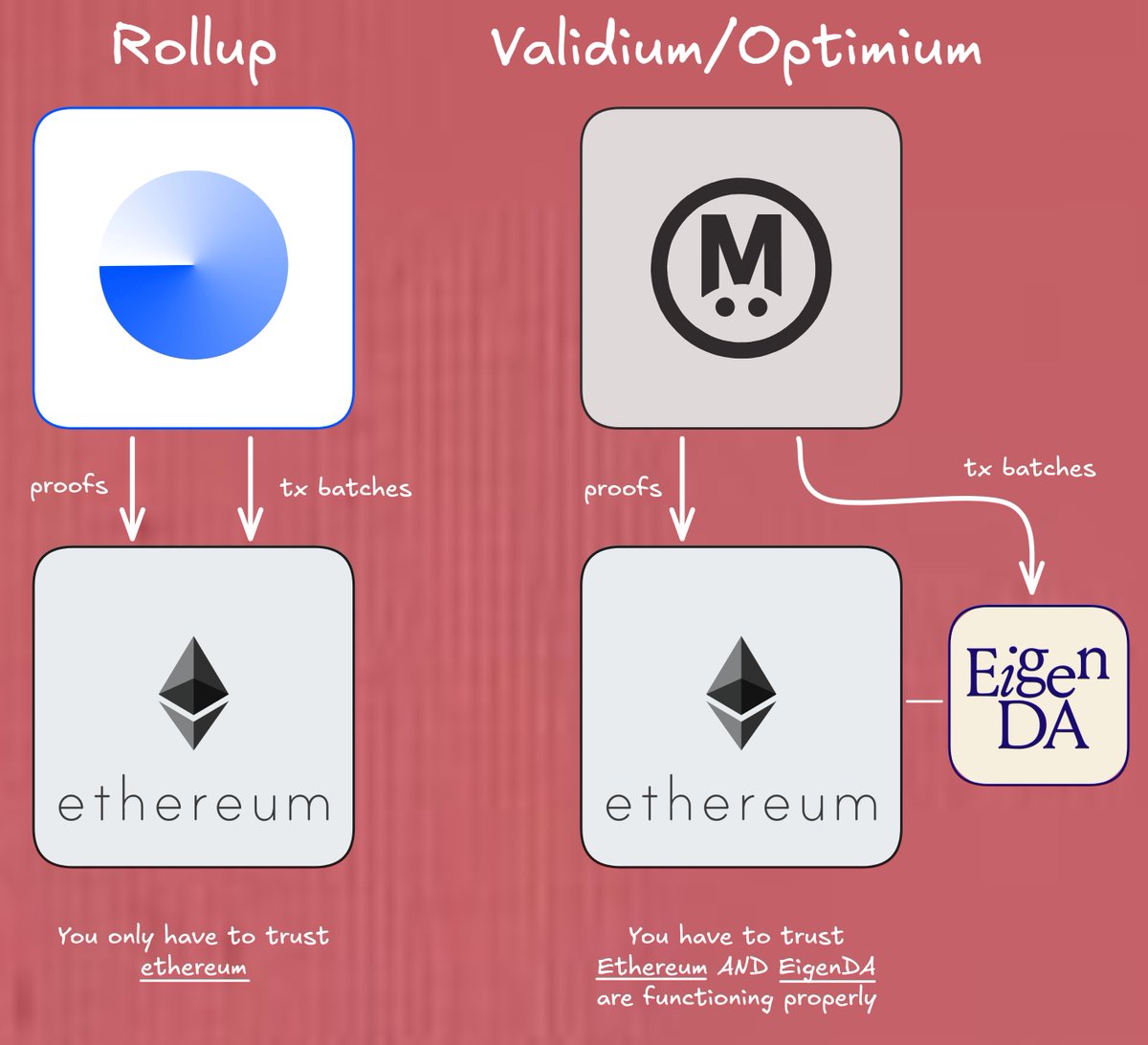
Getting a lot of this question, so I made a picture.
How does MegaETH use Ethereum?
One of the reasons the chain can even be so performant, beyond the raw software enhancements we've made, is because of one key decision:
We use Ethereum for proofs (the "source of truth" for ownership, state, etc, etc honored by a given L2) and post the actual, raw transactions generated on the chain to EigenDA.
If you want to know how that looks, and what the alternative is, here's a picture of our construction next to a rollup like Base:
We have fancy names for them too:
• Base is a rollup because both items go to Ethereum
• MegaETH is a validium/optimium because proofs go to Ethereum, but tx batches go elsewhere
If you want to know why, I did a longform recently that breaks it down, but the TLDR is:
• MegaETH is going to generate a lot of data. A lot a lot.
• Ethereum currently isn't big enough to even take that data, and won't be ready in the next ~3yrs+
So it was pragmatic for us if we want to achieve the scale we dream of.
Here is the longform:
https://t.co/X2kZMN7KL9
What tradeoffs does that come with?
It's in the picture, but essentially the tradeoffs are that you add trust assumptions.
Layman's for that is that in a rollup layout (proof+tx) both go to Ethereum - so you're trusting just Ethereum is doing it's job.
For MegaETH you're adding EigenDA to the mix and an assumption of trust that the system will be operational/secure to serve its role.
We're okay with that tradeoff because the magnitudes in performance difference are...staggering.
To give an idea of scale relative to current chain throughput capacity, here's our expected mainnet numbers vs the current landscape:
It's multiple orders of magnitude, and that's not even the entirety of the value prop!
That doesn't cover a whole host of other features that literally aren't or can't be replicated:
• <10ms block times (read: instantaneous state updates)
• Tx and contract sizes with nearly unbounded gas
• Power user colocation that can literally uplift the entire DeFi ecosystem and bring price discovery onchain
What we're attempting isn't typical and comes with risks as I've called out above - but we think there is a clear vertical/user demand for high performance onchain experiences that increase UX and widen what's possible for applications (cc: @megamafia).
No one knows how it'll play out but we're going to fuck around.
Ngl I spent +20 hours to solve this riddle to join a secret society.
I think it has something to do with NFTs.
Try it out here: https://t.co/ogqAUyQH2Q