The brilliant @nntaleb was able to encapsulate so much wisdom (as opposed to knowledge/intelligence) under the concept of antifragility. And to develop a mathematical model for looking at it. If you haven't read the book yet...you know what you need to do.
Nassim Nicholas Taleb walked into Google and explained what Antifragility is and how the world actually works:
1. The opposite of fragile is not robust. That is the first mistake almost everyone makes. Robust means something does not care about volatility. The true opposite of fragile is something that actually benefits from disorder, volatility, and stress. He calls it antifragile.
2. If you are shipping something fragile you write handle with care on the box. The true opposite of that package would have please mishandle written on it. Something antifragile wants to be mishandled. It gets stronger from it.
3. Fragility is always about nonlinear harm. Jumping ten meters kills you. Jumping ten centimeters a hundred times does not. The harm accelerates disproportionately with size. That acceleration is the mathematical signature of fragility and it can be measured precisely.
4. Anything that has survived long enough to exist today must have this property. If harm were linear you would be destroyed just walking to the office. Everything that persists is built so that small stressors barely touch it but large unexpected shocks destroy it.
5. Large size creates fragility automatically. A hundred million pound project in the UK had thirty percent more cost overruns than a five million pound project doing the same thing. The bigger the stone the more the harm. Size and fragility are inseparable.
6. Governments and institutions make the same mistake constantly. They chase perfect stability and call it good management. But something organic requires variability to survive. Greenspan tried to eliminate all economic volatility. He called it the Great Moderation. What he actually did was allow hidden risk to accumulate invisibly until it exploded all at once.
7. Small forest fires clean out flammable material and prevent catastrophic ones. By eliminating small fires you guarantee a massive one eventually. The same principle applies to economies, banks, and any complex system. Suppressing volatility does not remove risk. It stores it.
8. The only way to make something genuinely robust is to embrace bipolar strategies rather than medium ones. Eighty percent of your portfolio in something safe and twenty percent in something highly speculative is more robust than putting everything in medium risk. The average of extremes beats the mediocre middle.
9. Everything organic communicates with its environment through stressors. Your body needs the gym. Your bones need stress. Your immune system needs exposure. Depriving any living system of the stressors it needs does not protect it. It weakens it invisibly.
10. What does not kill me makes others stronger is closer to the truth than what does not kill me makes me stronger. When a system gets stronger under stress it is usually because the weaker components were destroyed, not because the survivors individually improved. The system improves through the death of its fragile parts.
11. Trial and error is not the opposite of knowledge. It is a form of knowledge with a convex payoff. You lose little when you are wrong and gain enormously when you are right. That asymmetry is what makes tinkering more powerful than theoretical planning in unpredictable environments.
12. Most of what we attribute to theoretical knowledge actually came from tinkering that was dressed up afterward as having been scientifically planned. The Romans built extraordinary things for centuries without ever having heard of Euclidean geometry. Technology routinely precedes the science that supposedly explains it.
13. The fragilista is Taleb's name for the person who denies antifragility and causes damage through that denial. Bureaucrats, central planners, academics, and policy makers who overstabilize systems from the top down are fragilistas. They remove the volatility that systems need and call it improvement.
14. Seneca, the wealthiest man in the ancient world, trained himself every day to wake up as if he had lost everything. He would deliberately live as if he were on a shipwreck to ensure he always had more upside than downside. Having more to gain than to lose from random events is the definition of antifragility in personal life.
15. In medicine, convexity matters more than people realize. If you are very ill the potential benefit of treatment vastly outweighs the risk, so you should see ten doctors not one. If you are mildly ill the risks of intervention almost certainly outweigh the modest benefits. The problem is that mildly ill patients are five times more numerous than severely ill ones, which is exactly who pharmaceutical companies focus on.
16. Removing something unnatural from your life has almost no side effects. Adding something artificial always has multiplicative hidden effects. In complex systems less is almost always more. The via negativa, improving by subtraction rather than addition, is consistently underestimated.
17. The real ethical crisis of modern times is that the people making decisions do not bear the consequences of those decisions. Bankers take the upside. Society takes the downside. Economists give broken advice and face no consequences when it fails. Nothing improves in any field where the people who are wrong are not harmed by being wrong.
18. Time is the ultimate detector of fragility. Whatever is fragile will eventually be broken by time. Whatever has survived for a long time has demonstrated antifragility and will likely survive longer still. A book that has been read for three thousand years will probably be read for three thousand more. A technology that is forty years old has at least forty more years ahead of it.
19. The only way to know you are alive and not a machine is that you benefit from variability. If you like variation and gain from disorder you are antifragile. If you require peace and predictability to function you are fragile. It is as simple and as profound as that.
Before you go, can we stay in touch?
I'd love to share one email with you every Sunday that'll challenge how you think about business, money and freedom.
Stay in touch here:
https://t.co/VMTlilB7aq
A Brown professor gave his students a take-home midterm exam. After suspecting many cheated using AI, he made the final in-person. The orange dots are the midterm scores and the gray dots are the final scores. Looks like all but 3 cheated on the midterm.
What just happened?
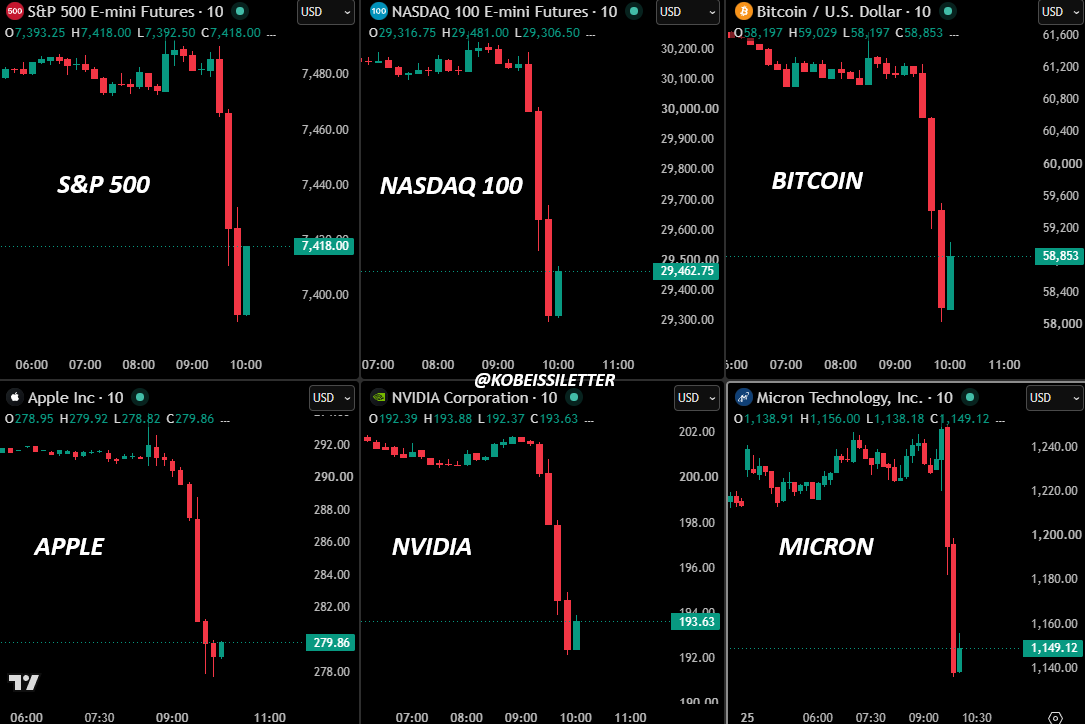
In just 27 minutes, the Nasdaq 100 just fell -1,000 points and the S&P 500 erased -$1 TRILLION without any major headlines.
The Nasdaq opened +1% higher then fell -3% between 9:30 AM and 9:57 AM ET.
What does it all mean? Let us explain.
(a thread)
Introducing Sakana Fugu: A full multi-agent orchestration system accessible via a single model API.
Our ‘Fugu Ultra’ model matches the performance of Fable and Mythos, delivering frontier capability without the risk of export controls.
Try it: https://t.co/hhO6qTawgb 🐡
@boardyai@andrewdsouza building Daring Capital to back deep-tech founders solving gnarly problems, plus hosting Startups Arabia to spotlight the Arab ecosystem. Boardy Pro would help for this.
The US job market is experiencing a historic divergence:
US information technology employment has declined -11%, since the launch of ChatGPT in November 2022.
During this period, the tech sector has shed -332,000 jobs, down to 2.78 million.
At the same time, private education and health service employment has risen +13%, to an all-time high.
This comes as the sector has added +3.16 million jobs.
As a result, technology employment is now below pre-pandemic levels seen between 2017 and 2019.
AI remains a key force transforming labor market conditions.
A French engineer who lives quietly in Paris has spent 30 years writing software that the entire internet now runs on without knowing his name.
He wrote the code that streams every YouTube video, every Netflix show, every TikTok clip. He wrote the code that runs the virtual servers underneath AWS, Google Cloud, and Microsoft Azure. He calculated more digits of pi than anyone in history. He has no Twitter. He has no marketing. He just keeps shipping.
His name is Fabrice Bellard.
Here is the story, because almost nobody outside the systems programming world knows what one man has built.
Fabrice was born in 1972 in Grenoble, France. He studied at École Polytechnique, the top French engineering school. He never went to Silicon Valley. He never built a startup empire. He just wrote code.
In 2000 he started a project called FFmpeg, an open-source multimedia framework for encoding, decoding, and streaming video. He was 28. The project did one thing nobody else had done well. It handled every video and audio format that existed, in one library, on every operating system. He led it himself for years.
Today FFmpeg is the invisible engine of the internet. YouTube uses it. Netflix uses it. VLC uses it. Chrome and Firefox use parts of it. Every Android phone, every iPhone, every smart TV, every video editing tool you have ever touched runs FFmpeg somewhere underneath. If you have watched a video on a screen in the last 20 years, Fabrice's code processed it.
He was not done.
In 2003 he started QEMU, a machine emulator and virtualizer. He wrote it solo until version 0.7.1 in 2005. QEMU lets you run any operating system on any other operating system. It became the foundation of modern virtualization. KVM, the Linux kernel hypervisor, runs on top of QEMU. Every major cloud provider, AWS, Google Cloud, Microsoft Azure, IBM Cloud, runs virtual machines on infrastructure built around it. The Quick Emulator is the most cited piece of cloud infrastructure code on Earth.
He kept going.
In 2001 he won the International Obfuscated C Code Contest with a small C compiler that grew into TCC, the Tiny C Compiler. TCC can compile and boot a Linux kernel from source in under 15 seconds. In 2004 he calculated the most digits of pi ever computed at the time, using a personal desktop computer and an algorithm he derived himself called Bellard's formula. In 2011 he wrote a complete PC emulator in pure JavaScript that runs Linux in your browser, a project called JSLinux that engineers still cannot believe is real.
In 2019 he released QuickJS, a small but complete JavaScript engine that fits where V8 cannot. In 2021 he released NNCP, a neural network based lossless data compressor that immediately took the lead on the Large Text Compression Benchmark.
Then he turned his attention to large language models. He built TextSynth Server, a web server with a REST API for running LLMs locally. He released ts_zip and ts_sms, compression utilities that use language models to compress text and short messages at ratios traditional algorithms cannot reach. He released TSAC, a very low bitrate audio compression system. In December 2025 he released Micro QuickJS, a new JavaScript engine for microcontrollers, separate from QuickJS, designed for environments with almost no memory.
Fabrice co-founded a telecom company called Amarisoft in 2012, where he serves as CTO. Amarisoft builds 4G and 5G base station software used by carriers and labs around the world. He has been running it for over a decade while continuing to ship personal projects from his own home page at bellard dot org
He has no Twitter. He has no Instagram. He gives almost no interviews. His personal website is a flat list of projects with no styling, no fonts, no marketing copy. Just titles and links.
A quiet French engineer who never moved to Silicon Valley wrote the code that quietly runs the internet.
He is still shipping.
"الرفيق قبل الطريق" 'The companion before the path'
An old Arab saying with a lot of wisdom. So relevant when choosing your startup co-founder. Startups, hopefully, last 10+ years; the companion is the most important factor. Especially, since it is never a comfortable path.
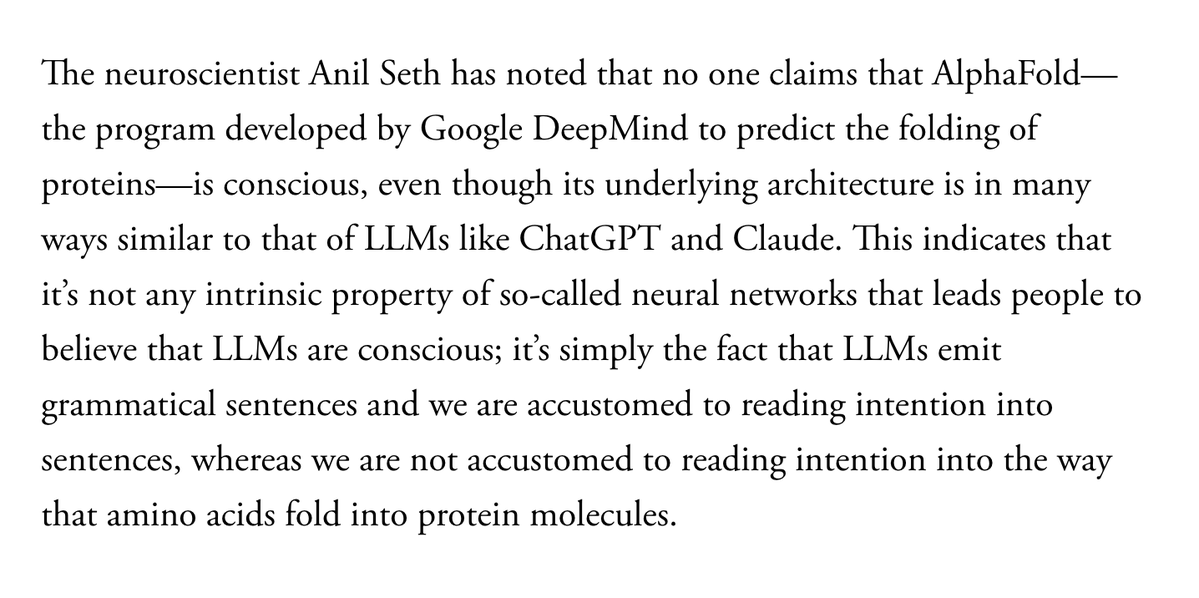
this is an interesting point in the new ted chiang piece – no one really claims that alphafold is conscious, or that sora or midjourney or dall-e are conscious
Today the EU made American AI illegal in 27 countries.
The reason is ONE sentence Microsoft's own lawyer said under oath:
This morning in Brussels, EU Tech Chief Henna Virkkunen unveiled the Cloud and AI Development Act. It's the most aggressive anti-American tech move from Europe since GDPR.
The law forces EU public sector procurement in banking, healthcare, defense, and energy to apply mandatory non-price factors favoring software and hardware built inside the EU. Microsoft Azure can be cheaper, AWS can be faster, Google Cloud can have the better model, and EU governments MUST legally prefer European alternatives.
AWS, Microsoft, and Google currently control roughly 70% of the European cloud market. Brussels is now openly targeting greater independence from US providers in cloud, AI, and semiconductors.
The largest regulatory market-share transfer in tech history is being written into law right now.
But the real story is how this happened...
On June 10, 2025, a man almost no one outside Brussels had heard of walked into the French Senate. His name is Anton Carniaux, Director of Public and Legal Affairs at Microsoft France.
Senator Dany Wattebled asked him under oath whether he could guarantee that data belonging to French citizens, stored on Microsoft European servers, would never be transmitted to US authorities without explicit consent from the French government.
Carniaux answered honestly. He admitted he could not guarantee it, because Microsoft must comply with the US CLOUD Act regardless of where European data physically sits. One sentence of sworn testimony from Microsoft's own counsel killed every sovereign cloud defense Big Tech had spent five years building.
It became the legal foundation for the law unveiled today.
Then Trump accelerated the divorce.
January 2025 brought executive orders expanding US surveillance authorities. Vance went to Munich and attacked European democracies on stage.
The tariffs followed and so did the Pentagon's $200 million AI contract war that ended with OpenAI replacing Anthropic after Hegseth labeled it a supply chain risk. So did OpenAI's Stargate and yesterday's Trump AI Executive Order, whose Section 3 lets the White House pick which AI companies get 30-day early access to frontier models. American AI was officially declared a US government strategic asset.
Europe heard every word of it.
On May 12, Mistral CEO Arthur Mensch told the French National Assembly that Europe had 24 months to build sovereign AI infrastructure or become a permanent US VASSAL state.
And the response came fast:
April 24: Cohere acquired Germany's Aleph Alpha for $20 billion with both Germany's and Canada's digital ministers in the room at the Berlin announcement. May 30: SoftBank committed up to $87 BILLION for French nuclear-powered data centers, the largest AI infrastructure project in European history.
Yesterday: EU Parliament announced it's dropping Google for French search engine Qwant tomorrow. France ordered every government workstation off Windows and onto Linux.
Today the Cloud and AI Development Act made all of it law.
- Mistral is building a 1.4 gigawatt AI campus near Paris by 2028 with Nvidia, MGX, and Bpifrance
- SAP's EU AI Cloud, launched last November, runs on Cohere, Mistral, and SAP's own sovereign infrastructure
- McKinsey forecasts $600 billion in sovereign AI needs by 2030
None of that money is going to Silicon Valley.
The America First AI policy built a wall around the world's most regulated economy, and American companies are on the wrong side of it.
Microsoft's lawyer told the truth in a Senate hearing nobody watched. Trump turned that admission into a national security narrative while the EU turned that narrative into procurement law.
And one entire continent walked away from the American tech stack...
JPMorgan just published the scariest oil chart I’ve ever seen.
World inventories are in freefall.
And when this line hits 6.8 — the global energy system doesn’t slow down.
It breaks. 🧵
While competing companies are trying to catch up to Nvidia in AI, they are already working on the next revolution: quantum computing.
They recently released the open-source Ising model that positions Nvidia GPU usage in quantum computing. Positioning themselves for 2030 & beyond!
JUST IN: The United States has fired 2,400 Patriot interceptors in 31 days. It manufactures 650 per year. Replenishment at current production takes three and a half years. It has consumed 40 percent of its global THAAD inventory. It produces fewer than 100 THAAD interceptors annually. Full replenishment takes four to five years. Each interceptor contains neodymium and samarium-cobalt magnets sourced from Chinese-controlled supply chains. The US defence rare earth stockpile has approximately two months remaining.
Read those numbers again. The US military has consumed more precision weapons in one month than it can manufacture in three years, using materials it can only source from the country it may need to fight next.
Every Patriot fired at an Iranian Fattah-2 over Riyadh is a Patriot that does not exist for a Chinese DF-21 over the Taiwan Strait. Every rare earth magnet consumed in Gulf interceptors is a magnet that cannot be installed in a replacement built for the Pacific. The Iran war is not just depleting American arsenals. It is depleting American deterrence against China. And the country counting the interceptors from both sides of the table, as supplier and as future adversary, is the same country hosting peace talks in Beijing right now.
China controls 90 percent of rare earth refining. China produces 90 percent of the world’s high-performance magnets. China buys 80 to 91 percent of Iran’s oil exports. China provides BeiDou navigation and ammonium perchlorate propellant to the Iranian missiles that are forcing the US to burn through its interceptor stockpile. China is simultaneously the supplier of the weapons America is using, the supplier of the weapons Iran is using, the primary customer of the oil the war is disrupting, and the only country with the leverage to end the disruption.
The arithmetic of the grand bargain is not complicated. The US needs Chinese rare earths to rebuild its interceptor inventory. China needs Hormuz open to receive Iranian oil. The US needs the war to end before its stockpiles hit zero. China needs tariff relief, semiconductor export control rollbacks, and Taiwan arms-sale restraint. Both sides need something only the other can provide. The question is not whether a deal happens. The question is how much of America’s strategic position in the Pacific gets traded for the minerals needed to survive the Gulf.
RAND estimated that 78 percent of US defence contractors would face production shutdowns within 90 days of a Chinese rare earth cutoff. The 2027 deadline to ban Chinese-sourced magnets from Pentagon procurement is nine months away with no domestic alternative at scale. MP Materials operates the only US rare earth mine and ships its concentrate to China for processing. The mine-to-magnet supply chain that the Pentagon needs to survive a Taiwan contingency runs through the country the Taiwan contingency is designed to deter.
This is not a supply chain problem. This is a civilisational dependency. The United States built the most advanced military in human history on materials processed by its principal strategic competitor. It is now fighting a war that burns through those materials at a rate that makes replenishment impossible without the competitor’s cooperation. And the competitor is sitting in a conference room in Beijing today, across the table from Pakistan’s foreign minister, calculating exactly how much of America’s future it can extract in exchange for the minerals America needs to have a future at all.
The deal of the century is not a choice. It is arithmetic. And the arithmetic leads to Beijing.
https://t.co/dAOBBMrIOk
Today is a monumentous day for quantum computing and cryptography. Two breakthrough papers just landed (links in next tweet). Both papers improve Shor's algorithm, infamous for cracking RSA and elliptic curve cryptography. The two results compound, optimising separate layers of the quantum stack. The results are shocking. I expect a narrative shift and a further R&D boost toward post-quantum cryptography.
The first paper is by Google Quantum AI. They tackle the (logical) Shor algorithm, tailoring it to crack Bitcoin and Ethereum signatures. The algorithm runs on ~1K logical qubits for the 256-bit elliptic curve secp256k1. Due to the low circuit depth, a fast superconducting computer would recover private keys in minutes. I'm grateful to have joined as a late paper co-author, in large part for the chance to interact with experts and the alpha gleaned from internal discussions.
The second paper is by a stealthy startup called Oratomic, with ex-Google and prominent Caltech faculty. Their starting point is Google's improvements to the logical quantum circuit. They then apply improvements at the physical layer, with tricks specific to neutral atom quantum computers. The result estimates that 26,000 atomic qubits are sufficient to break 256-bit elliptic curve signatures. This would be roughly a 40x improvement in physical qubit count over previous state-of-the-art. On the flip side, a single Shor run would take ~10 days due to the relatively slow speed of neutral atoms.
Below are my key takeaways. As a disclaimer, I am not a quantum expert. Time is needed for the results to be properly vetted. Based on my interactions with the team, I have faith the Google Quantum AI results are conservative. The Oratomic paper is much harder for me to assess, especially because of the use of more exotic qLDPC codes. I will take it with a grain of salt until the dust settles.
→ q-day: My confidence in q-day by 2032 has shot up significantly. IMO there's at least a 10% chance that by 2032 a quantum computer recovers a secp256k1 ECDSA private key from an exposed public key. While a cryptographically-relevant quantum computer (CRQC) before 2030 still feels unlikely, now is undoubtedly the time to start preparing.
→ censorship: The Google paper uses a zero-knowledge (ZK) proof to demonstrate the algorithm's existence without leaking actual optimisations. From now on, assume state-of-the-art algorithms will be censored. There may be self-censorship for moral or commercial reasons, or because of government pressure. A blackout in academic publications would be a tell-tale sign.
→ cracking time: A superconducting quantum computer, the type Google is building, could crack keys in minutes. This is because the optimised quantum circuit is just 100M Toffoli gates, which is surprisingly shallow. (Toffoli gates are hard because they require production of so-called "magic states".) Toffoli gates would consume ~10 microseconds on a superconducting platform, totalling ~1,000 sec of Shor runtime.
→ latency optimisations: Two latency optimisations bring key cracking time to single-digit minutes. The first parallelises computation across quantum devices. The second involves feeding the pubkey to the quantum computer mid-flight, after a generic setup phase.
→ fast- and slow-clock: At first approximation there are two families of quantum computers. The fast-clock flavour, which includes superconducting and photonic architectures, runs at roughly 100 kHz. The slow-clock flavour, which includes trapped ion and neutral atom architectures, runs roughly 1,000x slower (~100 Hz, or ~1 week to crack a single key).
→ qubit count: The size-optimised variant of the algorithm runs on 1,200 logical qubits. On a superconducting computer with surface code error correction that's roughly 500K physical qubits, a 400:1 physical-to-logical ratio. The surface code is conservative, assuming only four-way nearest-neighbour grid connectivity. It was demonstrated last year by Google on a real quantum computer.
→ future gains: Low-hanging fruit is still being picked, with at least one of the Google optimisations resulting from a surprisingly simple observation. Interestingly, AI was not (yet!) tasked to find optimisations. This was also the first time authors such as Craig Gidney attacked elliptic curves (as opposed to RSA). Shor logical qubit count could plausibly go under 1K soonish.
→ error correction: The physical-to-logical ratio for superconducting computers could go under 100:1. For superconducting computers that would be mean ~100K physical qubits for a CRQC, two orders of magnitude away from state of the art. Neutral atoms quantum computers are amenable to error correcting codes other than the surface code. While much slower to run, they can bring down the physical to logical qubit ratio closer to 10:1.
→ Bitcoin PoW: Commercially-viable Bitcoin PoW via Grover's algorithm is not happening any time soon. We're talking decades, possibly centuries away. This observation should help focus the discussion on ECDSA and Schnorr. (Side note: as unofficial Bitcoin security researcher, I still believe Bitcoin PoW is cooked due to the dwindling security budget.)
→ team quality: The folks at Google Quantum AI are the real deal. Craig Gidney (@CraigGidney) is arguably the world's top quantum circuit optimisooor. Just last year he squeezed 10x out of Shor for RSA, bringing the physical qubit count down from 10M to 1M. Special thanks to the Google team for patiently answering all my newb questions with detailed, fact-based answers. I was expecting some hype, but found none.
Software horror: litellm PyPI supply chain attack.
Simple `pip install litellm` was enough to exfiltrate SSH keys, AWS/GCP/Azure creds, Kubernetes configs, git credentials, env vars (all your API keys), shell history, crypto wallets, SSL private keys, CI/CD secrets, database passwords.
LiteLLM itself has 97 million downloads per month which is already terrible, but much worse, the contagion spreads to any project that depends on litellm. For example, if you did `pip install dspy` (which depended on litellm>=1.64.0), you'd also be pwnd. Same for any other large project that depended on litellm.
Afaict the poisoned version was up for only less than ~1 hour. The attack had a bug which led to its discovery - Callum McMahon was using an MCP plugin inside Cursor that pulled in litellm as a transitive dependency. When litellm 1.82.8 installed, their machine ran out of RAM and crashed. So if the attacker didn't vibe code this attack it could have been undetected for many days or weeks.
Supply chain attacks like this are basically the scariest thing imaginable in modern software. Every time you install any depedency you could be pulling in a poisoned package anywhere deep inside its entire depedency tree. This is especially risky with large projects that might have lots and lots of dependencies. The credentials that do get stolen in each attack can then be used to take over more accounts and compromise more packages.
Classical software engineering would have you believe that dependencies are good (we're building pyramids from bricks), but imo this has to be re-evaluated, and it's why I've been so growingly averse to them, preferring to use LLMs to "yoink" functionality when it's simple enough and possible.
From pipe dreams to reality, its worth highlighting how global investors BlackRock, Brookfield, KKR and others now own big stakes in Gulf energy pipelines. 🛢️💵 #OOTT
Given the US-Israel war, some may stand to make even greater returns...
I hope no one needs an MRI this year.
The world's largest producer of liquified helium is in Qatar and is shut off. We just got a notice that our supply for the year will be at least cut in half.
No one could have predicted this (unless they thought about it).
🚨 BREAKING: Tencent has killed the “next-token” paradigm.
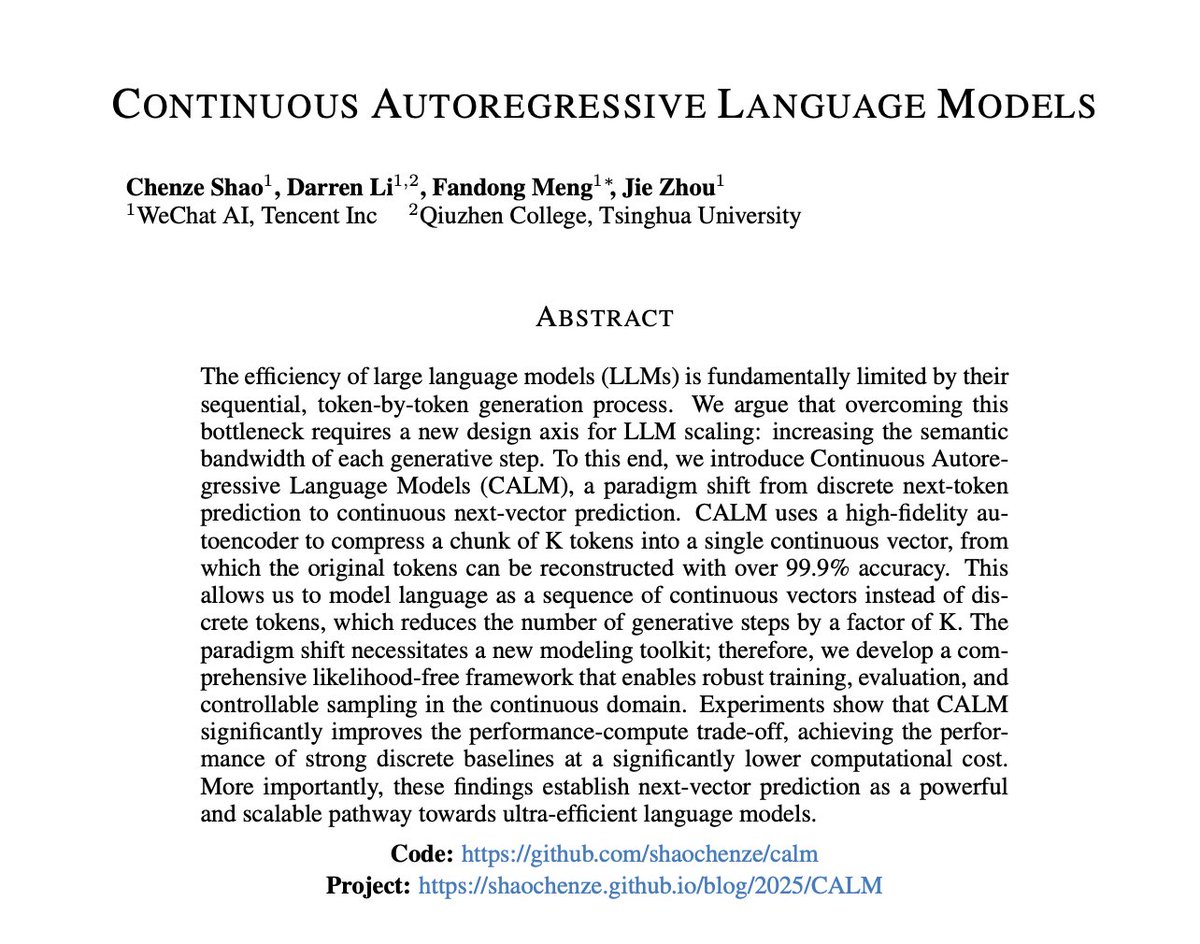
Tencent and Tsinghua has released CALM (Continuous Autoregressive Language Models), and it completely disrupts the next-token paradigm.
LLMs currently waste massive amounts of compute predicting discrete, single tokens through a huge vocabulary softmax layer. It’s slow and scales poorly.
CALM bypasses the vocabulary entirely. It uses a high-fidelity autoencoder to compress chunks of text into a single continuous vector with 99.9% reconstruction accuracy.
The model now predicts the “next vector” in a continuous space.
The numbers are actually insane:
- Each generative step now carries 4× the semantic bandwidth.
- Training compute is reduced by 44%.
- The softmax bottleneck is completely removed.
We’re literally watching language models evolve from typing discrete symbols to streaming continuous thoughts.
This changes the entire trajectory of AI.