Because Mutapa is so big, it’s managed in clusters: Agric & Industrials, Infrastructure, Financials Services, Minerals, Energy, Real Estate…
Ao, they brought in these vechidiki to lead strategy at the clusters. Hope they get enough elbow room. Tough job! 🙏🏾
Nahh bro don’t be weak. They fucked her now you want to apologize. Take the L and go find another cheap pussy and keep moving. This is toxic what you you’re doing to yourself. It will only get worse from here.. also judging by posting this on SM, you might need to talk to someone https://t.co/0PwL2Usdwk
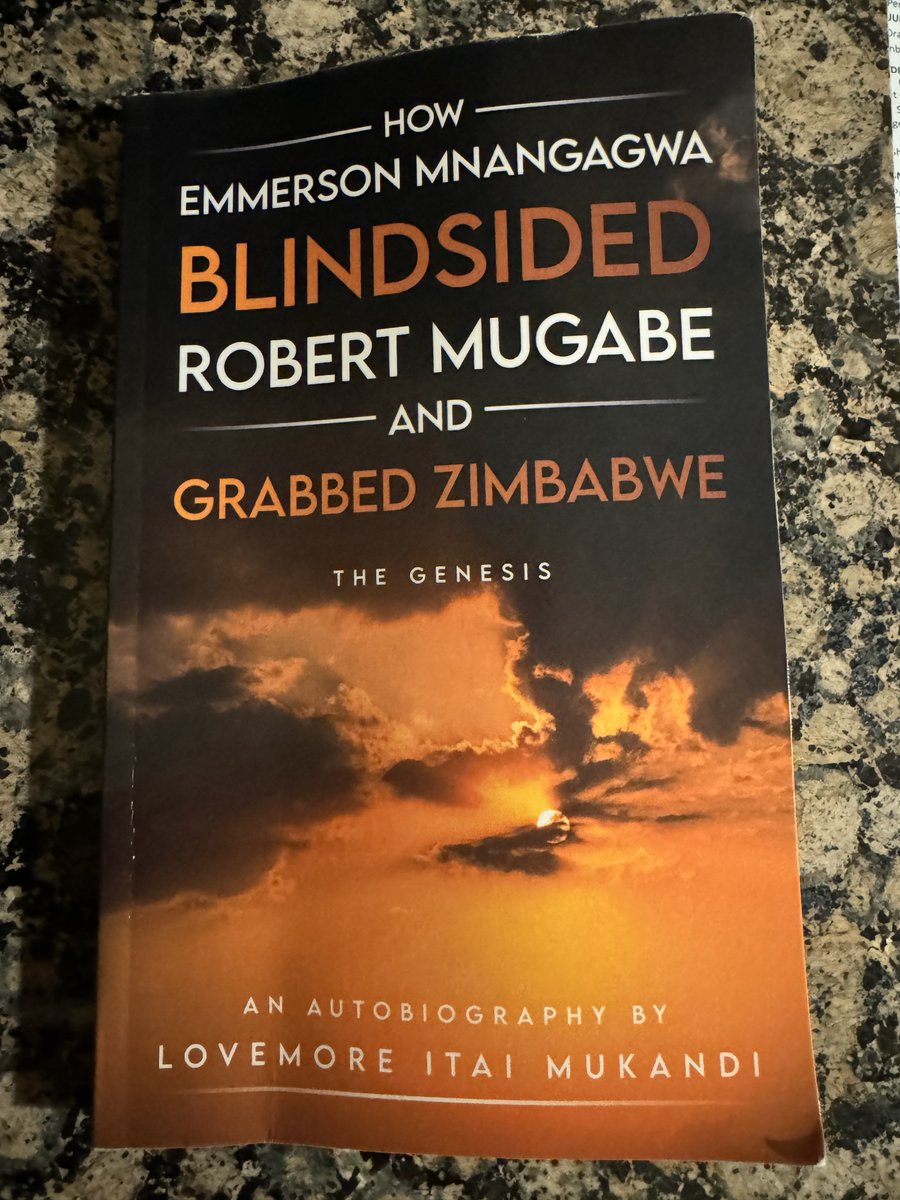
This book, written by former CIO Deputy Director, Lovemore Itai Mukandi, was delivered to my UK home by Amazon yesterday morning.
I took it with me on my flight to Canada and read it in one go on the eight-hour journey.
What I can say is that it is important for people who have held positions of power to write books, they help us understand issues better and provide insightful perspectives.
If Mukandi had written this book 7 years before the military coup, it might have prevented it, just maybe.
The book contains extensive information on how Zimbabwean tyrant, Emmerson Mnangagwa, carefully planned his path to the presidency from the 1980s, aware that he was unelectable within ZANUPF or in a national election.
It exposes how he captured the judiciary, the CIO, the military, the legal fraternity (including private practice lawyers), as well as the business and banking sectors and the media.
It names one journalist who it says was used by Mnangagwa, who later became a minister in Mnangagwa’s regime.
The book details how Mnangagwa uses journalists in private media to tarnish his opponents’ and critics’ images with lies, making use of “independent” journalists to lend credibility to these falsehoods.
Most chilling for me is how Mnangagwa continued to run a parallel CIO structure after leaving the Ministry of State Security in 1999, it says he held meetings in Gweru where he was briefed by his faction agents in the CIO behind Robert Mugabe’s back.
The book also illustrates that Mnangagwa was never a national leader in character, but an ethnic one.
His habit of appointing only his clansmen to powerful positions dates back to the 1980s.
It describes how he met his wife, who was a secretary to his legal adviser, John Ngara in the CIO, and how General Solomon Mujuru and his protégé General Constantino Chiwenga fell out over a woman. It describes the story in detail.
More importantly, it reveals how Mnangagwa was linked to apartheid elements and how he retained Rhodesian operatives within the CIO, potentially compromising the security of ANC cadres and uMkhonto weSizwe fighters living in Zimbabwe.
The book discloses how former CIO Director Edson Fungai Shirihuru, who was dating Rashiwe Guzha, ordered a named CIO provincial director to kill a buffalo and bring its head to him while the blood was still warm, allegedly for rituals after he reportedly murdered Guzha.
It also identifies the real CIO operative who shot former Gweru mayor and businessman Patrick Kombayi, and explains how the two CIO officers who were prosecuted took the fall to avoid implicating then Vice President Simon Muzenda, as the operative who shot Kombayi was Muzenda’s bodyguard.
It also discusses Mnangagwa’s relationship with the controversial white businessman, Billy Rautenbach and how Mnangagwa used to impress Mugabe by making Rautenbach’s private jet available when no other air transport was accessible for urgent government matters.
Mukandi left the CIO in 1998, so the secrets end there, but the book provides a clear picture of who Mnangagwa relied on to achieve his ambitions and how he outmanoeuvred his political rivals, including General Mujuru, Dr. Sydney Sekeramayi, and Mugabe.
I knew that Mnangagwa was a long game operator, vindictive, unforgiving, and that he never forgets, but I was not fully aware of the extent to which he captured the state long ago.
In moments when he seemed to be down, he would lie low and then strike when his victim least expected it, like a crocodile.
After reading this book, I am now fully convinced that he has a plan for his 2030 ambitions and is deliberately creating distractions and sideshows while the real plan remains unknown outside his inner circle.
He could also be designing a system to secure his interests posthumously.
The next 4 years are going to be interesting, we will see loads of fun and games in Zimbabwean politics.
Mukandi, who has degrees in Law, Economics, and Commerce, is a war veteran who joined the liberation struggle at the tail end in 1978 and was trained in intelligence gathering in Romania.
He explains how he was persecuted through the courts twice for his assumed support for the Mujuru faction, he was accused of fraud but the courts threw out the case twice.
He says that Mnangagwa’s network got him deported from Canada using a false warrant of arrest after failing to get a proper extradition order.
He was cleared twice at the magistrates court and says Mnangagwa’s current abuse of the court system is an old tactic that he has used since the 1980s, saying that he also used the old Rhodesian Emergency powers act to persecute his enemies using the CIO.
After reading the book, I see how Mnangagwa’s 2030 unconstitutional ambitions could be realised unless his adversaries become equally cunning and ruthless.
The information on the back cover does not do the book justice.
I bought it because, as a journalist, I read everything. I am glad that I did. It showed me how ordinary the state is in Zimbabwe and how it has always been abused to settle scores.
The book is available on Amazon.
By abusing state machinery to violate the rights of Zimbabweans, the ZANU-PF regime has demonstrated that it is prepared to go to any lengths to entrench its authoritarian rule.
SA, and by extension the SADC, must hold the Zimbabwean government to account.https://t.co/6ZmYCZbEGO