#Carbonaccounting and #CDR are two current interests of mine that emerged from this side project with this wonderful team of @NadineMengis and @Mar_Walimai! Very glad to see the fruits of this collaboration are now out.
Someone keen to become marine carbonate chemist/biogeochemist in New Zealand? Here is a rare tenure-track opportunity in a Otago with great colleagues at a beautiful spot. And Tassie is close to do collaborations on e.g. OAE research 😀
https://t.co/1rzhmxgZgS
#jobalert I am hiring a biogeochemical modeller to study the potential of #sargassum for #OceanCDR If you have the skills and want to find solutions to the climate crisis, apply before 19.03.2023 @CDRmare@AWI_Media https://t.co/YyFbe5vqTy
Postdoc position available in my group @GEOMAR_de. Flexible position with a focus on evolutionary genomics, temporal population genomics, or comparative genomics of marine copepods. Some datasets ready and waiting. Happy to answer questions! Please RT!
https://t.co/8R2GAnLQTa
@Mar_Walimai@bach_lennart@US_OCB Would love to join in such a timely workshop! It’s a busy week unfortunately but will try to fit it in. Will it be only in person or will there be a virtual/hybrid options?
"People demand services and not primary energy and physical resources per se.“ These kind of statements in latest IPCC report and this fantastic related #debunkingdemand article give me hope that change can and will happen. #climatesolutions https://t.co/JryWozjx7o
Hi everyone, I’m looking for two PhD students to join my new group @GEOMAR_en to study marine microbial interactions in diverse time-series contexts: https://t.co/eiOoUGBexn. Please spread with your networks. Danke!
In this study, Moritz Baumann et al. test how artificial upwelling could be optimised to cause as much carbon sequestration as possible. It does matter how nutrient-rich deepwater is added to the surface community.
#CDR#ArtificialUpwelling
https://t.co/IdBAljEkTJ
Join our interdisciplinary panel discussion at CEC21 on the importance of accurate CDR accounting next week Wed. 6th Oct. 11am CEST. Register for free here ➡️ https://t.co/X7Vm2CziHF #DiscussCEC
The Climate Engineering in Context (CEC21) conference will kick off on Monday, Oct 4. We encourage all to expand the 'critical global discussions by tweeting under #DiscussCEC! Please remember that Chatham House Rule applies in the sessions https://t.co/XhEtdcIdq4 @IASS_Potsdam
@LizR_15N@Mar_Walimai Good question, we’ve never tested storage time effect for the same sample but usually store and analyse the DIN samples in the same way as the TDN. That would only help for changes in DIN on storage but hard to say for DON. Worth testing out?
@Mar_Walimai@LizR_15N Yes, filtration before freezing is essential because cells may burst on freezing and leak extra DON/DIN. Best is to measure fresh but that isn’t always possible. Also useful to measure DIN on the same sample, helps to minimize errors in the calculation of DON from TDN.
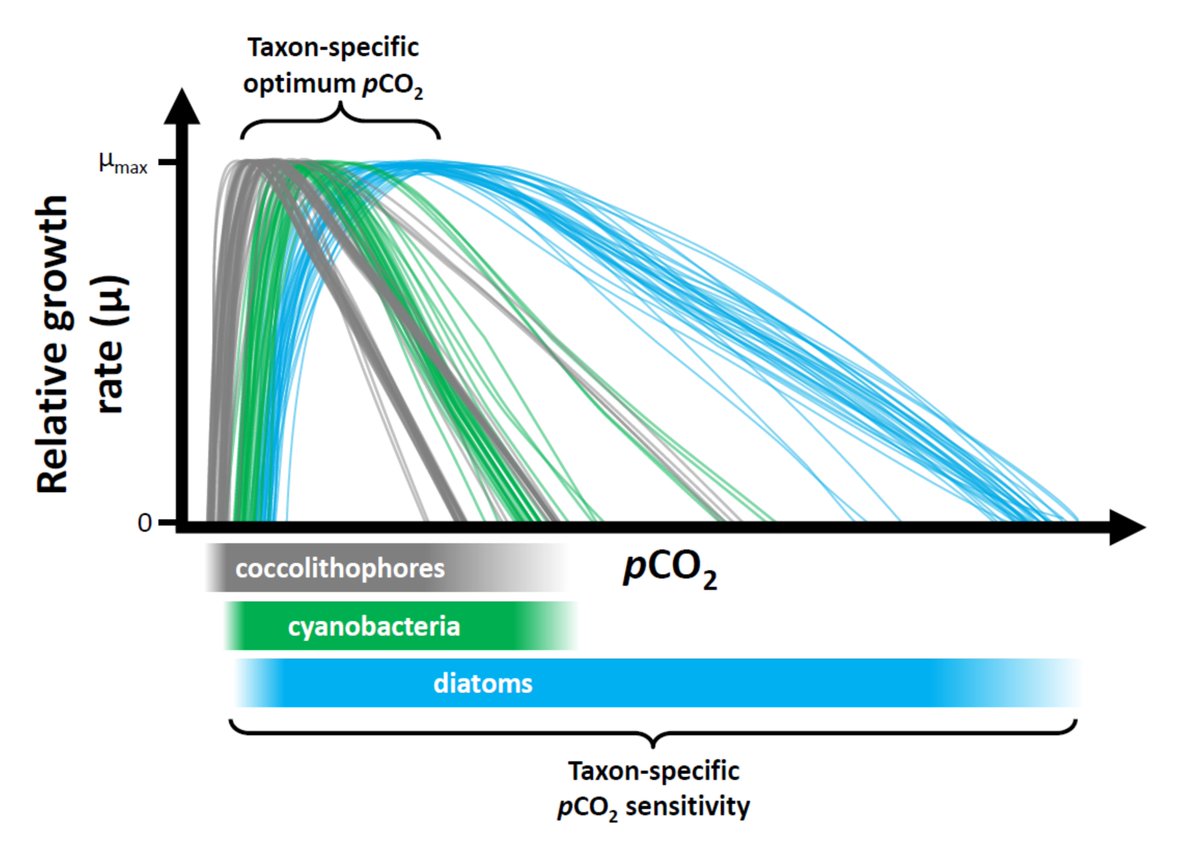
Sacrificing replicates for a broader range of treatments to produce these taxon-specific optimum curves could be an informative experimental design for phytoplankton culture studies. A beneficial approach to predict marine primary producer response to #oceanchange? (6/6)
Excited to share a new paper in @NewPhyt, co-authored with an inspiring mentor of mine @bach_lennart. Our analysis suggests a universal optimum curve response pattern of phytoplankton to #OceanAcidification. https://t.co/E77gnerxVW @GEOMAR_en@IMASUTAS (1/6)
We suggest this optimum curve should be regarded as the universal response pattern for phytoplankton growth under increasing CO2 and #notjustcoccos. (5/6)