"Imagine such a young person walking through the Louvre or the Uffizi, and you can immediately grasp the condition of his soul..."
Allan Blooms on Books and Art
"In the heat of our political squabbles we tend to lose sight of the fact that our differences of principle are very small compared to those over which men used to fight."
"Reason is only one part of the soul's economy and requires a balance of the other parts in order to function properly. The issue is whether the passions are its servitors, or whether it is the handmaiden of the passions."
@TheSimonEvans @Athens_Stranger 100%. These rare and wonderful spaces always appear in the most unexpected of places. And often at times in which society at large is in great distress. I made this edit of Bloom talking about this very point.
https://t.co/vgZGP3cew6
"The dislike of philosophy is perennial, and the seeds of the condemnation of Socrates are present at all times, not in the bosoms of pleasure seekers, who don't give a damn, but in those of high-minded and idealistic persons who do not want to submit their aspirations to
examination."
I think that also speaks to the (typically unrecognized) brilliance of his Closing
I mean this: Bloom, translator of the Republic and that great Modern version of the Republic (Emile), provides a thought experiment on the possibility of the Republic in an American setting. That thought experiment *is* his Closing
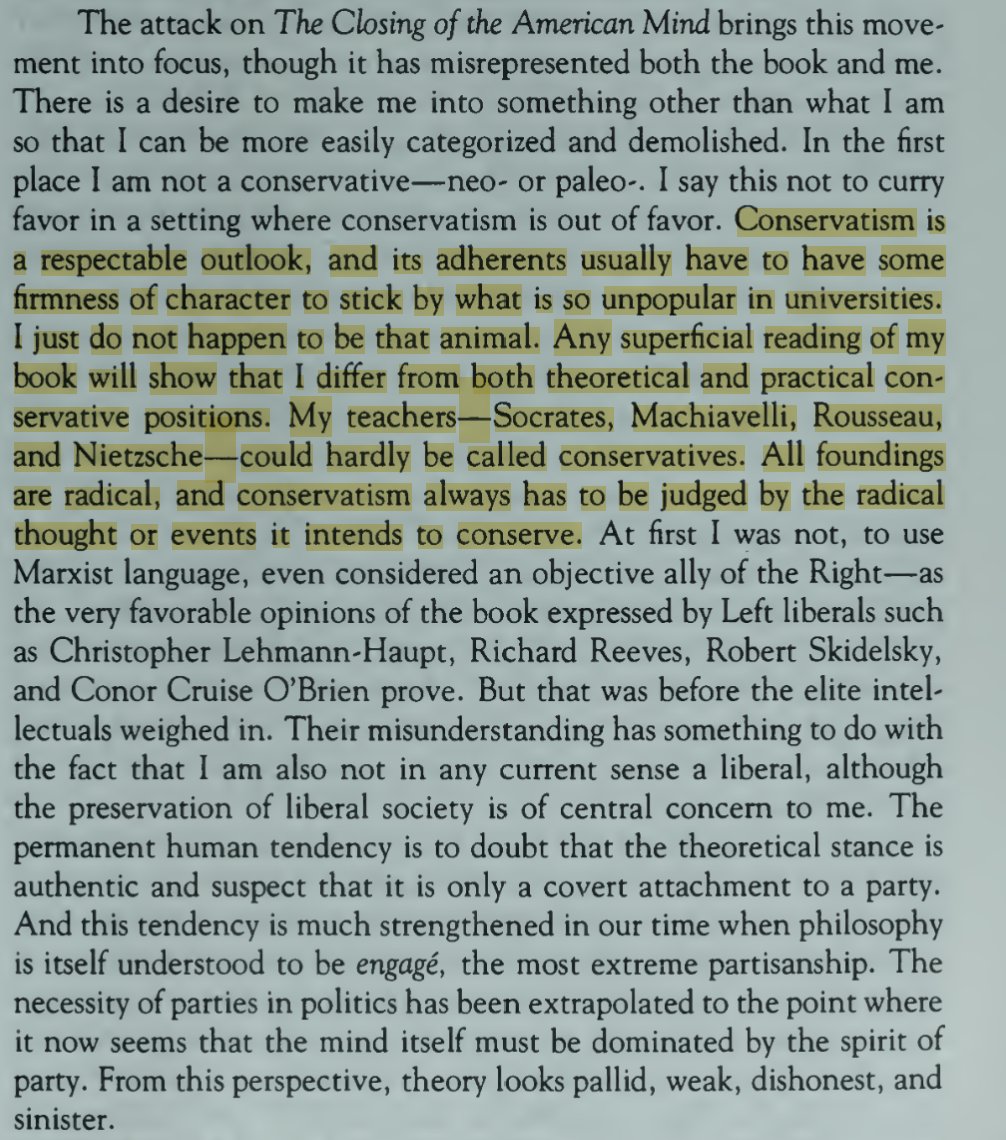
@TheSimonEvans @Athens_Stranger Yep, Bloom was certainly no conservative. He simply wanted to sit with friends in a Epicurean garden discussing beautiful and useless things. This was somewhat difficult when armed students took over Cornell University in 68'.
"Each age always conspires to make its own way of thinking appear to be the only possible or just way, and our age has the least resistance to the triumph of its own way."
"I thought of the old joke about the farmer who hears a thief in the chicken coop. Substituting the Harvard Coop, I imagined myself yelling, "Who's in there?" and getting the answer, "There's nobody in here but us antielitists."
"Many such lessons are to be learned on future voyages to the non-Western world ..."
An amusing passage in which Bloom imagines a Gulliver’s Travels-style journey to Japan for American professors eager to denounce ethnocentrism.
"The old view was that delicacy of language was part of the nature, the sacred nature, of eros, and that to speak about it in any other way would be to misunderstand it. What has disappeared is the risk and the hope of human connectedness embedded in eros."
"Edgar Z. Friedenberg once said that social scientists are always giving themselves hernias trying to see something about America Tocqueville did not see. That is why we need Tocqueville, and our neglecting to read him can be interpreted as an effort at hernia prevention."
"Science is surely somehow transcultural. Religion seems pretty much limited to cultures, even to define them. Is philosophy like science, or is it like religion?"
"None of the beautiful or noble activities of man which are the proper subjects of epic or drama can be found in the state of nature. The subject matter of epic or tragic poetry vanishes when man becomes essentially a being concerned with rational self-preservation."