This discussion is sometimes inadequately framed as pure context vs. pure text. But the Straussian interpretive method is not the same as New Criticism. The discussion should rather be framed as: context as a tool used by the author vs the author as guided by context.
One shouldn't reject the idea that Plato used his context to communicate his ideas. What one should reject is the idea that Plato's context influenced him without him realizing it. The point here is not to avoid looking at history in interpreting a great book. The idea is to look at those parts of history that the book itself tells us are essential to its meaning, as opposed to looking at history, perhaps using our own or our own time's standard of relevance, in order to explain critical things about that book that the author himself did not realize.
As an example: we can't understand Othello at even a basic level without knowing something of Venice and what it represented, politically and culturally, at the time the play's story takes place. But it's Shakespeare who chose to set the play in Venice. He is telling us where to look for historical context in order to grasp his intention.
This is a pretty extreme form of textualism, a bit like saying you can understand a sentence outside the paragraph, and a paragraph outside the whole work. In fact a reader is better off knowing both text and context. The problem with Marx and other practitioners of the hermeutica of suspicion is reducing the text to the context. Or, like our contemporaries, not reading the text at all. I agree that the author’s words should be primary.
Lincoln on human greatness as the overcoming of the fear and weakness fostered by historical fatalism. This passage can be paired beautifully with Tocqueville's treatment of democratic historians (DA I 1.20).
Eva Brann allegedly had a quip about Straussians that went something like this: Straussians are people who are not religious but want everyone else to be.
Is there a source for this somewhere?
Vente Venezuela, el partido de @MariaCorinaYA que fue duramente perseguido por la dictadura, reabrió sus puertas.
Buena señal.
Hay que seguir insistiendo y presionando hasta desmontar todo el aparato de represión del chavismo, devolver los partidos a sus líderes legítimos y garantizar la vuelta de los líderes exiliados.
Sólo así podremos avanzar y concretar una transición a la democracia en Venezuela.
Here's a question for people who like this combination of premises (I count myself among them): is the limitation on the role of governing in achieving this purpose, as you understand it, predicated on the recognition that the individual has certain natural rights that can never be justly abrogated? Or is the limitation predicated on a prudential estimate of the low likelihood that government power, past a certain point of growth, will foster the flourishing of its members? The limitation is in principle ironclad in the first case and in principle flexible in the second.
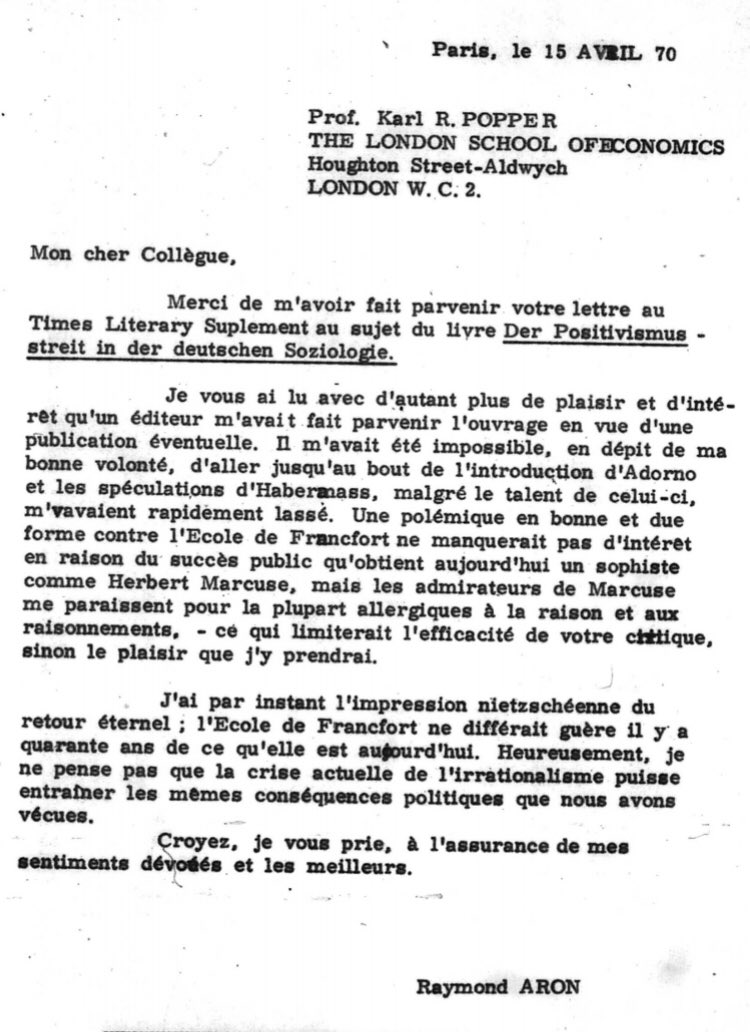
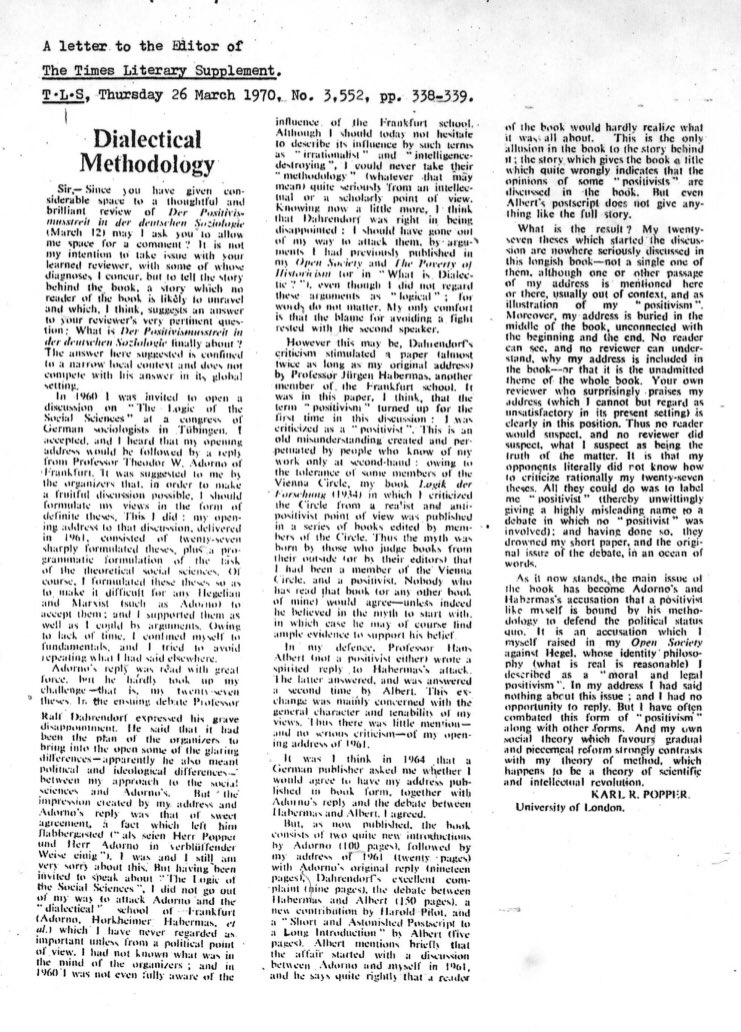
A letter exchange between Karl Popper and Raymond Aron regarding the “Positivism Debate” in which Popper refers to Adorno and Habermas as lunatics and Aron calls Marcuse a sophist (1970):
A less urgent but more important question, in this respect, I think, would be religious instruction in public schools. If it took Everson v Board of Education (1947) to incorporate the 1st amendment against the states (via due process clause of 14th amendment) in order to establish a wall of separation between religion and state (at all levels), that suggests to me that there was more than a century of American jurisprudence and political culture prior to that decision that would not have regarded a public school's endorsement of prayer or teaching of the Bible in class a violation of freedom of religion. Do you have thoughts on this?
Literature is calling you to put down your phone; ignore the culture wars; block out the secondhand musings of newspaper philosophers. Turn to the great works of civilisation. See that your life is a quest for meaning. Become as ambitious as the poets whose work outlived empires.
The fundamental problem with the Vzlan opposition is that they are committed to non-violent, non-conspiratorial means of acquiring power. They think that because 70% of the country supports them, that is enough. But in a semi state of nature like Venezuela, that is far from enough. If you can’t command the obedience of the military and the various patronage networks that flow from and to it, you do not have power, period. Opposition leaders are not even trying to gain influence in these circles, as far as I know. They’re too pure and principled for that. They are nice and gentle people who make eloquent speeches about human rights and international law. They are far more popular in Vzla than regime leaders, to be sure, but they don’t command the respect of the men with guns and they have no interest in learning how to get guns. What can U.S. statecraft do in this situation? Is it supposed to risk its entire strategic endeavor in the hopes that the mafia that rules Vzla will suddenly forego its fortune and power because someone won an election ?
If the Vzlan opposition wants to rule Vzla, it needs to seize the ruling offices. It needs to do a Nepal style coup or some such thing. At least since Chavez shut down RCTV in 2007, there has never been any other way to restore anything approaching liberal democracy in Vzla.
People say the admin has been inconsistent in its messaging. No. The view is that Iran’s conventional capabilities increasingly create a “line of immunity” around its nuclear program, & must now be degraded. They are also quite aware of production disparities in missiles & interceptors. All those things clearly factored into the decision to proceed the way that they did.